
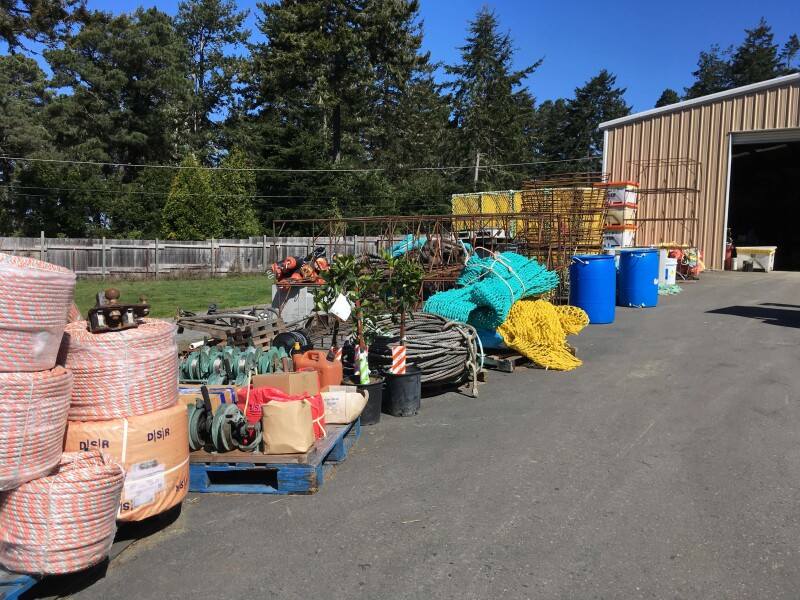
To keep a commercial fishing fleet in action requires support—everything from vessel maintenance to fuel and ice, and gear. On the rugged coast of northern California, Brian Kelley, the owner of Noyo Net Works in Fort Bragg, Calif., does everything he can to supply nets and pots for his family’s boats and others as far as Alaska.
“Right now, we’re rigging Dungeness crab pots for Alaska,” says Kelley. “And I have four nets in the shop that we are building or repairing.”
Kelley is the third generation of his family in the fish business. He owns one boat and part of another with his father and uncle, but since he got out of high school, he has opted to stay on shore and focus on gear. “Our family had a ranch in the valley; my grandfather grew almonds. In the summertime, they’d come over here and go salmon fishing.”
Eventually, they decided to stay, and Brian’s father started to build boats. “He built about 13 boats, including the Miss Kelley II, the one he and my uncle own now.”
As Kelley describes it, his career as a net builder started humbly. “I was a nail for an old Italian guy when I was about 5. I held the web, filled needles, and watched. Then my grandfather on my mother’s side decided to teach me how to really do it. He was hard on me. I thought he was mean.”
Tough though it was, the grandfather’s tutelage paid off, enabling Kelley to build his first net when he was 12. “I made $5 an hour, and I thought that was pretty good.”
Fast forward 35 years, and Kelley is still at it. “Without a salmon season, it’s pretty dead around here,” he says. “But we’re rigging 1,500 crab pots for a guy up in Sand Point, Alaska. I guess they’re seeing more Dungeness crab up there on the Gulf of Alaska side and in the Bering Sea. He wanted us to come up there and do it, but it’s just as easy to do it here and send them up on a barge.”
Besides the pots, Kelley builds nets for trawlers in California and the Pacific Northwest. “We’re building this upside-down trawl for north of the 40-10 line, where you can’t have floats in the middle part of the headrope. They use that for rockfish, petrale sole, blackcod, and dover sole.”
Kelley reports that he is building more square mesh cod ends for California fishermen who are participating in 100 percent retention fisheries. “If they go without observers, they have to go with cameras and keep everything. With the square mesh, it lets the small rockfish out and does a lot of the sorting for them. Without these, some guys say they wouldn’t be able to fish.”
Noyo Net Works just finished making 200 black cod pots for Pacific Coast Seafood, and is working on getting Dungeness crab gear into compliance with new color-coding requirements.
“For the whales, if they get tangled up, the Feds want to know where,” says Kelley. “So the top shot on each buoy line, down to 15 fathoms, has to be a certain color according to the state. Washington is red, Oregon is yellow, and California is purple.”
Since he started, Kelley has operated on his family’s land. He has been looking to expand, but California real estate prices don’t make it easy. “We’re pressed for space, but I can’t spend over a million on land and then another $300,000 for buildings,” he says. “We’ll stay right here for now.”