

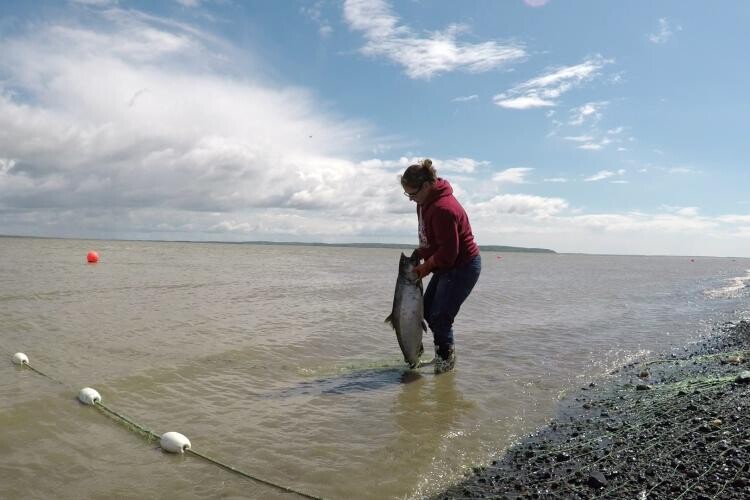
Wild salmon are super weird for a variety of reasons, including response to warming climate conditions, says fisheries researcher Peter Westley of the University of Alaska Fairbanks.
"Salmon have really evolved in places with changing conditions, including volcanoes blowing up, glaciers melting and making really good salmon habitat," Westley said on Wednesday, Sept. 24, in a webinar from his office on the Fairbanks campus. "Salmon are experiencing the front lines of (environmental) changes. Trends across the globe since 1991, the rate of warming is much, much faster in the Arctic. Salmon are experiencing warming and rapid change of warming."
To maintain healthy salmon populations, the fish need cool, complex, connected, clean habitat, said Westley, an associate professor and Wakefield chair of Fisheries and Ocean Sciences at UAF's Department of Fisheries and Ocean Sciences.
Connectivity is important so that the salmon have the ability to move around, he said. It is also important to protect the processes important to the fish, like the way groundwater comes up to cool the water, and gravel has to come into the streams, he said.
"Salmon bury their offspring alive and leave them in the gravel for months on end, nine to 10 months under the gravel. They are born in fresh water, and then they decide freshwater is not for them and migrate to the ocean, and then they come back," he said. "They can fill up streams in very high density and go back to their natal streams. They fight their way back home, and their bodies decay and become nutrients for others, including bears. Salmon are weird, but also awesome."
Sockeye salmon in Bristol Bay have benefited from the warming of area lakes, prompting juvenile salmon to grow faster, enter the ocean younger and larger than in the past. There is a trend of changing the life history of fish that come back, he said. While Chinook and chum are struggling, the sockeye salmon (in Bristol Bay) are an example of thriving in the face of climate change.
Westley also cited the work of Greg Ruggerone of Natural Resources Consultants in Seattle, who notes in his research published in November of 2024 that the pink salmon population has been increasing and more than doubled since the 1977 temperature regime shift in the North Pacific. “And there is a relationship between the rise in the pink population and a decrease in the size, survival, and abundance of Chinook salmon,” Ruggerone said.
"Warm water is good for pinks, and right now the temperatures are optimal for sockeye in Bristol Bay, Westley said.
Still, a drought this year in Alaska's Prince William Sound affected the pink salmon population there. There was little rain and a high tide, and then the tide went out, and all these fish died because they were unable to spawn, he said. The fish did better in watersheds that had more melting glaciers. There was plenty of water, and that water tends to be cooler, he said.
Westley told several dozen people during the webinar, including students in rural schools, that given the special relationship Alaska has with salmon it is important to continue discussions on protection of salmon habitat. "In Alaska we have a lot of habitat left and have a choice to make it right," he said. "Once you build things like a dam they are there for a long time and it is a lot of work to restore habitat." Meanwhile the salmon remain under stress because of change in climate and more, he said.