

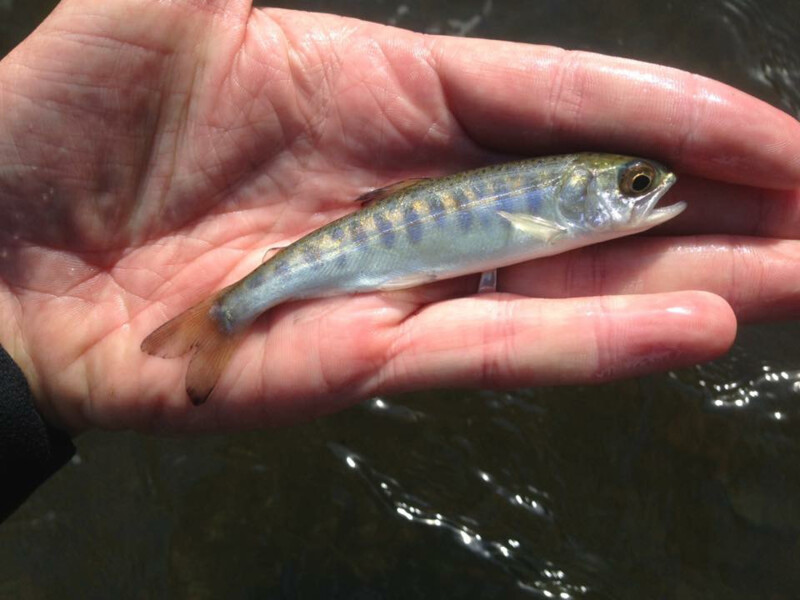
New studies at the University of British Columbia confirm the increasing heat stress for juvenile salmon at this vulnerable stage of their lives.
The studies by UBC's Pacific Salmon Ecology and Conservation Lab document how young fish cope with heat differently than older fish and that current methods of measuring that stress underestimate the risks these fish face in warming waterways.
The study exploring the biological mechanisms that influence heat tolerance was published in the Journal of Experimental Biology. The study examining swimming performance and survival at different temperatures was accepted by the journal Conservation Physiology.
UBC researchers focused in these two studies on juvenile Chinook salmon, but have
previously examined thermal tolerance in all life stages of sockeye and adult coho, adult Chinook, and adult pink, said studies leader Scott Hinch, a professor of fisheries conservation at UBC. Similar conditions have been observed in Alaska, Washington state, Oregon and California, he said.
"The results are always the same," Hinch said. "Populations (not the species) within a given species are adapted to their historically experienced thermal conditions for a specific life stage. When temperatures exceed those historical levels, salmon will experience heat stress and mortality unless they can find thermal refugia."
The studies found that some populations do show resilience despite continued warming, but supporting that resilience means reducing thermal stressors, especially during the warmest periods. This may include maintaining and protecting riparian trees and groundwater sources to help keep waterways cool.
While it is still too early to tell, all indications are that some parts of BC will experience warmer than normal temperatures this year, Hinch said. That will depend on several factors including snowpacks, climate change and El Nino effects.
Ensuring land use practices are such that riparian trees are abundantly protected is one approach and the same goes for protecting ground water sources, Hinch said.
But this involves land managers which are provincial agencies. Salmon fisheries are managed federally in Canada.
Even without El Nino, a warming phase of the central and equatorial Pacific Ocean,
rivers in British Columba will become warmer in coming years, but El Nino will make it worse, he said. La Nina, by contrast, is a cooling phase that causes deep, cool, nutrient-rich water to rise to the surface along the equatorial Pacific.
Forecasting salmon returns is a complex process. When juvenile salmon migrated to the ocean two years ago, they encountered cool, food-rich coastal waters linked to La Nina conditions, so returns this year of some populations may be similar to last year. However current El Nino conditions could pose challenges for returning adult salmon, who could find migration and spawning rivers very warm and low due to drought.
For young salmon who will remain in freshwater or another year or two before heading to the ocean the situation is more concerning, researchers said. A super El Nino is projected to bring warm coastal waters, poor food availability, abundant predators and a large blob of warm ocean water is also approaching the coast, reflecting cumulative climate change impacts, their studies show.
The 2025 Fraser River sockeye run exceeded expectations, but a single year does not signal recovery. For 2026 continued variability with some run year average should be expected, with others below historical norms, they said.