



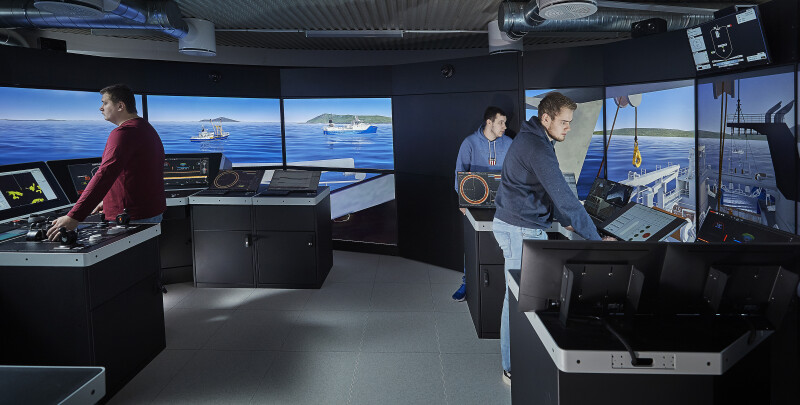
The most advanced fishing vessels on the high seas no longer have what could be called a wheelhouse; it’s a bridge, festooned with electronics that make it look like something straight out of Star Trek.
To help fishing companies train crew to operate these high-tech vessels safely and productively, Kongsberg Maritime developed the K-Sim Fishery simulator, a standalone unit that replicates a basic wheelhouse.
Inside the simulator, students operate a forward-facing station that includes several Simrad electronic products, including the ES80 echosounder, the SU90 Omni sonar, and the TV80 catch monitoring system. In addition, it has ECDIS, a plotter, a steering display, radar displays, and more. The aft-facing station in the simulator has most of the same fish-finding displays along with a trawl monitor and winch controls.
“We delivered the first one to the Lofoten Vocational School in 2018,” said Anne Voith, senior marketing and communications manager of maritime simulation at Kongsberg. “The system has been continually updated. It was originally designed for teaching trawling, and then in 2022 we added purse seining and longlining, and most recently we added more environmental features.”
According to Voith, the simulator helps instructors familiarize future captains and mates with what they will encounter on a real fishing boat.
“We also have multi-day training programs for the instructors who will be using the simulator,” Voith said. “As well as the technicians who maintain it.”
Besides addressing increasingly strict IMO safety requirements, the simulator helps future captains and mates read instruments accurately and classify target species, density and probability of bycatch, determine when to set, and when to haul back, as well as avoid bycatch, Kongsberg notes.
The K-Sim Fishery simulator is a companion to the K-Sim Navigation simulator, which is in use at vocational schools and universities throughout the United States and around the world.
At the Alaska Vocational Technical Center (AVTEC) in Seward, Alaska, the navigation simulator is primarily being utilized to train crews for oil spill response.
“These simulators can be configured and used on an individual computer,” Voith said. “The instructor can set up a training scenario, and the students run the exercise and respond on their computers.”
The first K-Sim Fishery solution was set up at Lofoten Vocational School in northern Norway in 2018, followed by the VDAB (the Flemish Service for Employment and Vocational Training) in Zeebrugge, Belgium, and the Greenland Maritime Centre in Nuuk — which was funded in part by almost $500,000 in contributions from nine Greenland fishing companies. “In addition, it has been installed in Canada, Peru, the Netherlands and at several training institutions in Norway and Spain,” Voith said.
While Voith reported that no U.S. institutions have invested in K-Sim Fishery yet, and that Kongsberg Maritime does not offer training, she noted that institutions that have purchased the equipment and software may offer training both to local and international students and crew.
.jpg.small.400x400.jpg)
