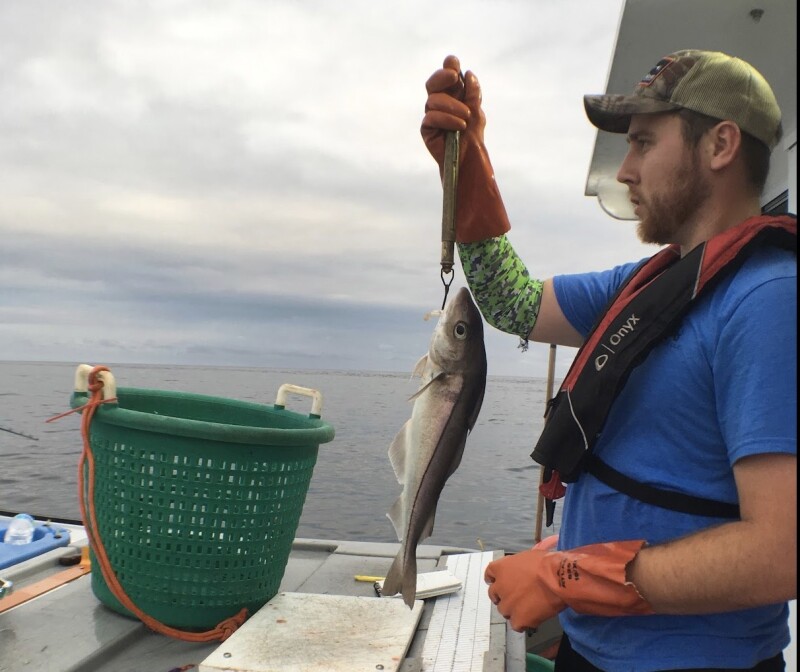
The loss of an observer aboard the groundfish dragger Lily Jean out of Gloucester, Mass., has increased scrutiny of the National Marine Fisheries Service (NMFS) observer program. The incident, one of approximately seven observer deaths in 50 years, illustrates how observers share many of the same risks as fishermen.
The NMFS observer programs began three years after President Richard Nixon and the US Congress established the National Oceanic and Atmospheric Administration (NOAA) in 1970, and the existing Bureau of Commercial Fisheries was renamed the National Marine Fisheries Service. In 1973, NMFS started putting observers aboard foreign vessels as part of the North Pacific Foreign Fisheries Observer Program.
“Initially, observers were placed on vessels only by invitation from host countries,” says the NOAA website on the history of its observer programs. After the 1976 passage of the Magnuson Stevens Act, foreign vessels had to accept observers, and by 1986, with the foreign vessels gone, NMFS began putting observers on U.S. boats.
According to NMFS Communications Specialist and Public Affairs Officer, Greater Atlantic Regional Fisheries Office, Andrea Gomez, vessel monitoring in the Northeast—where the Lily Jean sank on January 30, 2026—is accomplished with two distinct programs: the Northeast Fisheries Observer Program (NEFOP), which covers all commercial marine fisheries in the region, and the At-Sea Monitoring (ASM), which covers the Northeast Multispecies fisheries—New England Groundfish.
“NOAA Fisheries developed the current observer programs over several decades in close collaboration with the fishing industry, the New England and Mid-Atlantic Fishery Management Councils, and the Atlantic States Marine Fisheries Commission,” says Gomez. “Electronic monitoring (EM) is currently authorized only for use in the ASM program in lieu of a human observer.”
Gomez notes that EM vessel participation is optional and has been increasing, with some vessel operators choosing cameras over having to provide a bunk and food for a human observer. But EM covers only 29 percent of the boats—the rest take observers. “At-sea observer data collection in both programs is a critical component of quota monitoring and assessments, and the safety of our observers at sea is the foundation of both,” she says. “The observer safety training program meets or exceeds all National Observer Safety Training standards.”
Gomez points out that observers must complete offshore marine safety training prior to heading out on commercial fishing vessels. “All observers must conduct a Pre-Trip Vessel Safety Check (PTVSC) before each trip,” she says.
According to Gomez, observers must check life raft expiration dates, hydrostatic release expiration and set-up, EPIRB battery expiration dates, current USCG Decal issued, flare expiration dates, presence of fire extinguishers, presence of life rings, enough immersion suits for all crew onboard, presence of radio and confirmed operational, presence of first aid materials and confirmed expiration dates. “If the vessel does not pass the safety check, the observer does not deploy on the trip,” says Gomez. Observers can also refuse to deploy if they have personal safety concerns.
Gomez adds that observers undergo recertification every 18 months. “Each regional observer program ensures that established safety training standards are met during training,” she says, noting that they also conduct surveys and debriefings of returning observers to assess if the training provided was adequate to prepare them for their actual work experiences. If deficiencies are noted or needs identified, they are reported and hopefully lead to changes. But the fact remains, fishing is a dangerous business, and observers are not exempt from the risks.