


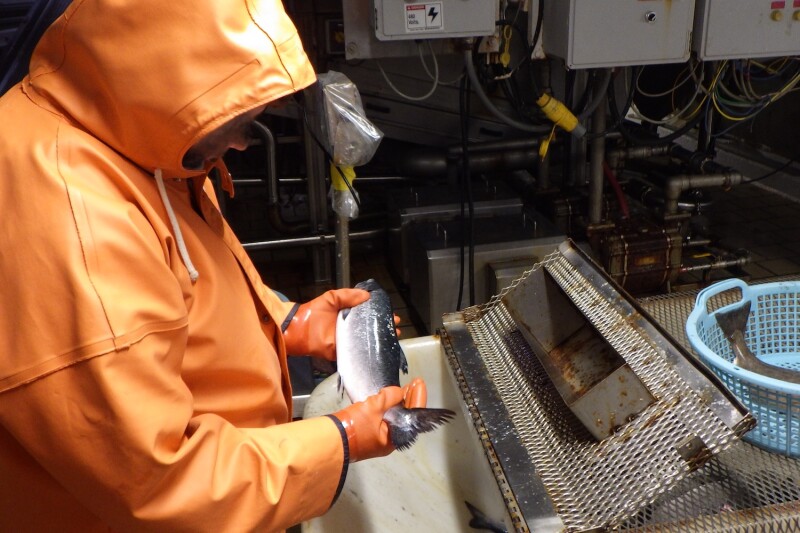
A recent study by NOAA Fisheries found that shore-based observers can effectively strengthen catch accounting in Alaska’s pollock fishery, offering a viable complement to electronic monitoring systems used at sea.
The Alaska pollock fishery is the largest U.S. fishery by volume and one of the largest in the world, and it sets the standard for accurate accounting and supports sustainable management and regulatory compliance. In addition to tracking pollock landings, managers must closely monitor prohibited species catch, including salmon and halibut.
Traditionally, this work has been carried out by at-sea observers collecting catch data and biological samples aboard vessels. But deploying observers at sea can be expensive and logistically challenging. In response, hybrid monitoring programs-combining electronic monitoring at sea with human observers on shore- are increasingly being explored, especially in low-discard fisheries where most catch is landed.
Researchers from the Alaska Fisheries Science Center evaluated the effectiveness of shore-based observers in the Alaska pollock trawl fishery under a voluntary exempted fishing permit. The study examined whether observers stationed at fish processing plants could meet core monitoring responsibilities, fulfill expanded sampling duties, and verify the accuracy of industry-reported catch data.
Monitoring thousands of offloads
Scientists analyzed data collected between January 2020 and November 2023 during more than 4,000 pollock offloads at 14 shoreside processing plants in the Bering Sea and Gulf of Alaska. Under the hybrid monitoring program, electronic monitoring systems documented fishing activity at sea for regulatory compliance, while shore-based observers focused on sampling landed catch.
Observers collected species composition data to support catch accounting and verify industry-reported landings. They also gathered biological information, including fish length and weight, sex, and otoliths, to support stock assessments. A key priority was monitoring catch of prohibited species, particularly salmon.
“Shore-based observers primarily focused on monitoring offloads to obtain accurate counts of salmon,” said Andy Kingham, a fishery biologist with the Alaska Fisheries Science Center. “This was particularly important for Chinook salmon, which has strict catch limits that can affect fishery closures.”
In the Bering Sea, all pollock offloads were selected for shoreside salmon monitoring and species composition sampling. In the Gulf of Alaska, about 30 percent of offloads were randomly selected. In both regions, observer data were compared against industry-reported offload receipts, also known as fish tickets.
According to the study, shore-based observers consistently met core monitoring responsibilities, particularly salmon accounting. It also addressed the challenge of determining appropriate sampling levels, which can vary widely by fishery, region, and management goals. To help evaluate the differences, scientists developed a structured approach that integrates four key components:
- Assessed observer performance relative to program goals
- Evaluated sampling sensitivity, including the ability to detect rarely caught species
- Compared data between observer samples and industry-reported landings
- Prioritized sampling objectives, making trade-offs among competing monitoring needs
NOAA noted that this approach can be applied worldwide to fisheries to evaluate the level of monitoring needed for different management and compliance objectives.
Independent verification of industry data
Comparisons between shore-based observer data and industry-reported fish tickets showed that industry reporting was not always reliable across all species groups.
“Our results show that shore-based observer programs do not simply duplicate industry reporting. Instead, they strengthen the accuracy of catch accounting by providing independent verification and identifying where reporting can be improved,” stated Jason Jannot, supervisory fishery biologist at the Center.
By validating industry-reported data and identifying reporting gaps, shore-based observers help improve confidence in the information used for fisheries management, the agency said.
NOAA said the findings provide tools that can be applied beyond the state’s pollock fishery, helping managers evaluate and optimize shore-based monitoring programs as part of broader hybrid monitoring strategies. The agency credited industry partners and fisheries observers for their support of the research.
.png.small.400x400.png)