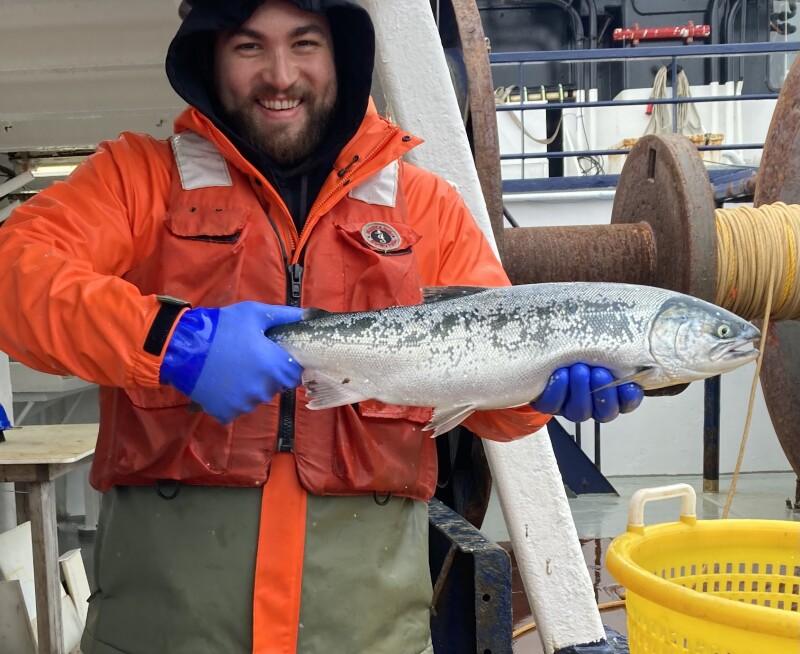
NOAA Fisheries scientists are examining how ocean conditions influence Chinook and chum salmon bycatch in the eastern Bering Sea pollock fishery, one of the world’s largest seafood harvests. The new study, led by researchers at the Alaska Fisheries Science Center and partner institutions, analyzes more than a decade of observer data to identify environmental factors linked to salmon encounters.
Alaska’s pollock fleet lands more than 2 billion pounds annually, but unintentional salmon catch remains a longstanding management concern, particularly for western Alaska Chinook and chum stocks that have declined sharply in recent years. These salmon are important to regional communities and vulnerable to bycatch because their migration routes overlap with pollock fishing grounds. NOAA and the industry have implemented multiple avoidance measures, but managers say a clearer understanding of what drives bycatch is needed.
“This is an issue that’s the subject of ongoing discussions at North Pacific Fishery Management Council meetings,” said lead author and fisheries biologist Lukas DeFilippo. “There’s limited information available on how environmental factors affect bycatch, which could potentially be useful for informing ongoing scientific and policy discussions.”
The research team analyzed observer data from 2011 to 2023 using a modeling framework that accounted for fishing season, depth, and a range of oceanographic indicators. They found that interactions between bottom depth and sea surface temperature anomalies consistently shaped bycatch rates, though effects varied by species and season.
During the A season, when sea ice remains over parts of the eastern Bering Sea, years with more ice were linked to higher Chinook bycatch in most regions. Researchers say one hypothesis is that both fishing vessels and Chinook were pushed into ice-free areas, increasing overlap. Chinook bycatch typically declined later in the A season as fish migrated. Chum salmon are usually absent from the shelf during this period.
In the B season, chum bycatch generally rose early, while Chinook bycatch increased later. Fishing deeper — about 475 feet or more — tended to reduce bycatch for both species. But unusually warm years can drive chum into deeper waters, raising bycatch risk. Warm phases of the Pacific Decadal Oscillation were broadly associated with higher B-season bycatch for both species. Shifts in the extent and position of the cold pool, the mass of cold bottom water left after sea ice melt, also influenced where bycatch hotspots formed.
“In a lot of marine ecosystems, oceanographic features have a significant impact on bycatch patterns, so it makes sense that the cold pool and Pacific Decadal Oscillation play an important role in salmon bycatch dynamics in the Bering Sea,” DeFilippo said.
DeFilippo described the work as an initial step toward identifying environmental indicators that may help reduce salmon bycatch. He noted that timing strategies have historically helped reduce Chinook interactions, but differing seasonal patterns for chum and Chinook make it harder to minimize bycatch of both species simultaneously.
“This work has been successful because of collaborations between Alaska Fisheries Science Center, North Pacific Fishery Management Council staff, Alaska Department of Fish and Game, and the University of Alaska,” he said. “That kind of cooperation is critical for advancing future research focused on reducing salmon bycatch.”