




Very early in the stability panel at the Pacific Marine Expo (PME), moderated by the Alaska Marine Safety Education Association (AMSEA), Leann Cyr, her colleague, Jerry Dzugan, showed a dramatic video of a purse seiner rolling over in the Gulf of Alaska. “They say that 80 percent of vessel losses are due to human error, but in reality, at some point, they are all human error,” says Dzugan, who ran down the list of mistakes the 25-year-old captain made: failing to lower the block, secure the seine skiff, or batten down a net in the hold that acted as a free surface effect contributor to the capsize.
The other panelists, Lee Lee Boltz — Senior engineer/Naval architect at Hockema Group, and longline freezer vessel owner Jim Hubbard, talked about things that help vessel operators avoid making mistakes.
Boltz offered three important considerations regarding stability booklets. “First, you need to have a stability booklet,” he said. “Then you need to understand it, and follow it.” To that, Boltz added that by following it, he meant, as a guideline, not necessarily a strict edict. “But if you have a booklet and you don’t understand it, please call us.
Another issue, highlighted by Hubbard, is that while a stability booklet applies to the vessel when the booklet was created, a boat can suffer from weight creep. “If you get a new block and it weighs 800 pounds, you start bringing tools aboard,” he said, noting that he took a pallet with 1400 pounds of tools off a seiner he was selling. “And paint. Think about 50 gallons of paint every year, for 50 years.”
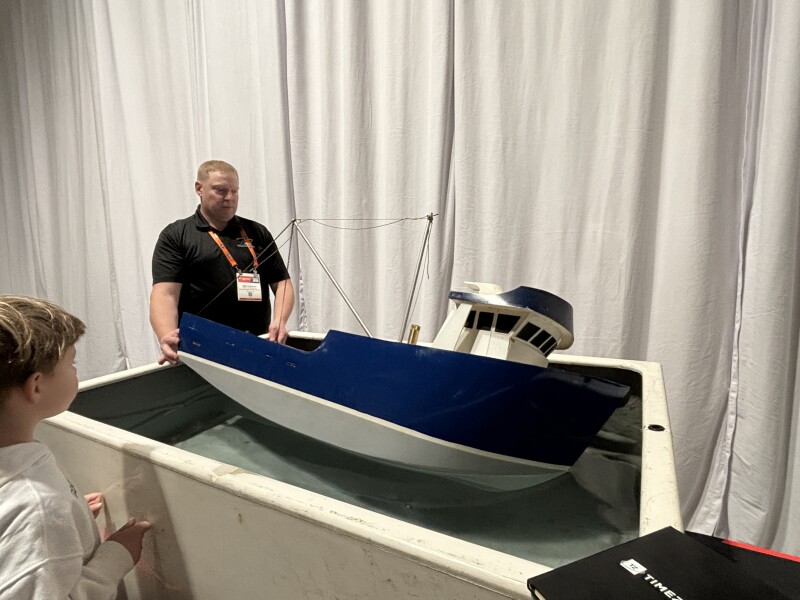
To illustrate the concepts discussed, Jerry Dzugan and Mike Rudolph of the U.S. Coast Guard conducted stability workshops every day of PME. Considering most small boats do not have stability booklets or the time to consult them if they did, Dzugan and Rudolf strove to impart some basic concepts of stability that might help vessel operators avoid some of the most egregious human errors.
Using an ingenious cut-out model of a hull, equipped with weights, Dzugan explained how weight on deck can raise a vessel’s center of gravity and create a longer roll period. “You can see,” he said, pointing to lines on the model. “That the righing arm gets shorter as the center of gravity gets higher. He also showed how the center of gravity of a load on deck shifts to the top of the boom as soon as the load is lifted even an inch off deck. He swung the load out further from the model, showing how it could pull a boat over. “Give me a lever, and I can move the world, or capsize your boat.”
With a model boat in a tank, Rudolph demonstrated the effects of free surface effect and how it could so easily lead to downflooding and sinking. At one workshop, a young boy, about 8 years old, and appropriately named Valour, studied the model. “What do you think will happen if we add more weight and reduce the freeboard, and the vessel rolls?” Rudolph asked.
“It’s going to sink,” said Valour.
“Smart kid,” said Rudolph.
The workshops and the earlier panel were intended to impart enough information to avoid the human errors that can lead to scary situations or worse, the loss of life. If an eight-year-old can get it, anybody can.
.png.small.400x400.png)

