

In Alaska’s pollock fishery, the largest in the United States and among the most productive in the world, every tow carries not just pollock but the risk of catching salmon.
For decades, commercial fishermen and scientists have collaborated to reduce salmon bycatch, refining net designs, developing exclusion devices, and implementing vessel notification systems to steer clear of populated areas. New technology is emerging that utilizes artificial intelligence, specifically a tool called You Only Look Once, version 11 (YOLOv11), which could help fishermen and scientists evaluate salmon excluders more efficiently, accurately, and potentially at a lower cost.
Why salmon bycatch matters
Pacific salmon, especially Chinook and chum, are prohibited species in the pollock fishery. When bycatch levels reach hard caps, pollock boats are forced to tie up at the dock. That means processors, crew, and entire communities that rely on the fishery lose revenue. In recent years, salmon bycatch has reached record highs, with Chinook peaking in 2005 and chum in 2006. Since then, fishermen have invested heavily in gear and technology aimed at preventing salmon from entering their codends in the first place.
Salmon excluders, also known as bycatch reduction devices (BRDs), have been at the center of this work, shared in a study published by the International Council for the Exploration of the Sea (ICES) Journal of Marine Science and NOAA Fisheries. The modifications provide salmon with a way out of the net, but measuring their effectiveness has relied on time-consuming video reviews by human observers. Hours of footage, including fishing, swimming, flashing, escaping, and not doing so, had to be watched and annotated frame by frame. Katherine Wilson, the lead scientist on the study, said, “It was challenging for people familiar with identifying salmon to review so many hours of video and identify every salmon.”
The technology
Wilson and her colleagues at NOAA’s Alaska Fisheries Science Center tested two deep-learning models: EfficientDet and YOLOv11. According to the study, both were trained on more than 85,000 annotations of 11,572 salmon and 73,394 pollock pulled from nearly 17,000 video frames shot inside Bering Sea trawls.
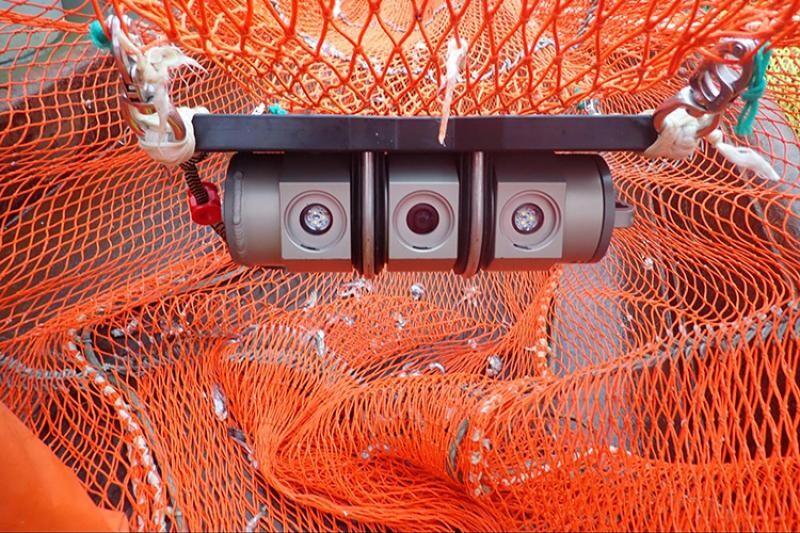
The videos captured everything from clear water with low pollock densities to murky conditions clogged with krill, heavy schools, or poor lighting. Cameras were mounted at the entrance of excluders, illuminated by LED light systems, to record the moment when salmon had a chance to escape.
The verdict was that YOLOv11 outperformed EfficientDet across the board. On average, YOLO detected about 90 percent of salmon and pollock with 72 percent accuracy at a 50 percent overlap threshold. That’s on par with human reviewers, sometimes better for pollock and a bit weaker for salmon, but a far faster process. What takes a trained observer days or weeks can be run by the model in a matter of hours.
Deck to lab
For fishermen, the payoff is the speed and reliability of this new technology. Faster analysis means salmon excluders can be evaluated quickly, with results feeding back into net design and deployment strategies. In test runs on full tows, the YOLO model correctly predicted the presence of salmon with 99.3 percent accuracy and reduced the number of frames requiring review by 85 percent.
That matters when every season counts. As Wilson put it, “Automating video analysis has the potential to save time and money. This research gives more tools to the fishing industry to reduce bycatch and be more sustainable.”
Of course, the technology isn’t perfect by any means. False positives came up, particularly when herring appeared in the footage and were misidentified as salmon. The models also struggled more in conditions of high fish density or low light. However, NOAA Scientists mentioned these issues could be mitigated with more training data, especially from Chinook-heavy tows, and by adding more species classes to the model so that herring, for instance, isn’t confused with salmon.
What fishermen need to know
Commercial fishermen know better than anyone that innovation isn’t just about the newest flashy tech; it has to be proven to work on deck or in the water. Excluders are already a familiar tool, and this new technology doesn’t change how nets are used to fish. What it changes is the pace of the feedback. Instead of waiting for months for video review and analysis, crews and managers could soon receive answers in near real-time.
This study could lead to more effective excluders and enable real-time decision-making for scientists. Knowing during a tow whether salmon are slipping past the excluder or being released safely will be game-changing for both the pollock and salmon fisheries. “Developing real-time tools may provide fishers with the necessary knowledge to operate even more sustainably,” Wilson said.
For processors and quota managers, faster assessments could help keep the pollock fishery open longer and avoid sudden closures triggered by bycatch overages. For fishermen, that means more consistent work, steadier paychecks, and less wasted time.
Beyond Pollock
The implications stretch beyond pollock. Deep-learning models, such as YOLO, are already being used in manufacturing to detect defects and in medicine to identify diseases in scans. In fisheries, they could expand to other gear types and species. From scallop dredges to longlines, video monitoring is becoming cheaper and more common. With the right datasets, similar models could one day help other fisheries reduce bycatch, whether it's flounder in the scallop fishery or interactions with protected species elsewhere.
However, for now, the pollock fishery is put to the test. The study’s dataset and salmon presence algorithm are publicly available, opening the door for industry and independent researchers to build upon the work. Wilson and her team recommend continued refinement of video footage of small Chinook, more diverse fishing conditions, and further work on distinguishing species, but the foundation has now been laid.
Looking ahead
Fishermen have always been quick to adopt tools that make their work more efficient, whether it was hydraulic haulers in the lobster fishery, steel hulls in draggers, or GPS plotters in wheelhouses. Artificial intelligence may seem like a stretch, but the principle is the same: better tools make for better fishing.
As the study authors mentioned, deep learning has “great benefits for bycatch mitigation and the pollock fishing industry.” If excluders can be fine-tuned quickly, and salmon can be kept out of nets more reliably, the results are fewer shutdowns, less waste, and stronger fisheries for everyone in that region.
For crews working long trips in the Bering Sea, the promise of AI isn’t about replacing fishermen, it’s about keeping the fleet fishing, helping fisheries thrive, and keeping communities from Dutch Harbor to Sand Point thriving on pollock.