Besides bringing its FS80 net monitor to market this year, Simrad is breaking ground with a number of innovations.
Simrad introduced its new FS80 trawl sonar system at the 2024 Pacific Marine Expo and launched it onto the market in early 2025.
“We just came out with a new trawl sonar system, a third wire trawl sensor that scans across the mouth of the net and uses multiple frequencies to scan up and down,” says David Barbee, Field Service Engineer at Simrad.
“We had to make our own telemetry for this and clean up the sonar,” says Barbee, noting that the multiple frequencies allow fishermen to set frequency responses for fish entering the net so that they can increase the likelihood of identifying the species they’re targeting as well as bycatch species.
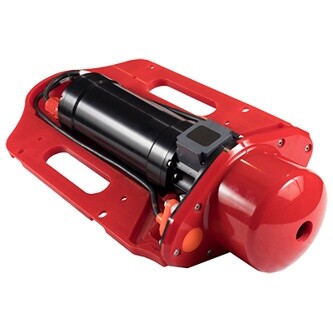
Simrad, as a brand of Kongsberg Discovery and part of the Kongsberg Group technology conglomerate, benefits from access to the group’s wide range of technologies, giving engineers like Barbee a chance to create hardware and software that give fishermen what they’re asking for.
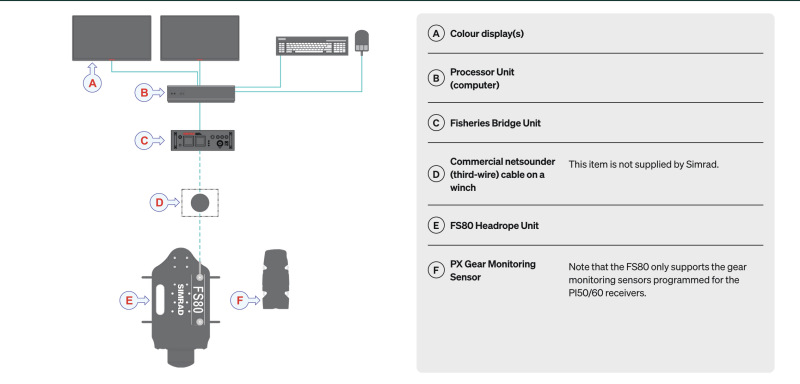
“The FS80 can monitor the net height, spread, and distance off bottom,” he says, noting that the 165 to 330 kHz net profiler allows for different types of fisheries, such as bottom and midwater trawling using one sonar. “It’s got two down sounders,” he continues. “A 200 to 400 kHz low-frequency down-sounder for monitoring the catch, and a 500 to 750 kHz high-frequency down-sounder to measure the height of the footrope off bottom. It also has a 200 to 400 kHz up-sounder to look at what is above the net.”
As Barbee describes it, the FS80 is a modular system, and fishermen fit their nets with as many as six acoustic sensors for precise monitoring of the catch progress, as well as Integrated depth, temperature, pitch, and roll sensors for accurate monitoring of the deployment pack.
The Simrad FS80, provides abstract imagery of what’s going into the net. While Simrad is looking at how AI can read that imagery, Barbee prefers to trust fishermen’s experience with interpreting the information from the FS80.
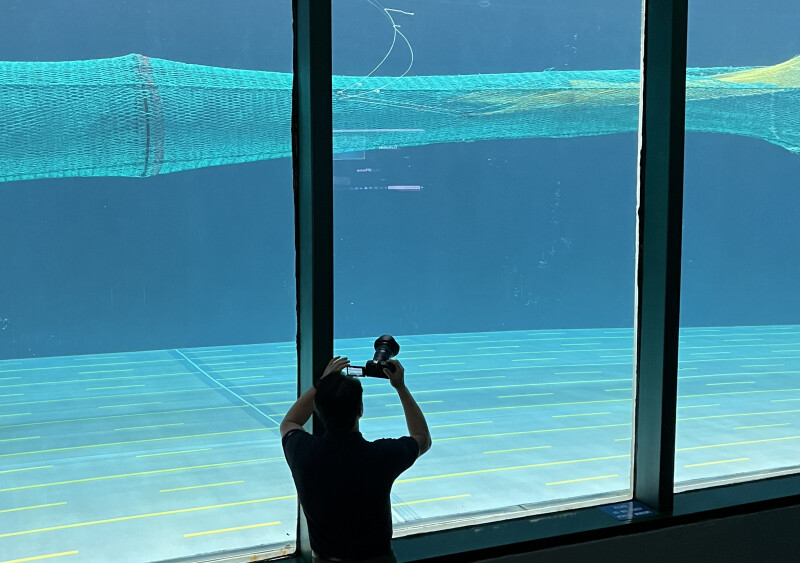
With Simrad’s FX camera system, fishermen can see, and ground truth what is going into their nets, whether it’s pollock, for example, or bycatch. It can also help monitor the gear. For example, the FS80 may show what looks like fish are going in the net, but the FX camera may show nothing there but a twist in the net.
The third component of the system is the Simrad FH80 Hub, which can connect to Simrad’s Catch Control system for Active Selection. “That’s ActSel for short,” says Barbee. “It refers to the actuator that plugs into the Simrad FX hub.”
Craig Rose, owner of FishNext Research, has been working on active selection for years, and in July 2025 he received another round of funding from the National Marine Fisheries Service (NMFS) Bycatch Reduction Engineering Program to continue developing and promoting the ActSel system. Rose is collaborating with Simrad, Trident, and other fishermen’s organizations to move the project forward.
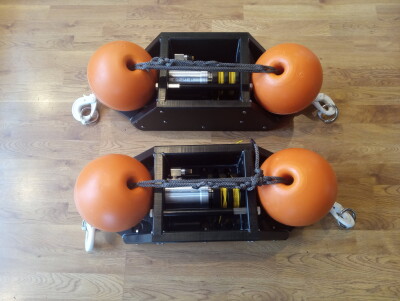
“I built the actuator for Simrad,” says Rose. “What it does is let one line in and one out about 20 inches, and that enables a kite on the leading edge to open and close a roughly 10- by 20-foot panel back in the extension of the net.”
As Rose describes it, ActSel in its current form depends on the FX camera. “If a captain sees a school of rockfish, or a few salmon, he can decide to let those fish out of the net.”
With the new funding, Rose and Simrad are focusing on getting fishermen to use the technology. “We’re using this to get over the speed bumps to wider adoption,” Rose says. “Chris Cooper on the Predator is our best collaborator,” says Rose. “He’s using it in the hake fishery off Oregon.”
Barbee agrees. “We’ve done the engineering for getting the signal down and feedback up from the net,” he says. “The key is that rather than passive excluder systems that rely on the fish behavior to remove them from the net, we are actively changing the net configuration to reject these bycatch species. Even closing the net when not at fishing target depths will help.”
Combined with AI Edge computing devices—specialized hardware platforms designed to run artificial intelligence (AI) and machine learning (ML) models at the edge of a network, close to where data is generated—Barbee notes that the actuator could learn to work automatically. “It’s been said it could change the destiny of fishing,” he says. “But I would rather trust the judgment of the fishermen.”
Regarding all these components, Barbee adds that versions of them have been around for years. “We’re just making it all smaller, better, and cheaper,” he says. “And they can all be connected through our FH80 Hub.”
But the current system relies on two third wires. “We’re trying to get it so a second cable from the boat is not needed,” says Barbee. "We can sew cable into the net for a pass-through of a single wire from the boat to the FS80 and then to connect the hub and camera and other things in the back of the trawl.”
Barbee points out another component in the package. “There’s always been controversy about whether midwater nets are on bottom. We have the technology to know that and adjust the net’s position with our acoustic modems for door control. A couple of trawl door manufacturers— MLD ApS in Denmark for one—are making doors that our two-way acoustics can work with to control spread and depth.”
While launching the FS80, which combines net monitoring, catch profiling, and bottom detection in a single unit, Simrad is also bringing the SY50 omni sonar to commercial fisheries. “The target market has been sport fishermen,” says Barbee. “But now we’re collaborating with an AI company, VIAME, and looking at the 58-foot limit seiners, pogie seiners, and pelagic fisheries like swordfish.”
According to a Kongsberg press release, “VIAME's technology allows SY50 users to translate complex sonar data into actionable targets and use AI to automatically tune key settings. Global fleets can seamlessly connect to the cloud, and captains can now instantly view underwater activity, enabling smarter decisions and enhancing performance.”
“It also minimizes vessel avoidance by fast schooling fish,” says Barbee, noting that the SY50 fits the common 8-inch transducer trunk and is a big tool for smaller boats.
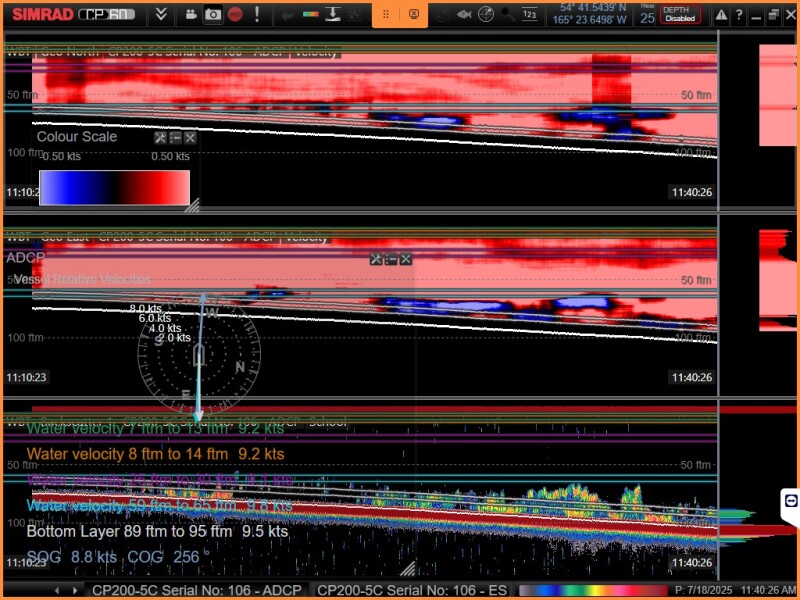
While the ES80 has long been the gold standard for echosounders, Barbee points out that it can be upgraded with the CP60. “The CP60 can measure five layers of current direction and velocity,” he says. “And if you focus all three beams on a school of fish, it can tell you where the school is going and how fast.”
According to Barbee, Simrad is also working to support fisheries management both through cooperative research and putting the best equipment on research vessels. “As NOAA looks at midlife refits for its research fleet,” he says. “They can add our technology and have the same equipment as the fishermen and get the same level of data at the same rate. The more we can help the research ships, the more it’s going to help the fishermen, and that’s our number one goal.”
With Kongsberg Discovery driving development, its Simrad brand appears to be taking advantage of rapid technological advances and integrating them into its product offerings to the commercial fishing industry.