

Day two of Pacific Marine Expo’s conference sessions was built for fishermen looking to expand their knowledge of seafood marketing and sales, whether that’s for hyper-local direct sales or insights into national and global market forces.
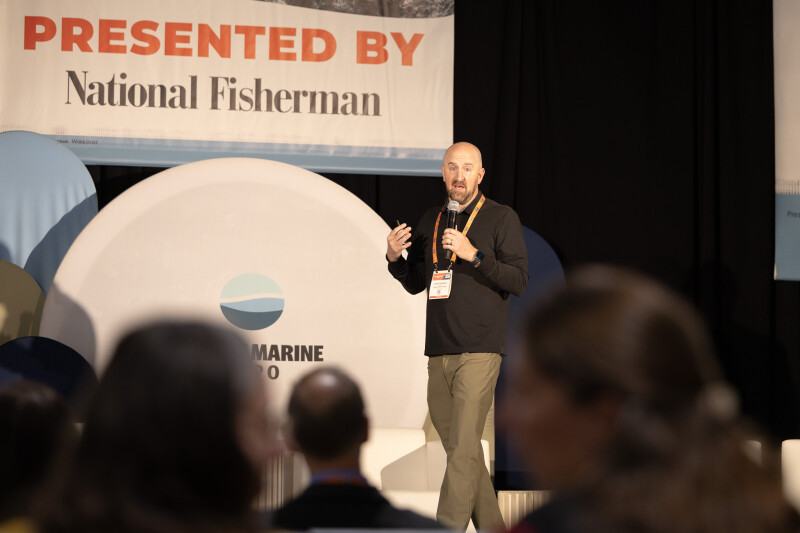
Cameron McNeil, president and owner of Lone Peak Packs, led a session on digital marketing that served as a full-spectrum 101 course on digital sales and marketing for small-scale seafood businesses.
His presentation included a wide range of helpful tips from the finer details like making sure your contact information is updated, accurate, and clear across platforms, to countering industry misinformation on digital platforms and keeping your social accounts protected.
McNeil teed up recommendations tailored for the domestic seafood and fisheries with a landscape analysis of the marketplace for direct-to-consumer seafood sales.
He noted that seafood is one of the fastest-growing food sectors, with the global market projected to grow from roughly $370 billion in 2024 to about $650 billion in 2032.
While “only about 12 percent of domestic fishermen engage in direct marketing,” McNeil noted, it’s a segment of the industry that is expanding because it bypasses traditional market barriers.
“Direct to consumer continues to scale and grow,” said McNeil. “The way that most consumers will interact with you will be through a four-inch screen in your pocket or through your website.”
Although digital marketing allows fishermen to reach across the globe on that four-inch screen, 77 percent of direct market seafood is sold within 100 miles of the business. That data suggests a solidly local (to you) market niche as well as opportunities to grow the sector.
But for now, McNeil said, “local is key.”
Access to local, sustainable, and high-quality fish is a significant driver for direct seafood sales. So McNeil recommends prioritizing authenticity and transparency on digital platforms.
“Focus on what is authentic to you and your business, and gives your end consumer the real feel of your business,” said McNeil. “Yes, be professional, but focus on your authenticity first.”
A presentation from the Alaska Seafood Marketing Institute indicates that both the volume and value of seafood landed in Alaska have been declining steadily since 2021. Alaska seafood trends are strong indicators for domestic seafood generally, since the state supplies nearly 60 percent of the nation’s seafood supply by volume.
Simon Marks, a research analyst at McKinley Group, presented market data on behalf of ASMI, including a review of employment statistics, ex-vessel value, and the effects of tariffs on the industry.
“In general, tariffs are up across the board,” Marks said, adding that they are still a moving target. “There may or may not be changes by the time happy hour starts.”
Despite a significant increase in tariffs on seafood imports — from about $4 billion in 1995 to roughly $14 billion this year (with a peak of $19 billion in 2022), Alaska is looking for a slight uptick in ex-vessel value for 2025, up to $1.68 billion from $1.38 billion in 2024.

He noted that the value is still well shy of the pre-pandemic average of about $2.5 billion a year and added that the decrease is not a segment-wide trend but rather primarily the result of the average price for key groundfish species, notably pollock, cod, and sablefish (blackcod).
Matt Alward, an Alaska commercial fisherman and national industry leader, raised another point on the scale of the global seafood marketplace during the Democracy in American Fisheries and Seafood panel discussion.
Alward noted that in this regime of implementing import tariffs to aid domestic suppliers, it’s important to pay attention to the Saltonstall-Kennedy Grant Program at the Department of Commerce. If the industry gained access to funds from the S-K grant program that we’re supposed to have, Alward said, we’d get $376 million to support marketing and infrastructure efforts across the country.
The program was zeroed out last year, but it received roughly $6 million the year before and $10 million the year before that.
“If we had substantial funding from Congress, we could create a national marketing campaign,” Alward said.