


Ask fishermen what determines fish quality, and most won’t hesitate. It comes down to two things: time and temperature. MJ Jackson, a commercial fisherman in Bristol Bay and for Northline Seafoods, has been saying that for decades, and he doesn’t see any reason to complicate it now.
“Time and temperature is quality,” Jackson said in an interview with National Fisherman. “That’s what equals quality.”
That equation sits at the heart of our conversation about refrigeration, slurry ice, and cold-chain efficiency in fisheries across the board, but Bristol Bay was the highlight. While these systems are increasingly discussed through a low-carbon lens, Jackson made it clear: fishermen don’t adopt new refrigeration technology to reduce emissions. They do it to protect their fish.
Looking back, Jackson sees one major fork in the road that shaped today’s cold-chain reality.
“Close to 40 years ago, the industry made a deal with the devil,” he said. “They decided to go with small-boat RSW (refrigerated sea water) instead of building an ice infrastructure for slurry ice.”
At the time, RSW systems offered a practical solution. But Jackson argues the tradeoff came at a cost.
“Once you dump 6,000 pounds of fish into an RSW system, the temperature goes from 33 degrees up to 42 degrees,” he said. “It slowly works its way back down, but the damage is already done. Bacteria starts working against you.”
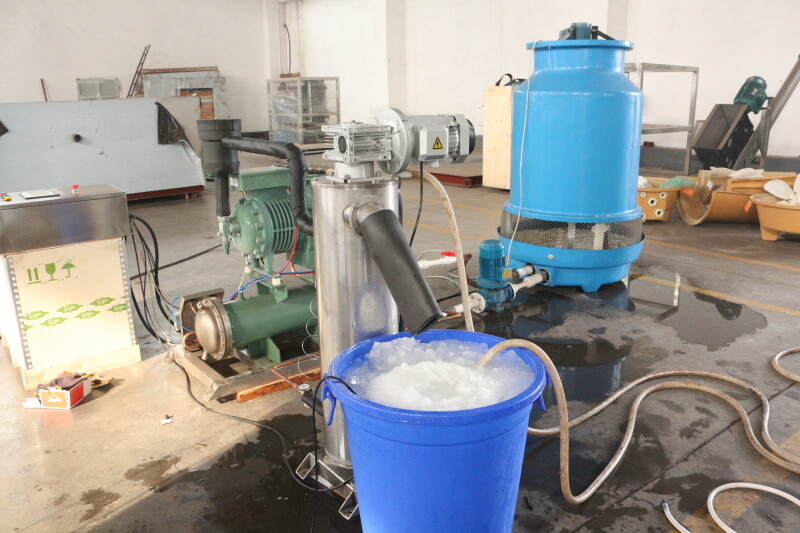
Slurry ice, in contrast, chills fish rapidly and evenly. “Slurry ice is far superior,” Jackson said. “We can get fish down to 31.2 degrees. You can’t do that with RSW- it’ll freeze up.”
At Northline Seafoods, slurry ice is used on barges to stabilize fish quality quickly and consistently. By slowing bacterial activity, it preserves firmness and shelf life- outcomes that fishermen and processors alike care deeply about.
Why slurry hasn’t taken over
If slurry ice performs better, why hasn’t it become the standard across fleets?
“The answer is money,” Jackson said.
Slurry systems remain expensive, and the infrastructure to support them hasn’t scaled. “There’s no economy of scale yet,” he said. “You might see 20 slurry systems a year compared to thousands of RSW installs.”
Without widespread adoption, prices stay high. Without affordable financing, most fishermen can’t justify the risk- even if they know the quality benefits.
“There will always be outliers,” Jackson said. “Guys who want that quality and will make it happen. But that’s not going to become the industry standard anytime soon.”
What often gets overlooked in refrigeration conversations is that quality-driven upgrades frequently improve energy efficiency as a byproduct.
By freezing and holding fish onboard, Northline avoids running energy-intensive processing equipment in Alaska, where power generation relies heavily on diesel. Processing instead happens farther south, where grid power- sometimes renewable- is available.
“We’re saving money, number one,” Jackson said. “And we’re reducing our footprint.”
That logic resonates with fishermen because it mirrors how they already think: fewer moving parts, less wasted fuel, better product.
The same applies at the vessel level. Efficient refrigeration systems reduce generator run time, stabilize temperatures faster, and limit the need for re-icing or additional handling, all of which save fuel without changing how fishermen fish.
Jackson doesn’t believe fishermen lack interest or understanding when it comes to better refrigeration. What they lack is affordable capital.
“Fishermen don’t have $200,000 to repower a system,” he said. “Not on a seven-year note at prime plus two.”
Longer-term, low-interest financing, the kind that matches the lifespan of major equipment, is what allows quality-driven innovation to spread. Without it, fleets default to what they know works, even if it’s not optimal.
Until that gap is addressed, Jackson expects refrigeration advances like slurry ice to remain incremental rather than transformative.
For Jackson, refrigeration upgrades aren’t about chasing trends; they’re about respecting the fish and the work it takes to harvest them. “When people start thinking about it- really thinking about quality- that’s when things change,” he said.
Carbon benefits and energy savings may follow, but neither replaces fishermen's need to get the fish cold quickly and keep it cold until they hit the dock.