An ambitious campaign is underway to boost the population of lucrative red king crab in Alaska’s Bering Sea.
The project centers on a newly constructed shellfish hatchery housed in the Trident Seafoods processing plant at St. Paul, a remote island community at the heart of the Bering Sea. St. Paul has long depended on crab landings to support the local economy, but the stocks have struggled in recent years.
The commercial crab fleet and crabbing ports such as St. Paul suffered a particularly heavy blow with the closure of the Bristol Bay red king crab fishery in 2021 and 2022. The fishery has since reopened, but catch quotas remain small.
Now a partnership of researchers, agencies, nonprofits, and industry are taking bold action to strengthen the red king crab stock. It comes after decades of research on how best to hatch crab.
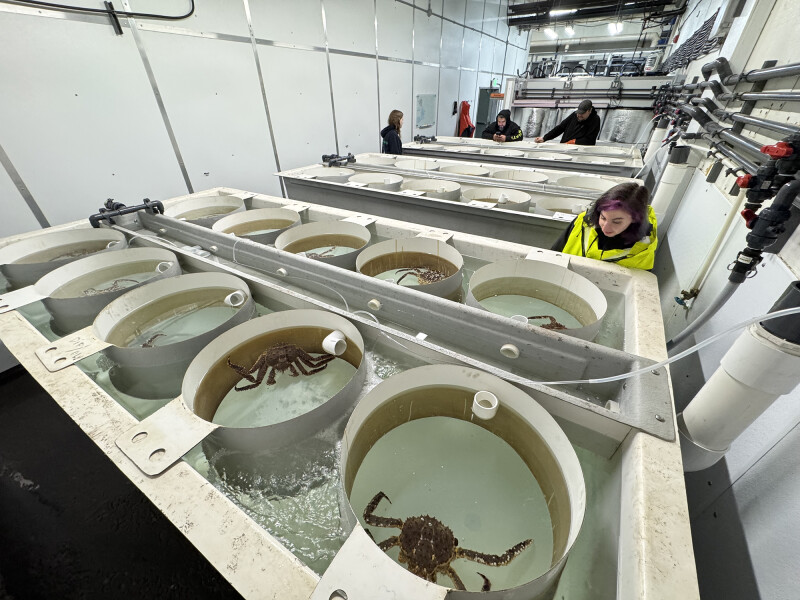
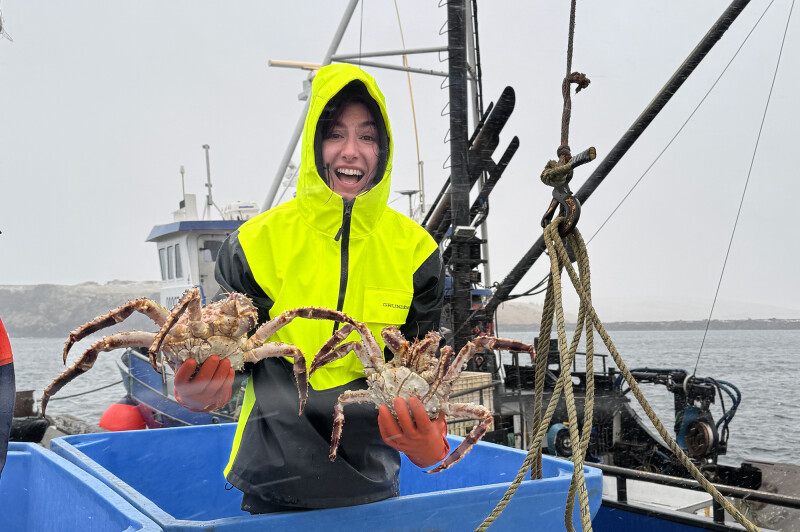
In early May, two chartered fishing boats, the Confidence and the Pacific Mariner, used pot gear to capture around 30 adult gravid red king crab – females full of eggs – for the St. Paul hatchery. The crab were placed individually into tanks. The eggs have since hatched, and the juvenile crab are expected to be released into the sea toward the end of July. Exactly where remains to be determined.
As many as 250,000 juveniles will be released.
For many years, researchers have worked to gather and hatch Alaska crab on a small scale. This is the first attempt at a crab hatchery on a production scale, said Heather McCarty, a Juneau fisheries consultant long involved with the crab research.
More cycles of crab capture and release are planned. A three-year, $4 million federal grant is fueling the effort.
It would be an overstatement to say the fate of the Bristol Bay red king crab fishery rests with the hatchery operation, McCarty said. But many people across Alaska’s fishing and scientific communities see the hatchery effort as important.
“What we’re trying to do is help bring back red king crab populations in the Bering Sea. That’s the goal. We’ve got almost 20 years of research backing this up,” she said.
“But it will take a long time,” McCarty continued. “King crab take five to six years to mature. You won’t see the results very soon.”
Alaska is a state with deep experience operating very large hatcheries to produce millions of salmon for commercial harvest, supplementing natural runs. In recent years, state law was amended to allow major shellfish hatcheries, and now we’re seeing the first steps toward replicating with shellfish what the state has built with its salmon hatcheries, McCarty said.
The St. Paul hatchery project might also be used to boost other struggling Bering Sea stocks, such as Pribilof Island blue king crab.
Project partners include the Alaska Department of Fish and Game, the Alaska Fisheries Development Foundation, the University of Alaska Fairbanks, Alaska Sea Grant, the Bering Sea Fisheries Research Foundation, and the Central Bering Sea Fishermen’s Association.