




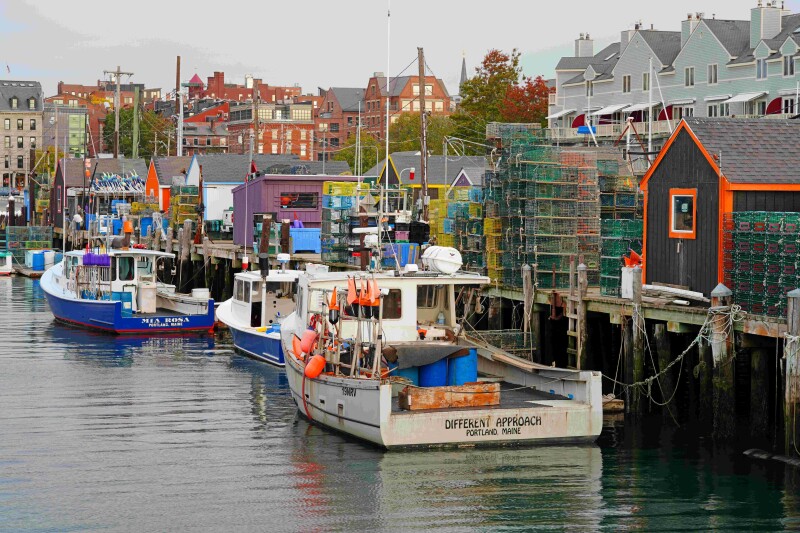
For most commercial fishermen, nuclear power doesn’t exactly come up in dockside conversations. But for Christian LaMontagne, a Maine lobsterman and scalloper, it’s not just a far-off concept; it’s something worth talking about now.
“I keep going back to nuclear,” LaMontagne said. “A couple of other fishermen that I chatted with are also ... excited about nuclear as just something that’s coming.”
While offshore wind and solar currently dominate headlines, nuclear energy is quietly reemerging in policy circles, and, increasingly, among forward-thinking fishermen who are tired of watching sustainable energy solutions stall.
“If we’re going to be shifting toward an electric fleet at some point… where do we want the power to come from?” LaMontagne asked. “We’ve looked at wind; there are a lot of concerns there. Solar is good, but it’s not a silver bullet. I don’t think we’re going to be able to rely on fossil fuels forever.”
A matter of perception & potential
Nuclear energy has long faced stigma, especially in coastal communities. But LaMontagne sees that starting to change, and says the timing may be right.
“I think we’re getting to a place with nuclear where it’s kind of rounding the corner,” he said. “We started really strong in the 50s, 60s, 70s, and then we had some disasters. But it’s pretty narrow-minded to assume that those accidents are the norm. When you look at the actual studies, it’s actually a relatively safe and really quite safe form of energy compared to the alternatives.”
He pointed out that every energy source comes with tradeoffs. “Even something as simple as solar, people think it’s perfect, but you’re mining silicon, and there’s silicosis,” LaMontagne said. “There’s so much bad stuff that can come with producing renewables. Everything has its issues, nuclear included. But when you look at the tradeoffs, how much energy production you get from it, and how consistent it is, it’s excellent.”
His optimism aligns with findings from the World Nuclear Association, which highlights how nuclear energy produces near-zero emissions during operation and offers a reliable base load power source — one that can help reduce ocean acidification and temperature rise, both of which are critical to preserving marine ecosystems.
Location, location, location
“We’re poised, being on the water, to be in a really good spot for nuclear,” LaMontagne said. “I know people think, ‘What if there’s a meltdown and it destroys Casco Bay?’ But nuclear was the most dangerous when it first started, and we’re just getting better all the time.”
That vision isn’t about building traditional reactors on the edge of town. Instead, it’s about emerging technologies like small modular reactors (SMRs), which are already gaining traction as potential low-risk energy solutions in coastal regions.
“I think before too long, it won’t be that much different than the oil and coal plants that we already have around the bay,” he said. “The smaller stuff is going to be more proven and tested. It’ll, in theory, require fewer personnel to operate. So it’s pretty exciting, and it would produce jobs in the area.”
According to MarineBio, nuclear power has one of the smallest environmental footprints of any major energy source, with no emissions of nitrogen oxides or sulfur dioxide and the smallest land-use requirement per unit of electricity. For coastal fishermen trying to preserve the resources they rely on, that’s no small point.
Balancing skepticism with strategy
Still, LaMontagne knows that bringing nuclear into the working waterfront conversation won’t be easy. “Fishermen are not the biggest polluters by any stretch,” he said. “But I think a lot of people are excited to move more towards zero-emission systems, not because we’re polluting that much, but because it’s the right thing to do.”
He added that incentives would help drive adoption. “Maybe there will be tax incentives to do so. Long term, it’s just the right choice.”
But he also points to a generational divide. “It’s tougher for the older generation,” he said. “They have the mentality of ‘if it ain’t broke, don’t fix it.’ But for me, being younger, switching over to a new system is potentially more rewarding because I have more years to capitalize on it.”
LaMontagne isn’t naïve about the road ahead. “There’s going to be skepticism,” he said. “But if you ask a bunch of fishermen up and down the coast whether they’d rather have offshore oil drilling, offshore wind farms, or a nuclear plant on shore, I think a lot more people would be in favor of nuclear than you might think at first glance.”
In his view, the future of small-boat fisheries and clean energy may go hand-in-hand. “If we don’t do anything and continue to see these trends of climate change continue, there’s not going to be a fishery to protect,” he said.
“I think most people agree things are at least seeming a little bit different than they used to. Maybe it’s cyclical. Maybe it’s climate. But I’m inclined to agree with the science.” If boats are going to have larger battery banks to power propulsion, then the electricity has to come from somewhere, so that's where nuclear on the waterfront would come into play.
His perspective is clear-eyed but hopeful. “Whether we like it or not, electrification has already come to the recreational scene. We’re seeing electrified punts and smaller boats now. It’s coming. So, in my mind, being an early adopter, getting some comfort with these systems and what supports that electricity seems like a smart choice.”
LaMontagne sees Portland and the broader Casco Bay region as particularly well-positioned to lead. “Portland is already exploding. It’s a really cool opportunity to harvest that potential energy and be an early adopter of something that could really show what the working waterfront looks like a few decades from now.”
Find more on Talking Shop on a Low Carbon Fleet here.
.png.small.400x400.png)

