

A scallop boat went aground on a Massachusetts Bay island in April 2025 when its captain fell asleep, after getting only around eight hours of sleep during 29 hours of fishing on three daily trips, the National Transportation Safety Bureau reported Wednesday.
The 86-foot Eileen Rita had a captain and two deckhands on board while dredging scallops on Stellwagen Bank, making three 200-pound trips April 9 to April 1, 2025, according to a summary by NTSB investigators.
On the crew’s third trip out, they fished until about 5 a.m., longer than usual because they “weren’t catching as much,” the captain told investigators. They then headed back to Boston Harbor, a trip of 30 miles expected to take three hours.
The captain engaged the autopilot to maintain a set heading and was the only crewmember navigating, as the deckhands were asleep during the transit. At 6:30 a.m., about 17 miles east of Boston, one of the deckhands woke up and brought the captain a coffee in the wheelhouse, then left the wheelhouse and went back to sleep as the vessel continued toward Boston, according to the report.
At 7 a.m., about 4 miles from the Graves Lighthouse and 12 miles from Boston, “the captain noticed his selected course on the autopilot was too close to the lighthouse,” investigators wrote. The captain “adjusted the heading ‘15–20 degrees to port,’ which he noted was ‘too much.’”
“He told investigators that he intended to adjust the heading back to starboard as the vessel got closer, but after adjusting the autopilot, he ‘sat down and fell asleep.’”
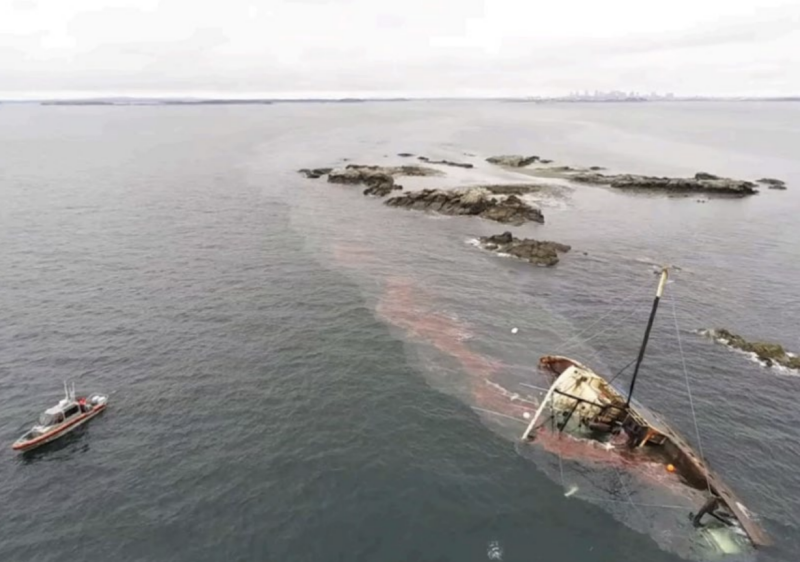
The Eileen Rita was not outfitted with a watch alarm, nor was it required, investigators noted. At 7:31 a.m, the Eileen Rita grounded on Green Island about 8 miles east of Boston. The grounding woke up the captain, who went below to wake up the two deckhands and then put the engines in neutral before backing the Eileen Rita away from the rocks.
The captain went to the engine room and saw water entering a hole in the hull as the boat began to list to port. He retrieved the emergency position indicating radio beacon (EPIRB) and survival suits to prepare to abandon the vessel.
The captain tried to tie off the vessel’s life raft, stored on the port side, but it was the boat was “already going sideways” on the rocks, the captain told investigators. At 7:46 a.m., all crewmembers were in their survival suits, and the captain made a mayday call on VHF channel 16 to the Coast Guard. Not hearing a response, he activated the EPIRB.
The fishermen climbed onto the starboard side of the hull, and at 7:58 a.m., the captain got a call on his cell phone from the Coast Guard, which had gotten his number from the Eillen Rita’s operating company. The Coast Guard launched response boats to the scene, and the Boston Police Harbor Patrol and Boston Pilots also responded.
At 8:27 a.m., a Boston Police Harbor Patrol boat picked up the Eileen Rita crew, who were still standing on the starboard side of the fishing vessel’s hull. Back in Boston at 8:48 a.m., they were evaluated by emergency medical service personnel, and none sustained injuries.
In the days after the grounding, the Eileen Rita came off the rocks and eventually sank. At the time of the grounding, the boat had an estimated 4,000 gallons of diesel fuel and 50 gallons of lube oil on board. The Eileen Rita was later salvaged, but deemed a constructive total loss valued at $720,000.
The captain submitted samples for the testing of alcohol and other drugs, and results were negative, according to the report. In their analysis, investigators concluded the accident was “due to fatigue resulting from an accumulated sleep debt and poor sleep quality in the preceding 48 hours.”
Between April 9 and April 11, the captain reported making three separate fishing trips on the Eileen Rita, totaling 29 hours of fishing. During this time, the captain reported getting a total of 8 hours of sleep, which were broken up into two 2-hour segments and one 4-hour segment, each occurring at different times, the NTSB report states.
“After the grounding, the captain told investigators, ‘I didn’t realize how tired I was … until it was too late.’ The captain estimated that he had fallen asleep about 10 minutes before the grounding.”
A bridge watch alarm may have helped in this case, the investigators noted.
“While not a substitute for a well-rested operator, a watch alarm can help ensure that navigation crewmembers remain awake and vigilant while on watch, especially when operating alone in the wheelhouse.”