
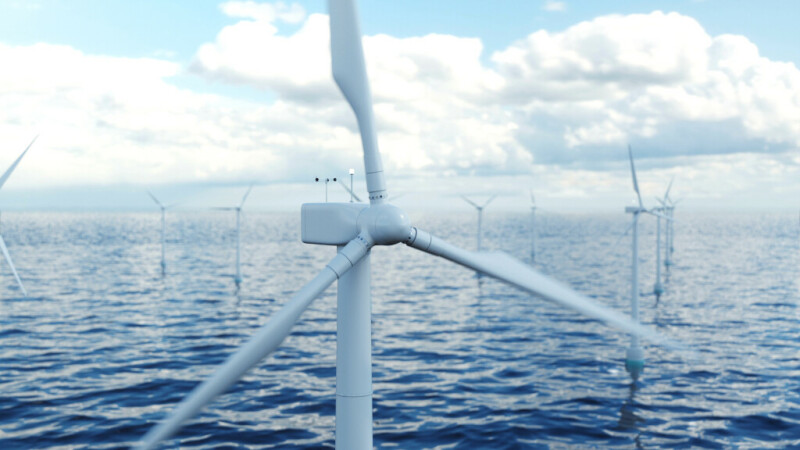
A federal court judge in Massachusetts declared President Trump’s sweeping Jan. 20 order to halt all approvals for wind power projects on federal lands was “arbitrary and capricious” in violation of the law, pushing back on the Trump administration’s campaign to derail the nascent U.S. industry.
In an order late Monday, U.S. District Court Judge Patti B. Saris said the Interior Department had failed to provide a “reasoned explanation” why it has stopped approving wind power projects. Government lawyers merely “candidly concede that the sole factor they considered in deciding to stop issuing permits was the president’s direction to do so,” the judge noted.
The order is another legal volley between renewable energy advocates and the Trump administration. New York State led a coalition of 17 states and the District of Columbia in a lawsuit filed in May challenging the Jan. 20 order.
With five offshore wind turbine arrays under construction, progress has been checkered, with developers cancelling some projects and turbine blade failures at the Vineyard Wind project off Massachusetts. Meanwhile Dominion Energy’s Coastal Virginia Offshore Wind project is progressing, with bipartisan political support in Virginia.
Shutting down wind energy projects was an Inauguration Day priority for Trump, who in 2014 opposed a plan to build wind turbines within sight of a golf club he owned in Scotland. In his 2024 campaign for a second presidential term, Trump avidly courted local opponents of offshore wind projects in East Coast states, promising to shut down projects .
The new court ruling is one more in the ongoing state of play. A September court ruling allowed work to resume at Ørsted’s Revolution Wind project off southern New England, after the Trump administration attempted a full shutdown. The administration’s April shutdown of Equinor’s Empire Wind project off New York was reversed a month later, after negotiations between the Interior Department and New York officials eased barriers to natural gas pipeline projects.
In a statement Monday evening New York Gov. Kathy Hochul said the new court decision “to uphold New York’s nation-leading offshore wind program is a major victory for our state and the entire region. The Trump administration has repeatedly tried to block these projects, risking blackouts and thousands of good-paying jobs. I'll always fight like hell to protect New Yorkers — today's decision shows that fight matters.”
Wind power advocates welcomed the court ruling after months of the Trump administration’s opposition campaign.
“Today’s decision is welcome news, not just for the thousands of American workers and businesses across 40 states supporting offshore wind in the U.S., but also for the critical relief the wind industry will provide to lower skyrocketing electricity prices for millions of American families with reliable, affordable power,” said Liz Burdock, CEO and executive director of the Oceantic Network advocacy group.
“Overturning the unlawful blanket halt to offshore wind permitting activities is needed to achieve our nation’s energy and economic priorities of bringing more power online quickly, improving grid reliability, and driving billions of new American steel manufacturing and shipbuilding investments,” said Burdock.
Commercial fishing advocates with the Responsible Offshore Development Alliance said they still support Trump’s order “to pause the identification of new areas for offshore wind leasing on the Outer Continental Shelf. A measured pause provides a crucial opportunity to improve scientific baseline data, evaluate the pace and scale of offshore wind development, and ensure robust and transparent engagement with the fishing communities who are most directly affected.”
“Although we are disappointed in the Court’s ruling, we urge federal and state decision-makers to move forward with meaningful dialogue and collaboration,” RODA said in a social media posting Dec. 9. “The fishing industry and coastal communities must have a substantive role in evaluating the cumulative impacts of offshore wind development and determining whether projects are compatible with local priorities.”
“As a fisherman who has witnessed the effects of offshore wind on our ocean and the risks it poses to coastal communities and fishermen, yesterday’s ruling is deeply disappointing,” said Aaron Williams, president of the New England Fishermen’s Stewardship Association.
“President Trump’s decision to halt offshore wind projects reflected a commitment to responsible ocean management, overturning that decision is a step backward in defending our oceans and the working waterfront,” said Williams.
The BlueGreen Alliance, a coalition of labor and environmental groups, saw the ruling as a long-sought reprieve from the Trump administration’s campaign.
“Yesterday’s ruling provides relief to dozens of projects that are creating good jobs around the country and planning thousands of megawatts of clean energy for communities,” said Katie Harris, the alliance vice president for federal affairs.
“Offshore wind is already delivering clean, affordable power to the nation’s electric grid, and we need more to help keep electricity prices affordable. Its potential could be a game changer for clean energy in the United States, but the administration keeps interfering in its progress.”