

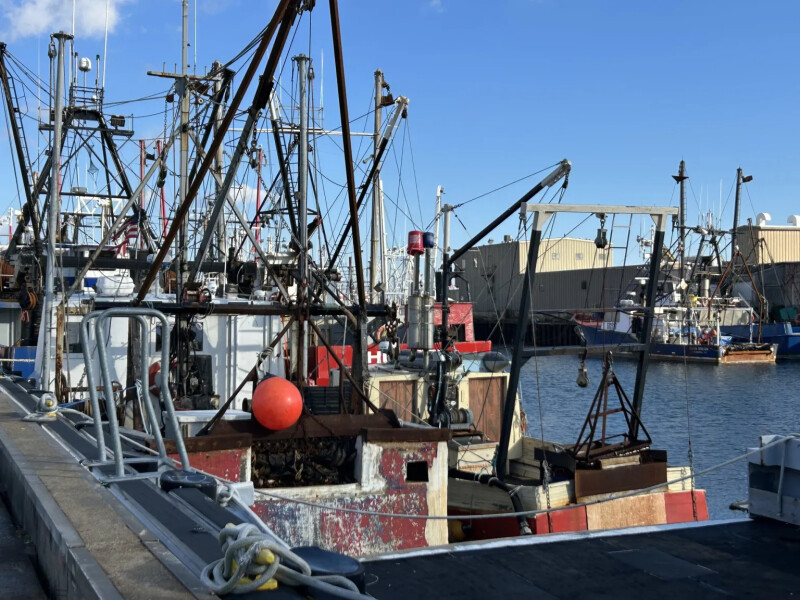
To walk down New Bedford’s Pier 3 is to view a time capsule of the historic fishing town, memorialized not just by plaques and monuments but by the decades-old, rusted trawlers parked stern to stern on the cramped commercial harbor.
By design, these boats spend more time tied up at the docks than they do on the open ocean. Some scallopers are trying to put them back on the water.
“You wouldn’t dare keep a plane grounded for 30, 40, or 300-plus days,” New Bedford scallop vessel manager and owner Tony Alvernaz said. “Boats are no different.”
For decades, scalloping permits have been tied to individual vessels, while regulations limit the number of days a particular boat can spend at sea. Now, a new proposal would allow owners of two or more boats to “stack” their scalloping permits on a single boat. With permit-stacking, a crew could take multiple trips on one vessel, and the boats’ owner could either sell or refurbish the oldest members of their fleet. Permit-stacking already exists in other fisheries, but for decades it has languished among scallopers, who fear stacking could lead to further industry consolidation.
In October, New Bedford Mayor Jon Mitchell penned a letter to the National Oceanic and Atmospheric Administration expressing early support for the new proposal to allow permit-stacking in scallop fisheries.
“Even the casual observer can’t help but notice that we have lots of boats in the dock,” Mitchell told The Light in an interview. “It’s pretty crowded, and so people wonder, ‘Well, why are they all there?’ Part of the answer is, ‘Well, they don’t fish all that much.’”
Mitchell’s endorsement of scallop permit-stacking contrasts with his position on a similar question three years ago.
In 2022, the New England Fisheries Management Council overwhelmingly struck down a similar proposal that would have allowed scallop permit holders to lease their scalloping permits to other vessel owners, essentially “stacking” multiple permits on a temporary basis.
Critics at the time worried that leasing would lead to greater industry consolidation as larger ventures bought up licenses, crowding out independent scallopers. Others worried that vessel owners would pass down the additional costs of leasing to their crews, as had already happened in the groundfish industry.
Mitchell was among those strongly opposed to the 2022 leasing proposal, traveling two hours to the Council meeting in Gloucester to speak out against it.
“This is at least the third time in the last decade that the largest ownership interests in the scallop industry have urged the Council to undo the bedrock one-boat-one-permit rule to reduce costs and increase profits,” Mitchell said in his 2022 testimony. “I oppose the proposal because it will inevitably lead to consolidation in the industry, and thereby reduce the industry’s workforce and lower demand for shore side services.”
What changed in three years? For one, the future of the scallop industry looks very different now than it did three years ago.
The 2022 leasing proposal came during a marked boom period for New Bedford scallopers. Three years later, scallop numbers have plummeted far below the brief heyday experienced in 2022, let alone the industry’s glory days of single-boat owner-operators in the 1990s. A growing starfish population — one of the sea scallop’s main predators — and overly optimistic resource management are the main causes of the scallop decline.
Under current conditions, the boats at Pier 3 will spend over 300 days of the next year at the docks, fishing for fewer days to catch fewer shellfish.
In his October letter, Mitchell outlined what he felt was different about the current proposal and why he was less concerned about consolidation under the new stipulations. His main concern, he said, was that the current situation — boats lined up rafted one against another — was untenable.
Rusty boats and waterfront real estate
Since 1994, scallopers have operated under tight regulations meant to prevent overfishing. Rules limit the amount of scallops each permit holder can harvest per trip and the number of trips each vessel can take. Facing a dwindling scallop population, the NEFMC earlier this year adopted some of the most stringent regulations yet for the 2025-2026 season.
Under the new framework, scalloping vessels can take only two total trips per year to approved scalloping access areas, one trip per area, compared to three total trips allowed in 2024. The framework does, however, increase the number of days scallopers can spend at sea scouring the open ocean floor from 20 to 24.
But even without these specific regulations, long voyages aren’t necessary to capture the same amount of scallops.
“The fishermen are a lot more efficient than they used to be,” Mitchell said. “The gear is better, the tracking, the geospatial technology is better. The data they work with is better. So it’s not likely that they’re going to go back to where they were in the ’90s, when sometimes they would go out for over 200 days a year.”
Drew Minkiewicz is an attorney for the Sustainable Scalloping Fund, the latest organization to back permit-stacking as a solution to underutilized vessels.
Three years ago, the region’s largest scalloping operations supported leasing, while small independent scallopers largely opposed it. There are several key distinctions between the 2022 leasing proposal and what’s being entertained now, Minkiewicz says.
Unlike the leasing proposal struck down in 2022, the current permit-stacking proposal would limit permit sharing to just two permits per boat, provided that each boat is similarly sized and shares the same owner. Keeping the permits between the same boat owner also eliminates some of the concerns fishermen had before about leasing, Minkiewicz said. In the groundfish industry, corporations sometimes recoup operational costs by nickel-and-diming their own crews, charging them for expenses such as fishing gear, fuel, boat maintenance — and leases of fishing rights.
“There’s no financial transaction to pass along in the case of stacking,” Minkiewicz said.
Under the current model, boat owners are incentivized to hold onto every boat they own because it’s tied to a permit, even if that boat may not necessarily be the most seaworthy. If permit-stacking passed, Minkiewicz argued that boat owners could also finally retire their older vessels, improving safety conditions for their crews and clearing up the harbor. Abandoned vessels are a problem in New Bedford Harbor, Mitchell said, and unlike houses, the city can’t just repossess an orphan boat.
“You’re stuck with a vessel on the dock with no recourse to anybody else,” Mitchell said. “They’ve stopped paying their bills, they’ve abandoned it. It’s just a big piece of steel sitting there.”
Another big difference between permit-stacking and leasing, Minkiewicz added, is how the conversation around each issue started. Minkiewicz said that much of the public opposition to leasing came from the lack of public engagement around the issue.
“Quite frankly, [in the] last go-around, proponents of leasing went right to D.C. with a fix and said they were going to do leasing, and that really rubbed the mayor and a lot of the local politicians the wrong way,” Minkiewicz said. “They felt they were left out of the loop, that their opinion wasn’t sought after or well-regarded. So we made sure we didn’t do that again.”
Jeff Pike is a former commercial fisherman and a Washington, D.C., lobbyist behind the Scallopers Campaign, the organization that pushed for the 2022 leasing proposal. According to Pike, the opposition to leasing three years ago was entirely political — and he wasn’t surprised to see fishermen and elected officials like Mitchell coalesce around a similar proposal now.
“I wanted to write the mayor a letter saying, ‘I knew you would see things my way. And now you’ve finally admitted it,’” Pike said.
‘I’m still fearful’
Even with these adjustments, some scallopers remain wary of permit-stacking’s potential impacts on smaller, independent fishermen.
Captain Tyler Miranda strongly opposed the leasing proposal in 2022 on grounds that it would lead to further industry consolidation and added fees for crews, as it had done in the groundfish industry. In his mind, permit-stacking is no different.
“If there’s a dollar amount, like a transaction for a permit, I just think inevitably, at some point, the crew’s gonna pay for that,” Miranda said.
Miranda added that he didn’t believe fishermen should adopt new regulations purely based on financial interests. The focus, he said, should always be on the resource — the scallops and their habitat.
“This has nothing to do with the resource at all,” Miranda said. “This is 100 percent financially motivated.”
Mitchell acknowledged that any new rule should come with a lengthy monitoring period, so advocates can’t push for greater flexibility without understanding its impacts. As far as the idea that his interests are financially motivated, Mitchell agreed.
“It’s all grounded in financial interests,” Mitchell said. “That’s baked into the Magnuson-Stevens Act, that Congress and the Fisheries Council have to consider the businesses of fishing themselves, and the ports and the communities.… There’s nothing untoward about that.”
Paul Weckesser owns five commercial scallopers, a fish house and a shipyard fabrication shop in New Bedford. He and his daughter, Shauna Weckesser, who joined the family business in 2019, both oppose permit-stacking for similar reasons as Miranda does.
“I don’t know what the problem is, but we clearly have a problem with the resource,” Shauna Weckesser said. “Stacking is not the answer to that problem.”
In lieu of permit-stacking, both Miranda and Weckesser said the Council should be looking into smarter resource management solutions to account for the projected next few years of low scallop numbers. Some scallopers have looked to reopen historic scalloping grounds on the northernmost edge of Georges Bank to provide some relief while the scallop population flatlines, a measure Mitchell also supports.
Kevin Stokesbury, the dean of the University of Massachusetts Dartmouth’s School for Marine Science and Technology, has spent decades studying marine fishes, including the Atlantic sea scallop. His research has led him to advocate for a form of fisheries management that takes into account the entire ecosystem. (He does not recommend reopening the closed portion of Georges Bank at this time.)
For example, both the 2021-2022 boom in harvestable scallops and the most recent lean years are related to the starfish populations in scallop fisheries, Stokesbury said. Starfish eat sea scallops, and several years ago, their numbers declined due to a sudden illness, causing scallops to proliferate. Now, the starfish have recovered from their plague, and found their top food source to be more plentiful than ever. Feasting on scallops, starfish have rebounded stronger than before.
Current fisheries management doesn’t take into account starfish or other links in the food chain, however, and only looks at the sea scallop in isolation, Stokesbury said. This approach can lead to overly optimistic catch limits that further deplete the scallop population.
But Stokesbury doesn’t have a solution for the new era of tough scalloping. Permit-stacking, he admitted, likely wouldn’t impact the resource itself very much.
“The argument against [permit-stacking] is that it’s going to reduce employment,” Stokesbury said. “Employment is going to be reduced anyway.”
This article is republished with permission from The New Bedford Light. Read more here.