




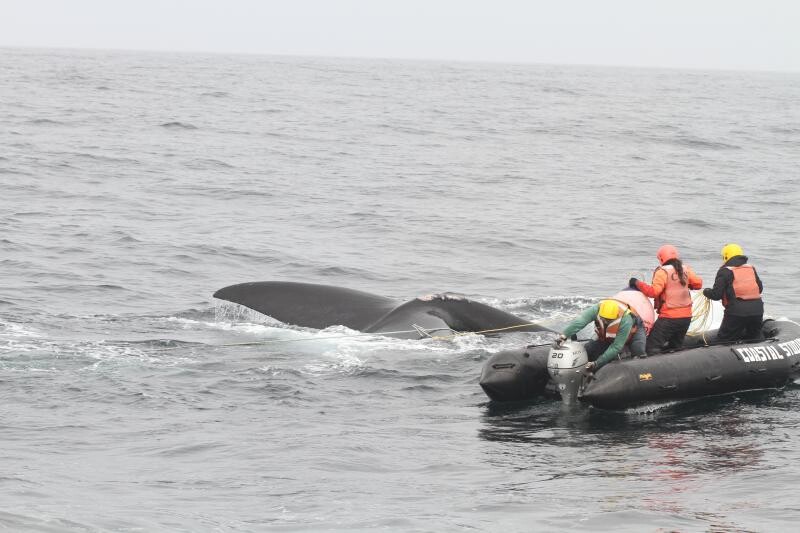
Entanglement in fishing gear or marine debris ensnared 64 large whales in U.S. waters during 2023, below the average annual number of cases in recent years but not yet a clear trend, the National Marine Fisheries Service reported.
The National Report on Large Whale Entanglements Confirmed in the United States in 2023 notes the 64 confirmed large whale entanglement cases nationally was less than 67 confirmed large whale entanglement cases in 2022.
“It is also below the average annual number of confirmed entanglements over the previous 16 years (which was 71.8),” according to a July 28 summary from the agency. “We will continue to analyze data from 2023 to understand whether this dip is temporary or part of a longer-term downward trend.”
Along with ship strikes, entanglements are a threat to individual whales and threatened or endangered species, such as the North Atlantic right whale with a population now estimated at only around 370 animals.
Reducing that danger to meet NMFS’ mandates under the Marine Mammal Protection Act drives management actions on the East, Gulf and West coasts, including changes to fishing seasons, gear restrictions and efforts to develop and test so-called ropeless gear in fisheries.
According to a NMFS breakdown of 2023 confirmed entanglement cases, 61 cases or 95 percent involved live animals, and three were whales found dead and floating when initially reported. The 2023 cases were lower than the average annual number of 71.8 confirmed entanglements from 2007–2022.
Four species of large whales were documented with 2023 entanglements in U.S. waters: humpback whales, gray whales, minke whale and North Atlantic right whales.
“Humpback whales continued to be the most frequently reported entangled large whale species and represent more than 69 percent of all confirmed large whale entanglements since 2007,” the report notes.
The 2023 entanglements were first reported and confirmed off the coast of 11 states. More than 77 percent of all confirmed live whale entanglement reports were observed off the coast of four states:
• 26.6 percent off the coast of California
• 23.4 percent off the coast of Massachusetts
• 17.2 percent off the coast of Alaska
• 9.4 percent off the coast of New Jersey.
Some 50 percent of confirmed cases in 2023 involved commercial or recreational fishing gear, according to NMFS.
“Although various marine industries add gear into the ocean, one of the most common sources of line is commercial or recreational fishing. Therefore, it is likely some of the cases involving only line that could not be identified to a specific source were related to fishing activities,” the report said.

 (1).jpg.small.400x400.jpg)
