Together, New Zealand scientists and fishermen have created the FloMo – a net that’s easy on the fish
“It was because the regulations are using mesh size and our system, FloMo, doesn’t have meshes,” says André Pinkert, general manager commercial of FloMo. “Precision Seafood Harvesting started working on this in 2012, and it took until 2024 for FloMo to be approved for fishing for the majority of species and areas in New Zealand.”
As Pinkert describes it, the FloMo system replaces the traditional mesh extension and cod end, with dramatic results.
“It started as a partnership between the government and three fishing companies,” he says. “Initially, the goal was to improve the quality of the fish, but we discovered that it can offer additional benefits in terms of survivability and selectivity.”
Unlike the typical nets used since trawling was invented in the late 1800s, the FloMo system does not have mesh.
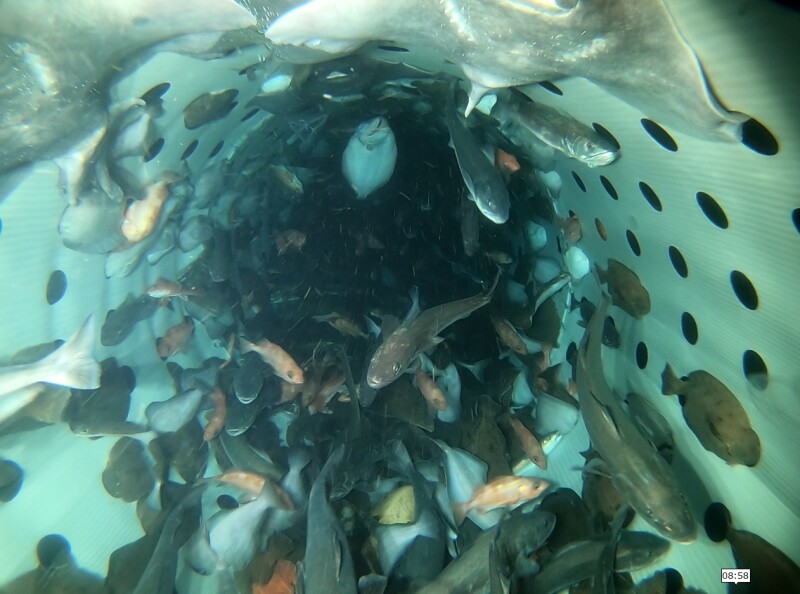
“Instead, what we have is a long tube of composite material that creates a laminar flow. At the front, the water is moving into the FloMo at boat speed and decreases as you move further back until the fish in the cod end are swimming in an aquarium-like environment. The extension has holes in it that the smaller fish can escape from, and because it’s not a stress situation where they’re squeezing out through meshes, we believe there’s less of what’s called cryptic mortality – the fish that die after getting out of the net. It’s hard to say, but the fish we see escaping the FloMo are less damaged, and that increases their chance of survival.”
“The fish swim naturally in the FloMo and are not building up lactic acid in their flesh or rubbing against each other or the sides of the net,” Pinkert says.
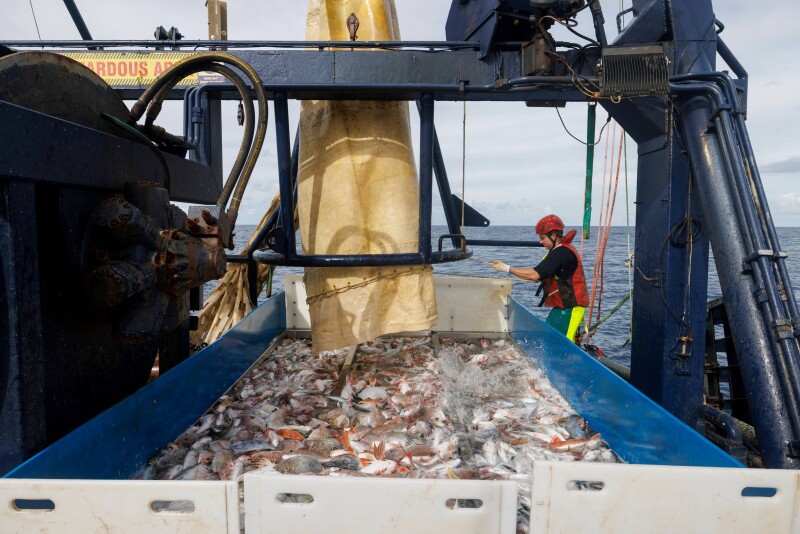
Fish caught in the FloMo net are not getting crushed or squeezed, Pinkert notes, and when they come aboard, they are still flapping and not bruised and bleeding.
“This means the fillets are a higher quality,” he says. “And while we have heard that they have a longer shelf life, that depends on how they are handled all through the supply chain, and we don’t have any control over that. What we can say is that the fish coming out of the cod end are the highest quality trawl-caught fish.”
After more than 10,000 test tows, the scientists at Precision Seafood realized that the behavior of fish in the FloMo varied according to species and could be used to improve the gear’s selectivity.
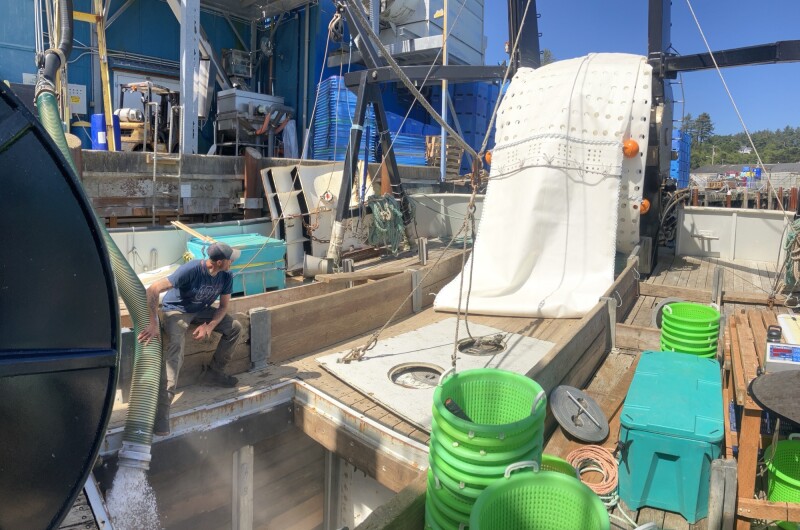
“The stronger fish swim at the front where the water is moving fastest. The slower fish swim further back. Some species in that situation tend to swim up, others swim down, or off to the sides. We determined that there were three parameters we could control that would affect selectivity: the size, the geometry, and the position of the holes.”
“We could vary those depending on the behavior of the species that we want to allow to escape. Size selectivity is obvious, but we also found the shape of the hole could affect escapes, and if we want to reduce bycatch of a fish that swims up towards the top of the net, for example, then we put more holes up there.”
In New Zealand, fishermen are forbidden to dump quota fish species from their nets unless they are undersized. “But our fishermen using FloMo, because the fish in the net are in good shape, are allowed to open the net and let the catch go if they get a protected species, such as a dolphin or a turtle in there,” says Pinkert.
“In the future, because the fish are alive at depth, we hope regulations will allow that if the fisher sees a lot of what they don’t want or don’t have quota for, they can open the bag and let them go.”
Pinkert points out corollary evidence that snapper escaping the FloMo unharmed may be bolstering stock recovery.
“Right now, the snapper stocks are booming up around the North Island, and that happens to be where FloMo boats have been working for years now. There’s no scientific evidence, but it’s interesting,” he says.
“The FloMo system may help the industry address the animal welfare concerns, because the fish in the back of the net are just swimming along, not getting stressed or damaged,” adds Rossiter. “And what we’re finding is that protecting the welfare of the fish also protects the quality, so we’re landing a better fish.”
To get eyes on what is going into the net, FloMo is working with the UK company CatchCam. “FloMo is revolutionary,” says CatchCam CEO Tom Rossiter. “When I was fishing, we never would have conceived of it.”
“We’re working on an acoustic camera for the FloMo that would be positioned in the extension just ahead of the cod end, looking back,” Rossiter says. “The captain would get images every 20 or 30 seconds, and if he sees something he doesn’t like, he can push a button that opens the cod end.”
Rossiter says in the future, CatchCam could be tied in with an artificial intelligence system designed by SnapCore, a New Zealand tech company.
In its current iteration, the captain interprets the images from the CatchCam camera and makes the decision whether or not to push the button. “But in the future, the Snap AI may be able to make the decision and open the net automatically,” notes Rossiter.
While it took some time to get the gear permitted in New Zealand, Precision Seafood has been working on partnerships all over the world. “In the U.S., we’re working with people in the Pacific Northwest, because their regulations aren’t based on mesh size,” says Pinkert.
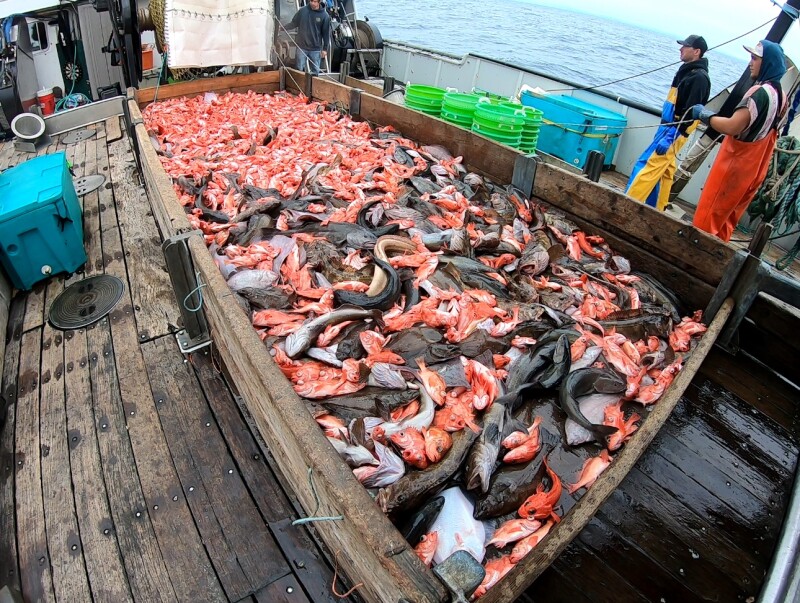
The 83-foot groundfish vessel Last Straw out of Newport, Ore., spent 12 days testing FloMo, according to Martin de Beer, general manager of operations at Precision Seafood.
“They really don’t need to change anything to use the FloMo,” says de Beer. “The only limitation is the lifting capacity of the vessel, as we look to match the capacity of the liftbag to the standard bag weight caught when using a mesh cod end. However, with FloMo, we recommend bringing the liftbag, or cod end, aboard with 50 percent water, 50 percent fish. If you’re used to bringing three tons aboard, you’re either going to bring six tons of water and fish, if you have the lifting capacity, or maybe one and a half tons of fish and a ton and a half of water.”
As de Beer explains, the possibility of getting bycatch back in the water alive depends on how the fish are handled.
“We can only promise to get the highest quality fish to the back of the boat,” he says. “After that, it depends on how you handle them. On the Last Straw, they handled the fish the same way they handled them with a regular net. They let most of the water drain out and then opened the lift bag on deck. On some of our New Zealand boats, they empty the lift bag into a wet tank, which gives you more time to pick out the small fish and unwanted species, and they’re more likely to survive when returned to the sea.”
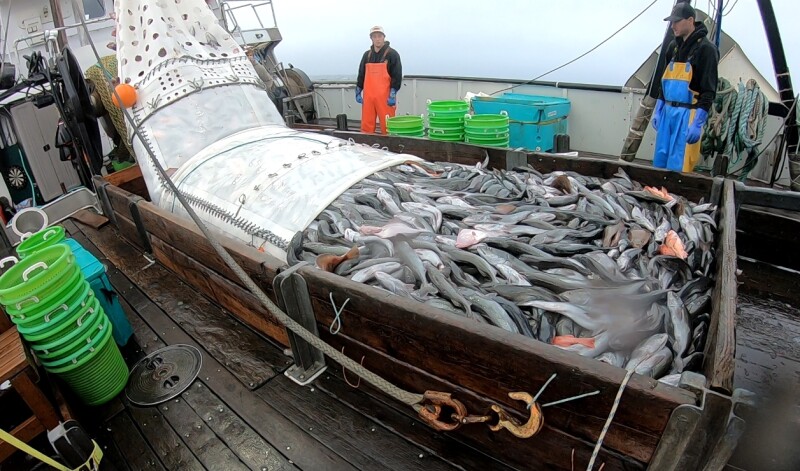
In terms of durability, the FloMo is made from a tough Kevlar-like material. “Ultra-high molecular weight polyethylene,” says de Beer. “We have boats that have been using the same gear for four years, but I wouldn’t recommend that. The lift bag should last a year or more. We find it floats more than a mesh cod end, and we don’t need to put chafing gear on it.”
De Beer adds that New Zealand fishermen worked with the scientists to develop the FloMo. “Their feedback was vital,” he says. “Especially at the beginning. And now the ones who are using it don’t want to go back to the old nets.”
Fishermen testing the FloMo in the UK found it much easier to work with than they expected, according to Tom Rossiter.
“We had some concerns about the weight of the water and free surface effect when we opened the cod end,” he says. “But the weight of the water and fish coming aboard is the same as a full cod end, it’s just more water and less fish, and it didn’t seem to make any difference on our boats.”
Pinkert notes that the FloMo can lead to better fuel efficiency. “What some fishermen are telling us is that they can reduce their towing speed, and actually burn less fuel,” he says.