

Of $31.2 billion in grants awarded by the U.S. Department of Agriculture’s marketing service during 2018 to 2023, $261.7 million went to seafood-related projects – just 0.5 percent of all USDA funding for food supply investments.
A research team recently published those findings in the journal Frontiers in Sustainable Food Systems, titled Fish, funding, and food systems: a review of the U.S. Department of Agriculture’s recent history of grant funding in support of the seafood sector (2018-2023). The authors call the study “the first empirical study looking at the USDA’s
The authors wrote that they found is no single explanation for why seafood projects gets such a small fraction of USDA grant funding, compared to other U.S. food production sectors. But they did find “numerous opportunities for increasing the USDA’s investment in American seafood.”
The research was funded by the Alaska Sustainable Fisheries Trust (ASFT), as part of a larger
“Alaska’s fishermen harvest some of the healthiest and highest quality food on the planet and
To conduct the study, the Alaska Sustainable Fisheries Trust brought in assistant professor Joshua Stoll and his team at the
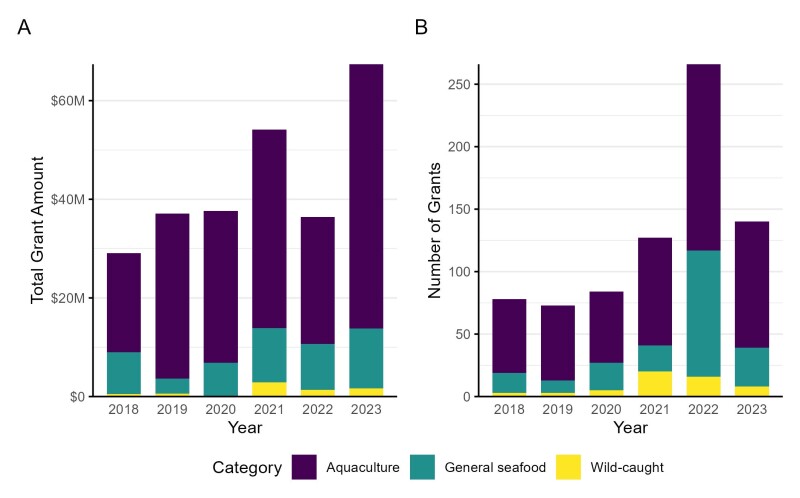
For the funding analysis, Stoll’sgroup reviewed USDA funding data from 2018-2023 and created a special coding
Of that total, only 768 grants of $261.7 million were awarded to seafood-related projects, while while
Other findings from their analysis showed:
– USDA funding was primarily directed at production-related activities in the supply
– Businesses were the most commonly funded entities (53 percent) followed by universities (32 percent).
– Maine, Washington, Alaska, and Mississippi received the most seafood-related grants, while Maryland, Washington, and Maine received the most funding in terms of dollar value.
– USDA grant funding increased by 161.5 percent between 2018-2023, while the number
The researchers conducted15 interviews with 19 people, representing 18 USDA grants that
were focused on fisheries and aquaculture. The interviews helped single out common problems facing seafood projects, including what seafood is eligible for USDA grants, wild capture fisheries that are not eligible, “misalignment between grant requirements and fishing practices, and misinformation within the USDA about the seafood sector and how it functions.”
"The purpose of our analysis was to help inform broader discussions about seafood and its role in our nation’s food systems. There continues to be a lot of uncertainty around when, if, and howthe seafood sector can access USDA funding, and our work brings attention to some of the real and perceived barriers that exist,” said professor Stoll, at the University of Maine.
“Finding ways to strengthen our country’s fishing and seafood industry, while also building more vibrant food systems, has the potential to benefit everyone.”
Sponsors of the study are working with members of Congress to make the USDA programs and funding more accessible to the seafood sector. Sen. Dan Sullivan, R-Alaska, in 2023 introduced the National Seafood Supply Act of 2023, which would establish an Office of Seafood Policy and Program Integration at the USDA. In June 2025, Sen. Lisa Murkowski, R-Alaska, and Sens. Susan Collins, R-Maine, and Angus King, I-Maine, reintroduced the Working Waterfronts Act
“We hope that this new information will help advance the Trump Administration’s commitment to