




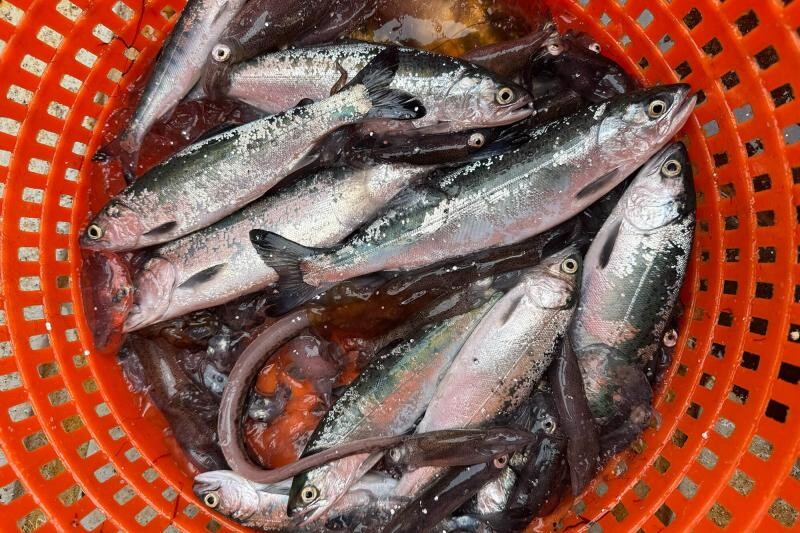
Juvenile salmon experienced a mix of favorable and challenging ocean conditions off the West Coast in 2025, according to an annual analysis by NOAA Fisheries and Oregon State University researchers.
The analysis evaluates 16 ocean indicators that describe conditions juvenile salmon encounter during their first months at sea, a critical period for growth and survival. The indicators include measures of temperature, salinity, and the quantity and quality of prey available to young fish as they attempt to grow quickly enough to avoid predators.
Researchers have refined the indicators through decades of monitoring to help fishery managers anticipate how many juvenile salmon are likely to survive and return as adults in future years. Those projections inform management decisions affecting recreational, commercial, and tribal fisheries that contribute millions of dollars to coastal economies.
Warmer ocean conditions leading into last winter suggested that juvenile salmon entering the ocean in spring 2025 would encounter less abundant prey dominated by species historically associated with lower survival. Seasonal upwelling of cold, nutrient-rich water began strongly in the spring, typically a positive signal for salmon, and sampling in June showed the highest abundance of juvenile coho salmon observed across all survey years. The upwelling weakened in July, however, resulting in overall ocean conditions that ranged from good to moderate for physical and biological indicators.
Researchers reported poor food-related indicators during winter, a cool start to summer, and weakened winds later in the season. Taken together, those contrasting signals point to a moderate outlook for salmon survival. The combined indicators for 2025 ranked near the midpoint between the strongest and weakest years on record, conditions that historically have produced modest marine survival and adult salmon returns.
“The start to the upwelling season in 2025 looked favorable for a highly productive year to come,” said Jennifer Fisher, a research fisheries biologist at the Northwest Fisheries Science Center’s Newport Research Station. “However, the upwelling winds weakened mid-summer, crustaceans (like krill) were scarce, and jellies were abundant. These are all signs of low productivity and poor habitat for many species, including juvenile salmon.”
The indicators are based primarily on data collected off the Oregon Coast and are most relevant to Northwest salmon stocks, though gradual changes in ocean conditions mean the findings can also provide insight into conditions affecting salmon along the broader West Coast, according to Brian Burke, a research scientist at the Science Center.
The Newport Research Station team monitors ocean conditions along the Newport Hydrographic Line, one of the longest and most detailed records of ocean change on the West Coast. Scientists have surveyed the line twice a month for 28 years, weather permitting, building a dataset that reveals long-term patterns and links between ocean conditions and salmon survival.
The 16 indicators tracked by the team include seawater temperature, salinity, the availability of potential fish prey for outmigrating juvenile salmon, the number and types of copepods that reflect habitat quality at ocean entry, and catches of juvenile coho and Chinook salmon. “These indicators track the ecosystem health, so we can often connect that with salmon survival when they are the most vulnerable, when they first enter the ocean habitat” Fisher said. “Right now, the signals are mixed, reminding us how important it is to continually track ocean conditions and try to understand the mechanistic linkages between ocean conditions and juvenile salmon survival.”
.jpg.small.400x400.jpg)
