Virginia holds the distinction of being the largest East Coast state for seafood catch volume and the third-largest producer of marine products in the nation, surpassed only by Alaska and Louisiana.
This is largely tied to Reedville, Va. having historically been the fifth largest “volume of catch” commercial fishing port in the United States, and home to Omega Protein, Inc. and its fishing partner Ocean Harvesters.
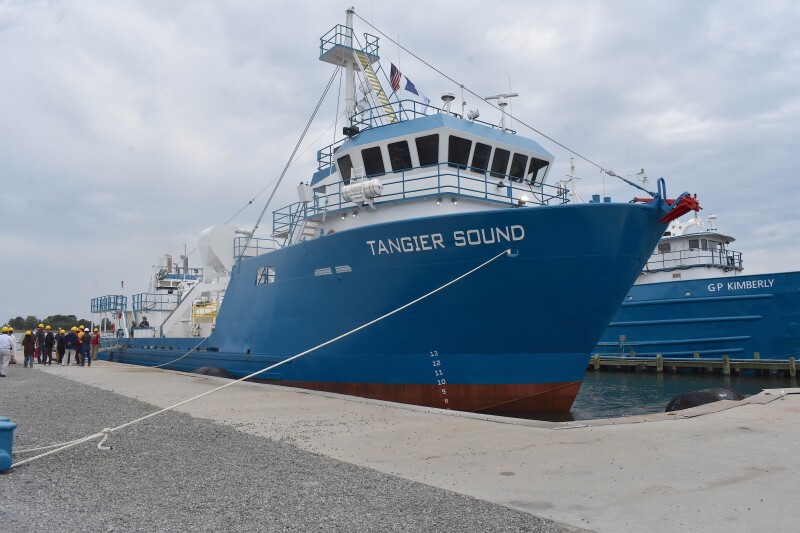
The recent news that Ocean Harvesters is adding a $9 million menhaden vessel, the 165-foot F/V Tangier Sound, to its fishing fleet is sending a message that Ocean Harvesters, Omega Protein Inc. and Canadian parent company Cooke Inc. plan on fishing in the bay region well into the future.
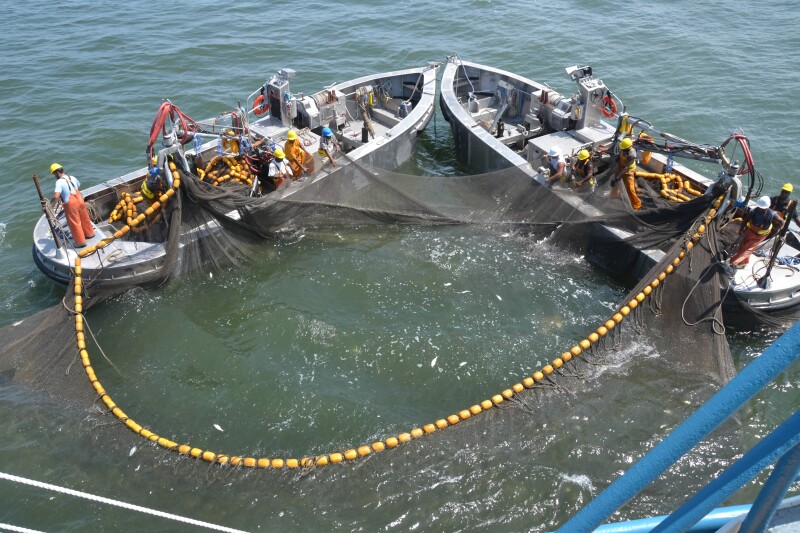
The company has been dodging a barrage of opposition up and down the East Coast, ranging from Maryland 5th graders writing letters to the firm to “stop killing ospreys," to opponents throwing blocks into nets. Tactics have included a jet skier interrupting net sets, protest boats attempting to block the fishermen, and environmental groups alleging that overfishing of menhaden is depleting osprey and striped bass populations.
A lawsuit in federal court for the Southern District of New York alleging that Cooke Inc. had been illegally fishing in U.S. waters because the boats are owned by a Canadian firm was dismissed in January 2025, allowing Ocean Harvesters to continue to fish.
The jet ski incident occurred in September 2023 and brought national attention to the debate, prompting Virginia legislators to pass a “right to fish” law to protect menhaden crews and commercial fishing watermen from harassment.
During a Sept. 15 tour of Omega Protein’s fish meal and oil plants and the new vessel, including a 45-minute ride on Tangier Sound and a three-hour classroom style seminar, Ocean Harvesters defended why reduction menhaden fishing should continue on Chesapeake Bay.
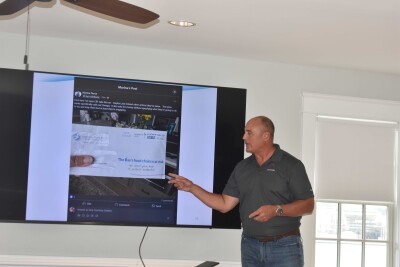
Ocean Harvesters’ CEO Monty Diehl addressed each issue with detailed graphic presentations aimed at countering growing opposition from environmental groups such as the Chesapeake Bay Foundation, as well as a swelling waterfront population whose changing demographics have no ties to the bay’s seafood or maritime culture.
Virginia has a small purse net bait recreational fishery that catches menhaden as well as the larger “reduction” fishery, so named because of how its catch is processed for omega fish oils, meal and related products. It is the only large menhaden reduction fishery remaining on the East Coast. The reduction fishery was founded in 1867 by Elijah Reed who brought the modern day pogy (menhaden) fishery to Virginia from Brooklin, Maine. Reedville is named after Elijah Reed and a monument in the town square memorializes that history.
The company
Omega Protein Inc. is a menhaden reduction fishery composed of fish plants in Reedville, Abbeville, La., and Moss Point, Miss. The company also owns Omega Shipyard in Moss Point. On the Chesapeake and Gulf, Omega Protein recently harvested 437,000 metric tons of menhaden; produced 40,000 metric tons of fish oil; 135,000 short tons of fish meal; and generated $300 million in sales.
Omega Protein was publicly owned and traded until December 2017 when Cooke Inc. (also known as Cooke Seafood or Cooke Aquaculture), out of Saint John, New Brunswick bought the company. Cooke Inc. also owns and operates one of the largest salmon aquaculture businesses in the world and bought Omega primarily because of the high protein fish meal component used as a supplemental food source to grow salmon, swine, poultry, etc. said Diehl.
Ocean Harvesters, the company that owns and fishes the boats at Reedville, has nine large vessels, six of which are “fish steamers” that annually harvest 156,000 metric tons of menhaden (51,000 metric tons from Chesapeake Bay), yielding 8,000 metric tons of fish oil and 40,000 short tons of fish meal.
Omega Protein is one of the largest private employers and the largest minority employer in the Virginia Down Neck region, with an “overwhelmingly” multi-generational employee workforce, said Diehl.
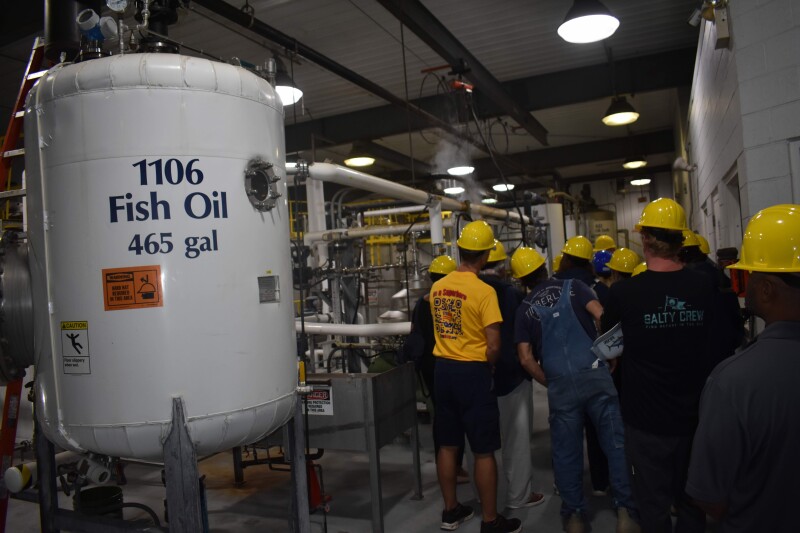
The company employs six spotter airplane pilots, 260 Omega employees and 250 indirect employees from outside companies and individuals who do work for the firm. Diehl reported the company has a $29 million annual payroll, including benefit packages, and makes a $100 million economic impact on Virginia’s Northern Neck and Middle Peninsula. Starting entry level pay, currently $17 an hour, will be $18 an hour as of January 1, Diehl said, and fishermen who work the purse boats seven months out of the year earn an average income of $70,000 plus benefits.
Mitigation
Efforts by environmentalists, advocates and waterfront landowners to push the menhaden fishery out of Chesapeake Bay has escalated over the last five years. There has been public outcry when torn nets result in dead fish floating up on shore, and allegations of kills and pollution whether the fishery is involved or not.
A recent Facebook post noting public anger towards Omega stated, “Welcome to all the tourists who came to Virginia Beach to enjoy Labor Day weekend! Unfortunately, you cannot go swimming at the beach because our Virginia Marine Resources Commission and Virginia Beach City Government allowed Canadian owned Omega Protein to pollute the waters off our coast.”
After conflicts escalated between the fishery and recreational users of the bay, Omega agreed in 2023 to stay one mile off populated areas from Tangier Sound to the Chesapeake Bay Bridge Tunnel on Eastern Shore, and from Hampton down to Sandbridge Pier on the western shore; to not fish on weekends between Memorial Day and Labor Day; and to stay 1/2 mile away from the Bay Bridge Tunnel.
Many opponents want the fishery to be limited to the Atlantic Ocean. Presenting reasons to continue fishing the bay, Diehl said menhaden schools stay close to shore and 75 percent of the catch is taken within visual range of the shoreline. If the fishery were required to work exclusively in the ocean, it would greatly limit profitability, Diehl noted.
He also said the company's boats and equipment are not designed to work in sea conditions with wave heights over three feet. “Any time there are three-foot ocean seas and over it becomes a safety hazard for our crews and we do not fish,” he said. “The Chesapeake Bay provides safer and more dependable sea conditions for our boats to fish.”
Diehl said the company has established a mitigation program to defuse some of the opposition. The program includes the following proposals:
• Fish in the ocean when weather and fishing conditions allow
• Avoid high risk areas and known hazards that can cause net tears and fish spills
• Purchase new nets annually at $75,000 apiece
• Notify Virginia Marine Resources Commission (VMRC) of any suspected fish spills
• Develop ‘skimmer’ capability to capture floating dead fish close to shore
• Have an environmental contractor on standby
• Monitor any fish spill areas up to four days after cleanup and report to VMRC
• Clean up any fish which reach shore
• Reach out to impacted landowners
Ospreys
Environmental advocates say the fishery is depleting the menhaden stock and starving the bay’s osprey population, which eat menhaden. Diehl used recent United States Geological Survey (USGS) science data to show that fish species consumed by ospreys depend on where the birds feed and nest. According to a USGS graphic, catfish are the fish hawks’ primary source of food in the Susquehanna River and upper Chesapeake Bay estuarine areas, and spotted sea trout, Atlantic menhaden and Atlantic croaker, in that order, are their primary foods in the lower Bay estuarine areas.
“Ospreys do not just feed on menhaden,” said Diehl.
Diehl argued that a recent study on ospreys by Bryan Watts, director of the Center for Conservation Biology at The College of William & Mary, suggesting that the osprey population on Mobjack Bay is depleted because of low numbers of Atlantic menhaden is “skewed and inaccurate.” Ocean Harvesters’ boats do not fish anywhere near Mobjack Bay, Diehl added.
Diehl quoted Virginia Institute of Marine Science fisheries scientist Rob Latour:
“To my knowledge his (Watts) work did not involve . . . menhaden data, or on anything regarding fisheries management. I think it’s a linkage that he made, and I don’t think it can be validated, so we’ve spoke with him about that. We’re trying to work on developing collaborative ideas and better exchange; but my take is we can’t answer the question if management has failed the osprey; or if abundance (food sources) are below levels necessary to support the osprey.”
Striped bass (rockfish)
Diehl insisted that allegations that striped bass are depleted due to lack of menhaden on the bay are also not true. He says the Atlantic States Marine Fisheries Commission (ASMFC) striped bass fishery report of November 2022 states, “the (striped bass) resource is still overfished” and noted that recreational fishing is the main reason.
“It is not the menhaden fishery that targets striped bass. It is recreational fishermen up and down the bay’s shores,” said Diehl.
The Atlantic states commission in May 2023 addressed recreational overfishing when the commission approved an emergency action to change the recreational size limit, stating “this action responds to the unprecedented magnitude of 2022 recreational harvest, which was nearly double that of 2021.”
Diehl noted there are increasing numbers of rockfish, blue catfish, spiny dogfish, red drum, spotted sea trout, cobia, Spanish mackerel and blue carb, all of which are predators of striped bass.
Science
Opponents of the menhaden reduction fishery consistently argue that a lack of “good science” is the reason the fishery has been allowed to fish on the bay. The opponents also argue that Omega has historically used political clout to hamper those studies and cannot be trusted.
Up until 2020, Virginia’s reduction menhaden fishery was managed through the Virginia General Assembly while all the other fisheries were controlled by VMRC. Omega violated a 2019 ASMFC harvest cap, which in part resulted in VMRC taking over regulation of the fishery.
Diehl argued that the 2022 ASMFC stock assessment has provided adequate science and that the new ASMFC 2025 stock assessment will provide further science. “We knew the new stock assessment was coming out and that will tell what we have to do,” he said.
According to the July 2022 ASMFC report, “overfishing (of menhaden on the bay) is not occurring and the stock is not considered overfished. The fishing mortality rate was highest in the 1970s and 1980s and has been declining since approximately 1990. Biomass has fluctuated over time with a time series high in 1950 to a low in 1973. From 1990 to the present, biomass has increased.”
The first bay cap of 109,000 metric tons of menhaden was set in 2005. Between 2009 and 2012, when estimated numbers dipped lower than the approved harvest target, 45 Omega employees were laid off at the Reedville plant and three fish steamers were removed from the fleet. In 2013 ASMFC lowered the bay cap by 20 percent to 87,000 metric tons, and in 2017 to the current 51,000 metric tons.
Ben Landry, Omega Protein’s director of public affairs, said “environmentalists are trying to scare the public into believing that if we are not completely removed from the bay the entire eco-system will collapse. We have been doing this (fishing the bay) for a long time and it has not collapsed.”
“We are removing such a small part of the biomass on the bay,” Landry added. With the reduction fishery estimated to be removing 5 percent of the annual biomass, “there is no science out there that says the bay’s food chain is at risk,” he said.
The ASMFC 2025 menhaden stock assessment will be out soon. “We can live with the current quota (51,000 metric tons from Chesapeake Bay) but even if the assessment shows above the target lines on the graph, there will be some who want to cut us,” said Diehl. “Just give us some consistency so we can run our business.”