

New Jersey environmental officials and food distributor Sysco Corporation announced a partnership Nov. 10 to recycle more seafood shell from restaurants and expand the state’s program for building oyster reefs.
At a news conference at Sysco’s Buckhead Meat & Seafood processing facility in Lakewood, N.J., the state Department of Environmental Protection detailed how Sysco “will collect discarded oyster and clam shells from restaurants it serves across the region and provide them to the agency’s Shell Recycling Program for oyster reef enhancement projects that could potentially expand to multiple sites along the state’s coastline.”
It's an ancient principle of shellfish growers that oyster larvae need to attach to a hard substrate to develop – preferably clean oyster or clam shells. With water quality improvements, enterprising New Jersey shellfishermen began working on leased grounds for aquaculture leases, and by the 1990s a commercial oyster revival showed the potential for future growth.
“Sysco is excited to partner with the New Jersey Department of Environmental Protection to scale a project we have been interested in for several years,” John Yates, president of Buckhead Meat & Seafood’s Mid-Atlantic Region, said in a joint statement with DEP officials. “Preserving and restoring oyster reefs is not only important for the shellfish themselves but also to the broader marine ecosystem and our communities that rely on this for critical proteins.”
“This partnership will not only help to bolster local oyster reefs but also inspires the public to value and protect coastal ecosystems,” said DEP Commissioner Shawn LaTourette. “Oysters filter water, improve water quality, and sequester carbon dioxide through the formation of their shells, helping provide a nature-based solution that addresses both climate adaptation and environmental enhancement.”
Traditionally empty oyster shells were little more than solid waste, sometimes re-used as driveway and parking lot cover in rural South Jersey bayside communities. But the expansion of oyster reef building projects – by oyster growers, the DEP’s shellfish program and environmental groups – has increased the need for shell, organizers say. Sysco’s collection efforts could bring in more shell from restaurants and businesses.
More shell equates to planting more oyster reefs with larvae, growing the population and benefiting the Jersey Shore’s bay ecosystems, according to DEP workers. “More shell will also allow NJDEP to expand reef enhancement work to other areas, with hopes of creating reef habitat connectivity across the state’s coastal waters,” according to an agency summary.
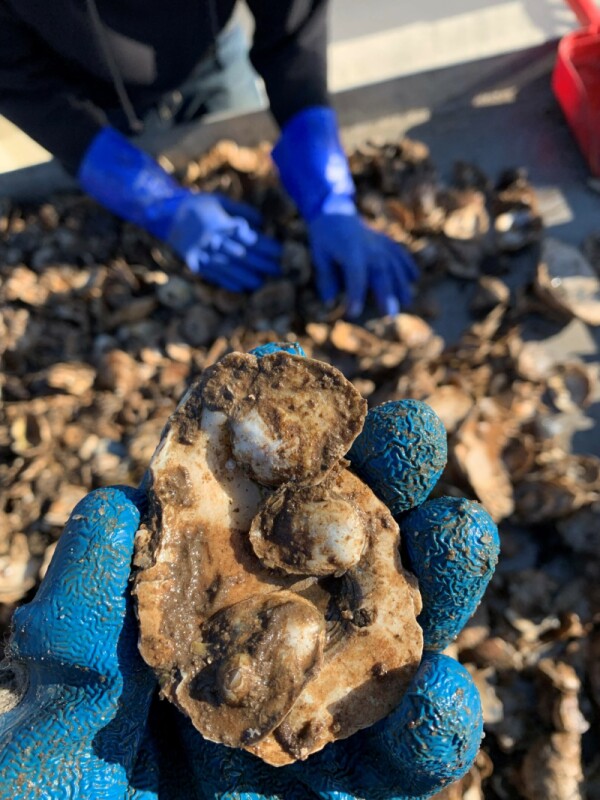
“Oysters are a keystone species in our local estuaries and are essential to our mission to maintain healthy and productive marine ecosystems,” said Dave Golden, the state’s assistant commissioner for fish and wildlife. “These reefs offer critical habitat for a wide range of recreational and commercially important marine species. By recycling shells, we reduce waste and support the recovery of ecosystems that benefit both marine life and coastal communities.”
The DEP’s Division of Fish and Wildlife first tackled the shell shortage in 2019 with a recycling program centered in Atlantic City, collecting first from a single restaurant partner and expanding to nearly every city casino and seafood restaurant. The program now collects from 32 restaurant partners in three Shore counties.
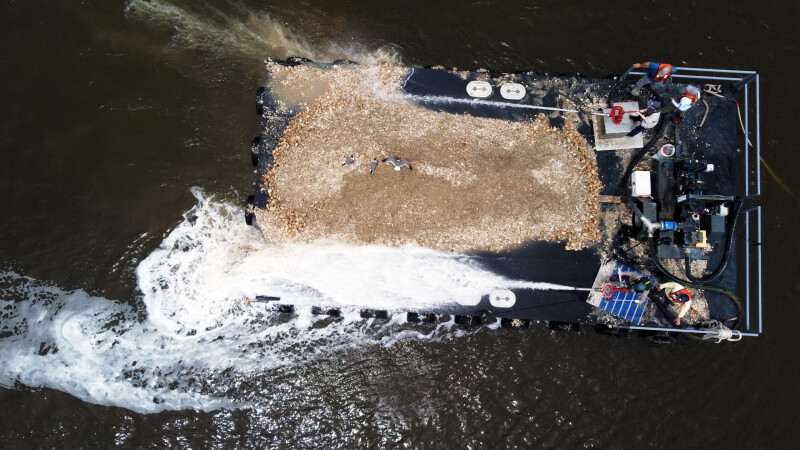
“Since 2021, more than 45,000 bushels (more than 1,100 tons) of recycled shell along with shell purchased from local processors have been planted onto the reef system,” according to the agency. “Sysco Corporation learned of this initiative and inquired about partnership opportunities, as the program aligns with the company’s overall mission and sustainability goals.”
In 2024, the program gained funding from the National Oceanic and Atmospheric Administration’s Coastal Zone Management Program, enabling expansion beyond Atlantic City and development of a environmental education program called Project S.H.E.L.L. (Strengthening Habitats through Environmental Learning and Leadership), which provides experiential marine science learning opportunities to students in Atlantic City and surrounding areas.