

For most operators, few routine tasks generate more frustration than an impeller change. The job is usually performed in a cramped space, on pumps that haven’t changed design in decades, and with tools that haven’t evolved much either. Veteran marine technician Eddie Protzeller, founder of ImpelPro, has been trying to fix that.
Protzeller spent 14 years maintaining engines, pumps, and auxiliary systems at Seattle’s Western Towboat Co. That experience, combined with the number of fouled, seized, or deteriorated impellers he fought in the field led him to design a puller that reduces the fight to a one-handed operation.
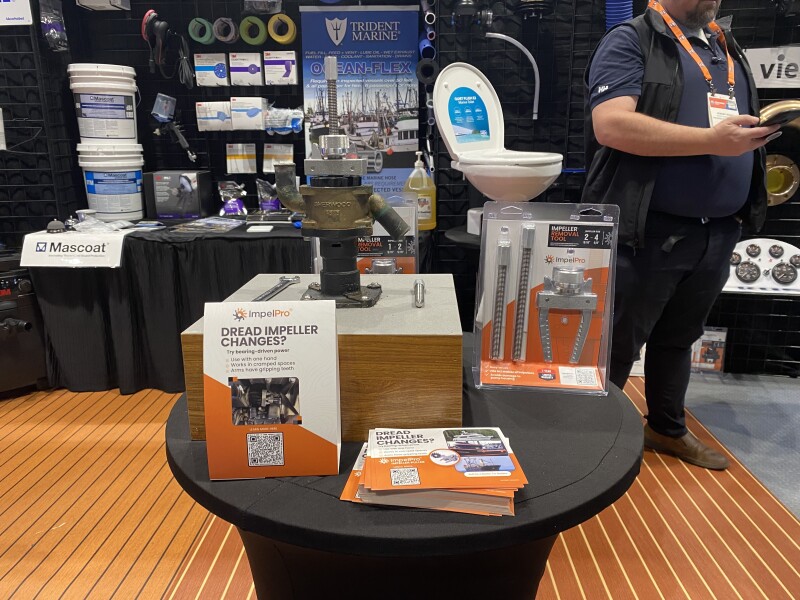
At the Pacific Marine Expo, Protzeller pulled me over to a nearby engine on the showfloor to demonstrate the tool under real conditions. It was an effective choice, as the impeller pump was wedged behind guards, plumbing, and brackets that limit a technician’s access.
“Nobody likes impeller changes,” he said. “You ask anyone, ‘Do you try to change an impeller?’ ‘Yeah, it sucks.’ There's no one that says, ‘Oh, it's the easiest thing in the world.’”
He said the problem is universal across commercial fleets and yachts: tight clearances, aging pumps, and rubber impellers that stiffen after long idle periods. When veins dry out and snap, they travel upstream, clog coolers, and create “a huge amount of havoc.”
Compounding the issue, many existing pullers rely on a single threaded mechanism. As Protzeller put it, “You don’t know if the impeller is actually easy to come out or if you’re just fighting your thread. Most of the time you’re fighting your thread.”
Pointing to the showfloor engine’s design, “With the knobs that are on the other side, like a T-handle, there's no way you could try to spin that to get it out. And that's what everyone's complaint is,” he said. “A lot of these [impellers] you can't even see. So, you're doing it one-handed like trying to use your phone or a mirror.”
The ImpelPro tool separates those movements. One thread tightens the arms; a second performs the extraction. “So you’re not working against yourself,” he said. A bearing under the assembly carries the load as the operator tightens the arms. “It’s all made in the USA, besides the bearing that’s underneath here.”
He showed how the arms slide and bite into the hub cleanly. “The more stubborn that the impeller is to pull out, the more it’s going to want to try to bite into the rubber.”
The puller also accounts for keyed or splined hubs that won’t rotate with the engine stopped. Manufacturing is kept local, with arms cut in Ballard, Wash. and other components machined in Idaho. “The whole idea is to keep this distance and the same geometry, the same with both of the arms.”
Every feature focuses on reducing bulk and reaching deep into pump housings without removing guards or adjacent equipment. “You can still have that pull, but the tool’s not very long,” he said.
The idea started after a failed puller slipped off a friend’s yacht impeller. “I bought all the tools from Fisheries Supply, tried to use one of them and thought I was pulling it out and it slipped off. ‘Okay, well now what?’” That led him to redesign the arms, then the entire tool.
Today the product line includes multiple sizes. “You shouldn’t have to take a cab or a truck off to work on an engine,” he said. “There's definitely a long list of things where you have to take a hundred things off just to do one simple task.”
Protzeller demonstrated the tool’s simplicity by handing me the ImpelPro tool and a wrench to remove a dry impeller from a table display. Despite spending what feels like every summer day wrestling with the 20-hp Universal diesel on my Tartan 30, my engine-room experience still falls in the vivid green category. Even so, the tool proved foolproof with me removing the impeller in less than two minutes.
That experience aligned with Protzeller’s intention in designing ImpelPro. In addition to efficiency and simplicity gains, improving the tool is also about restoring confidence for operators who prefer to handle their own maintenance.
“The biggest thing is trying to rehabilitate people into knowing that they can do this themselves," he said. "There's a tool out there that they're not going to get halfway out. Or something's going to happen where they're still having to call a mechanic and feel defeated again.”