

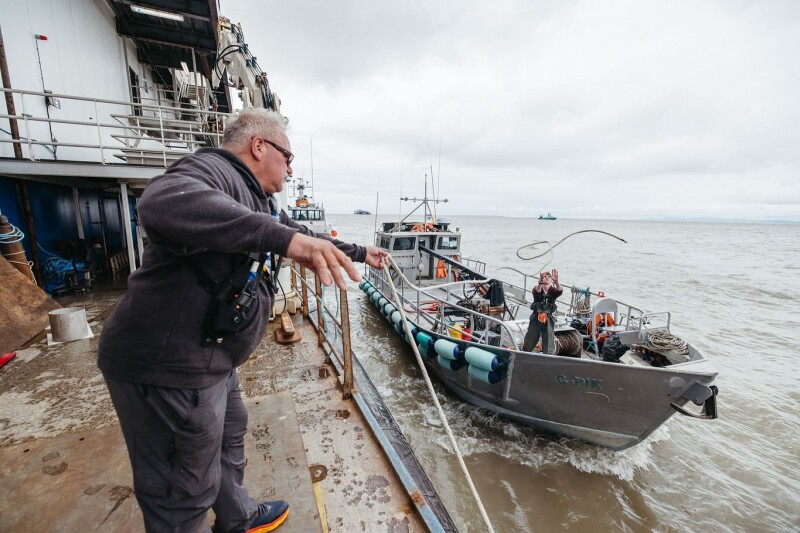
When conversations turn into low-carbon seafood, many fishermen hear a language that doesn’t belong to them. It sounds abstract, political, or designed for someone else entirely. But for MJ Jackson, a longtime Bristol Bay fisherman, past National Fisherman Highliner, and employee of Northline Seafoods, the reality looks very different on the water.
In Bristol Bay, efficiency isn’t a marketing strategy- it’s how the fishery has always worked.
“There was a carbon study done by Ray Hilborn, professor at the University of Washington,” Jackson said, referencing research that looked at the full carbon footprint of global fisheries. “Bristol Bay is on the podium. I think we’re in second place- and that’s all the way through the chain, packaging, delivery, everything.”
That standing, Jackson said, isn’t the result of new technology or climate mandates. It comes from the structure of the fishery itself: a short season, a highly coordinated fleet, centralized logistics, and the use of freighters to move product efficiently. “We do it just by the nature of our fishery,” he said.
That distinction matters. Jackson is careful about how carbon language gets layered onto fishing operations. From his perspective, the story fishermen should be telling isn’t about carbon scores or offsets- it’s about efficiency, quality, and responsibility that already exists.
At Northline Seafoods, Jackson has seen firsthand how small operational decisions add up- especially when it comes to packaging and waste. One of the company’s pushes has been encouraging customers to buy IQF products instead of individually vacuum-packed portions.
“We’re trying to reduce packaging,” he said. “No vacuum plastic until we can get a product that’s either consumable, edible, or recyclable. Same with Styrofoam- we’re using cardboard and new technology.”
Those changes weren’t driven by a marketing department chasing sustainability buzzwords. They came from a practical desire to reduce plastic use and unnecessary material in the supply chain- something fishermen instinctively understand.
“It’s just trying to be responsible in our production,” Jackson added.
He believes that resonates far better than abstract carbon claims. Fishermen know what waste looks like. They know what inefficiency costs. Tying those realities to marketing works, but only if it stays grounded in how boats actually operate.
Jackson is also clear-eyed about seafood certification programs. While consumers often rely on logos and labels to guide purchases, fishermen tend to judge those programs by whether they reflect real-world practices.
“One thing I do think helps is certification programs that actually take energy use into account,” Jackson said, pointing to Certified Seafood International (CSI). “Part of their audit looks at energy use. So the consumer can say, ‘Okay, they’re making headway toward reducing their footprint.’”
But he’s cautious about certification organizations that drift too far from the dockside reality. “Some are just pay-to-play, and they don’t do what CSI does.”
For Jackson, certifications are only useful if they reinforce what fishermen are already doing right- not if they impose outside narratives or standards that don’t fit how fisheries actually function.
“Sustainability was baked into this stuff long before people started calling it that,” he said.
Fishermen shouldn’t lose control of their story
Jackson has watched European markets move toward stricter carbon accounting, where buyers increasingly want to see the footprint of a product traced through the entire supply chain. While that approach hasn’t fully taken hold in the U.S., he sees it as a potential preview of what could come.
“In Europe, some companies are setting requirements,” he said. “If you don’t meet them, they’ll go find another supplier.”
He doesn’t see that as a threat, but he does see it as a reason fishermen should stay involved in how their story is told.
“If we can get credit for moving in that direction, that’s a positive thing,” he said. “Some of the standards, we’re not going to meet right away. But that doesn’t mean the work isn’t happening.”
The risk, Jackson believes, is letting low-carbon messaging drift too far away from the realities of fishing. When that happens, fishermen stop listening- and stop participating. For him, the better path is simple: talk about efficiency, quality, and responsibility the same way fishermen always have. The carbon benefits will follow, whether or not they’re the headline.