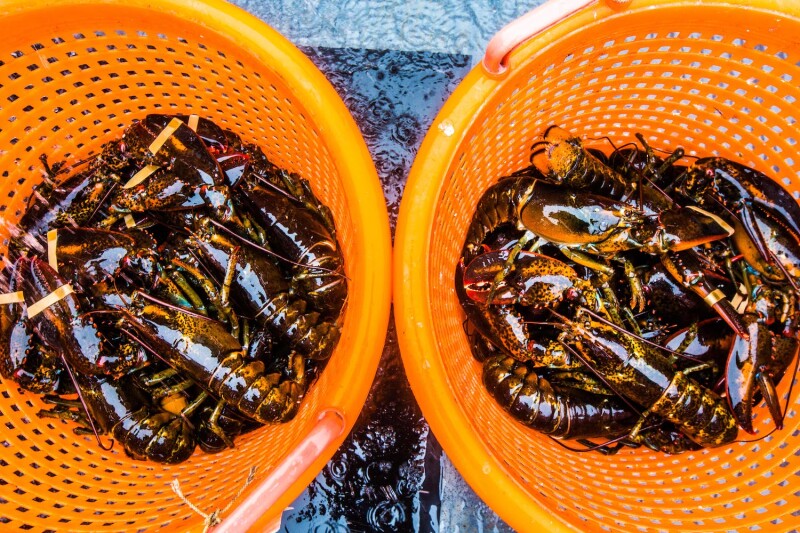
Maine’s lobster fishery brought in more than half a billion dollars in revenue last year, but the long-term health of the fishery remains under pressure as warming waters reshape the Gulf of Maine ecosystem, according to reporting from Northeastern Global News.
As ocean temperatures rise, invasive and southern species are moving into traditional lobster habitat, competing for resources and preying on native lobsters. Understanding how those changes play out on the water may depend heavily on the people who spend the time there: lobstermen themselves.
Jonathan Grabowski, a professor of marine and environmental sciences at Northeastern University, led a study examining lobstermen's ecological knowledge in Maine and Massachusetts. Through detailed surveys and in-depth interviews, Grabowski and his team documented how fishermen understand food-web relationships and species interactions across different habitats.
Coastal waters are warming faster than fisheries management can keep up, Grabowski told Northeastern Global News. That gap makes fishermen’s observations especially valuable. Many of the lobstermen interviews have decades of experience on the water- often more than 25 years, and in some cases more than 50.
That long-term perspective has enabled lobstermen to detect shifts that scientists alone cannot track. According to Grabowski, fishermen are keenly aware of species expanding into the Gulf of Maine, including black sea bass, which prey on lobsters. “We don’t have adequate sampling in the system from the scientists alone, so we need the lobster industry to help fill in the gaps,” Grabowski said, as quoted by Northeastern Global News.
Lobstermen have also raised concerns about habitat loss. In the study, one fisherman pointed to green crabs damaging eelgrass beds- critical nursery habitat for juvenile lobsters- by turning them into muddy bottom. While that kind of observation might surprise researchers, Grabowski said it reflects how sharp fishermen’s understanding of the system can be.
To capture that knowledge, Grabowski’s team used a mix of surveys, hour-long interviews, visual mapping exercises, and a technique known as “fuzzy cognitive mapping.” Fishermen were asked to describe how they believe the ecosystem functions and how changes- such as warming waters- could affect predators, prey, and lobster survival.
The results reinforce a broader shift in scientific thinking. Grabowski told Northeastern Global News that the idea that fishermen aren’t experts in their home waters is “almost laughable,” given the hundreds of days they spend at sea each year- far more time than most scientists can devote to fieldwork.
After two decades of working with lobstermen, Grabowski said their observations are not just useful- they’re essential. “The lobsterman voice is an invaluable voice,” he said.