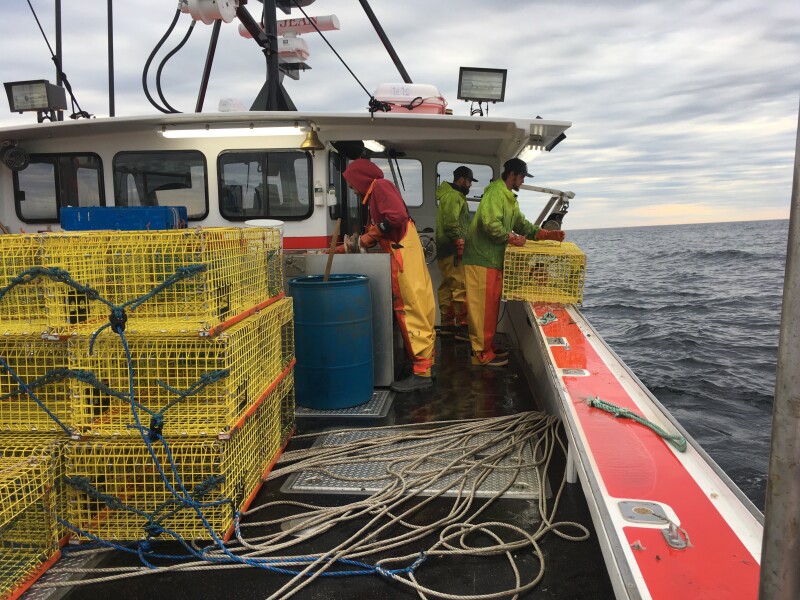
For commercial fishermen accustomed to vessel monitoring, observers and other data requirements, a Maine lobsterman’s case headed to the U.S. Supreme Court raises a more fundamental question: How far can government monitoring follow a fisherman when he isn’t fishing?
The Supreme Court is scheduled to consider Frank Thompson’s petition Sept. 28 in a challenge to electronic tracking requirements for federally permitted lobster vessels.
Thompson, a fifth-generation lobsterman from Vinalhaven, Maine, argues that requiring a GPS tracking device aboard his privately owned vessel amounts to an unreasonable search under the Fourth Amendment. His challenge focuses particularly on the requirement that the vessel continue transmitting its location while underway, including when it is being used for something other than lobstering.
“The petition asks whether Maine can force lobstermen to carry government GPS trackers on their private boats, even when they are off the job,” Matt Gilliam, Thompson’s lead attorney, told ABC News. “We are hopeful that the court will grant review and address this important Fourth Amendment question.”
The tracking requirement went into effect in 2023 for federally permitted American lobster vessels from Maine to Virginia. The devices transmit a vessel’s location every minute while it is at sea.
For some Maine fishermen, however, a fishing boat is not used exclusively for fishing.
In a Sept. 2 Washington Post opinion piece, Tobias Russell, strategic research manager at Pacific Legal Foundation, which represents Thompson, wrote that boats can serve much like family vehicles in Maine’s island communities. Fishermen may use them to reach stores, hospitals and other services on the mainland or to transport friends and relatives.
Russell recounted being told by one lobsterman that he used his vessel to rush his pregnant daughter from an island to the mainland when she went into labor. Because the boat held a federal lobster permit, Russell wrote, its location continued to be transmitted during the trip.
That distinction is at the center of Thompson’s challenge.
Thompson filed his federal lawsuit in 2024 against the head of the Maine Department of Marine Resources (DMR). A district court dismissed the case, and a federal appeals court upheld that decision in November 2025. Thompson then appealed to the Supreme Court.
According to Russell, the lower courts relied on legal precedent allowing warrantless searches in certain “closely regulated industries.” Thompson’s attorneys argue that treating commercial fishing as such an industry should not give the government authority to continuously track a fisherman’s location when he is not working.
The Pacific Legal Foundation argues the implications could extend beyond Maine’s lobster fleet. Its case asks whether working in a heavily regulated industry can justify continuous, warrantless location tracking, potentially raising similar questions for workers in other regulated occupations.
Government officials and conservation advocates, meanwhile, say detailed vessel information serves an important role in fisheries management.
ABC News reported that human observers and electronic devices are used across U.S. commercial fisheries to collect information that regulators say is important to maintaining fisheries and fish populations.
Maine DMR Commissioner Carl Wilson said last year that lobster vessel data are important to “mitigate economic harm to the industry” and inform regulations, according to ABC News.
Conservation Law Foundation senior counsel Erica Fuller also defended the need for detailed fishery data.
“Efforts to overturn a federal appeals court ruling don’t change the fact that New England’s lobster population has declined and fishery managers urgently need reliable and detailed data to respond to the complex issues facing our ocean,” Fuller told ABC News.
Maine fishermen landed more than 78 million pounds of lobster in 2025. While that was comparable to typical annual catches during the 2000s, it was well below a decade ago, when landings routinely exceeded 120 million pounds.
Thompson’s challenge, however, puts a different question before the courts: whether the government’s authority to monitor a federally permitted commercial fishing vessel extends to tracking that vessel during personal use.
The Supreme Court has previously recognized GPS tracking as a search under the Fourth Amendment. Russell pointed to a unanimous 2012 Supreme Court decision involving law enforcement attaching a GPS device to a suspect’s vehicle without a warrant.
Thompson’s attorneys are now asking the court to consider where that constitutional protection applies when the person being tracked is not a criminal suspect, but a federally permitted commercial fisherman.
For fishermen, the next step comes Sept. 28.
The justices will consider Thompson’s petition during the Supreme Court’s annual long conference. If they decline to hear the case, the lower court ruling will stand. If they grant review, a dispute that began with GPS trackers aboard lobster boats could become a broader test of how far government monitoring can extend into the private use of a commercial fishing vessel.