
The Virginia General Assembly in Richmond, Va., officially passed on June 29 fourteen budget amendments to the states $205 billion biennial budget including $2 million for a comprehensive study on Atlantic Menhaden in the Chesapeake Bay.
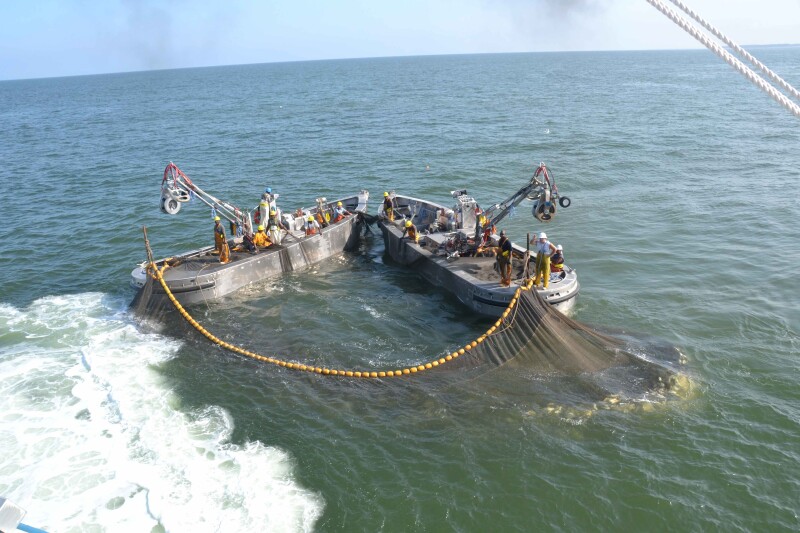
The Assembly had presented a proposed budget to Virginia Gov. Abigail Spanberger on June 22 that did not include funds for the study. This prompted political finger pointing from the Chesapeake Bay Foundation (CBF) at Omega Protein Inc. and Ocean Harvesters, the Reedville, Va., firms involved in the only large reduction menhaden fishery on Atlantic Coast.
CBF accused the Reedville firms of using “political pressure” to persuade legislators not to approve research funding in the state budget. Promptly, Omega Protein and Ocean Harvesters issued a news release adamantly denying the use of “political pressure” to discourage funding of menhaden research.
The release stated “Ocean Harvesters and Omega Protein flatly deny playing any role in the Virginia General Assembly’s decision not to include funding to study the Chesapeake Bay’s Atlantic menhaden population in the two-year state budget. These false claims were made by the Chesapeake Bay Foundation, an organization that has misled Virginians as part of a special interest campaign against the industry for more than two decades.”
Gov. Spanberger came back on June 26 with an amendment to the legislator’s proposed budget that included $2 million for the Virginia Institute of Marine Science (VIMS) in collaboration with Virginia Marine Resources Commission (VMRC) to conduct a comprehensive study of menhaden research on Chesapeake Bay.
CEO of Ocean Harvesters Monty Deihl responded in support. “We hope the Virginia General Assembly will adopt the Governor's amendment, and we look forward to working with stakeholders involved in the process,” says Deihl.
Spanberger’s approved amendment
Spanberger’s amendment stated, “This funding shall be used for Atlantic menhaden research necessary to inform a scientifically defensible and ecologically meaningful Chesapeake Bay harvest cap.”
“This report will be generated by VIMS in collaboration with VMRC, and with the cooperation of relevant stakeholders, including recreational anglers, the reduction and bait fishery sectors, and non-governmental organizations. VIMS will create an annual proposal to draw from this funding, until delivery of the final report that provides an approach to setting a scientifically-defensible Chesapeake Bay harvest cap.
“The development of this approach may be informed by research on (i) the seasonal abundance of Atlantic menhaden in the Chesapeake Bay; (ii) the movement rates of Atlantic menhaden between the Atlantic coast and the Chesapeake Bay; (iii) the impacts of predator (e.g. striped bass, osprey, and other species) demand and consumption of Atlantic menhaden on the Atlantic menhaden population; (iv) the spatial and temporal patterns of the Atlantic menhaden commercial fishing effort in the Chesapeake Bay; (v) and the possibility of localized depletion of Atlantic menhaden in the Chesapeake Bay.
“This work can utilize recommendations from the report delivered October 1, 2023, titled “Atlantic Menhaden Research Planning” and/or the expected December 2026 deliverables from the Science Center for Marine Fisheries (SCEMFIS)-funded project titled “Development of a Research Roadmap for Atlantic Menhaden in the Chesapeake Bay.
“The Virginia Department of Workforce Development and Advancement and the Virginia Economic Development Authority, in consultation with the Menhaden Management Advisory Committee of the VMRC, will contribute analysis and recommendations to the Menhaden report on potential workforce impacts.
“Beginning with fiscal year 2028 and in subsequent fiscal years thereafter, VMRC shall provide new scientific data and research products generated under this item by VIMS, to inform the annual discussion and deliberations of Atlantic States Marine Fisheries Commission (ASMFC) on any proposed changes to the coast-wide or Chesapeake Bay total allowable catch levels.
“The committee report shall include (i) projected workforce impacts from coast-wide and Chesapeake Bay changes in total allowable catch, and (ii) recommendations for addressing impacts to workers by changes in total allowable catch.
“VIMS shall present report progress, current findings and any recommendations, along with their annual proposal to draw from the menhaden funding for the following year to the Chairmen of the Senate Committee on Agriculture, Conservation and Natural Resources, the House Committee on Agriculture, Chesapeake and Natural Resources, the Secretary of Natural and Historic Resources, the Ecological Reference Points Workgroup of ASMFC, and the Menhaden Management Advisory Committee of VMRC, yearly by October 1."