.jpg.medium.800x800.jpg)
John Deere is bringing two new marine engines to the commercial fishing industry in 2026, when production will begin on the new JD18 and JD14, which will replace the existing John Deere 13.5L 6135SFM85 and 6135AFM85 engines.
“These are more powerful engines with heavier-duty cycles,” says Vince Rodomista, marine business and product manager at John Deere in Waterloo, Iowa. “The JD18 is a new platform; it has a power range of 550 to 803 horsepower. It’s a heavy-duty engine built 100 percent for the commercial fishing industry and other commercial applications. The JD14 replaces the 13.5-liter and has a heavier-duty cycle.”
Rodomista notes that both engines have a max 803 horsepower rating to keep them within EPA Tier III and IMO Tier II emissions limits. “But compared to the 13.5L engine, the JD14 has a more robust bottom end. It has a heavier block and a heavier drive train. That allows us to get more power out of the engine at a heavier duty cycle. Which means you can use more power more often,” he says. Despite its beefed-up lower end, the JD14 comes in only 320 pounds heavier than the 13.5L, and with slightly smaller dimensions. “The footprint is pretty much the same, but we were able to reduce the height by an inch,” says Rodomista.
Among the other additions that differentiate the JD14 from its predecessor, Rodomista notes that John Deere added an overhead camshaft design and hydraulic lash adjusters. “We did that with both engines, along with adding high-pressure common rail fuel injection systems on both. From a serviceability perspective, we went from a side service to front service, so all the filters for fuel and lube oil are on the front end of the engine,” he says. “We also went from a remote-mounted ECU (engine control unit) to an ECU mounted on the engine. And we have a new design for all the electrical connections, which we call the electrical service center, that allows easy electrical connections to be made to the engine.” Those connections include systems monitors that collect information on how efficiently the engine is running and whether it needs maintenance.
"That information comes to us via John Deere Connected Support, and we can relay it to our customers,” says Rodomista. “Or fleet owners can collect it on their boats.” According to Rodomista, the engine performance data can be transmitted in real time if the vessel is within cell service range or has a satellite connection.
"Another thing we did was go from a rubber to a bronze impeller on the seawater pump, which enabled us to go from maintenance every 500 hours to every 10,000 hours, and we increased the oil interval from 250 hours to 500 hours, so that’s going to bring down maintenance costs.”
The enhanced seawater pump cools coolant in either an AFM single circuit system that cools the intake air from the turbo and the block, or an XFM dual circuit system that cools the intake air and the block separately. “On the JD18, we did not want a seawater-cooled aftercooler,” says Rodomista. “But on the JD14, we do have the option for the SFM, in which the seawater goes first to the aftercooler and then to the heat exchanger to cool the jacket water.” Rodomista points out that the improved cooling systems enable cooler and denser air to enter the cylinder. “The denser the air, the more oxygen, more oxygen means more fuel you can burn in the cylinder, and that means more power,” he says.
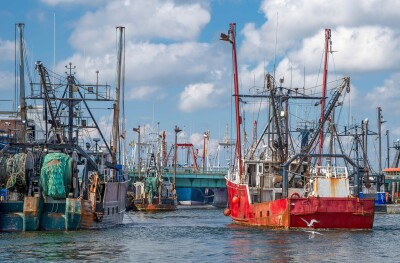
Rodomista believes the JD18 will work well for trawlers and scallop vessels, and that the JD14 will appeal to smaller inshore vessels such as lobster and crab boats. “We are seeing a lot of interest from these and other sectors of the fishing industry,” he says.