

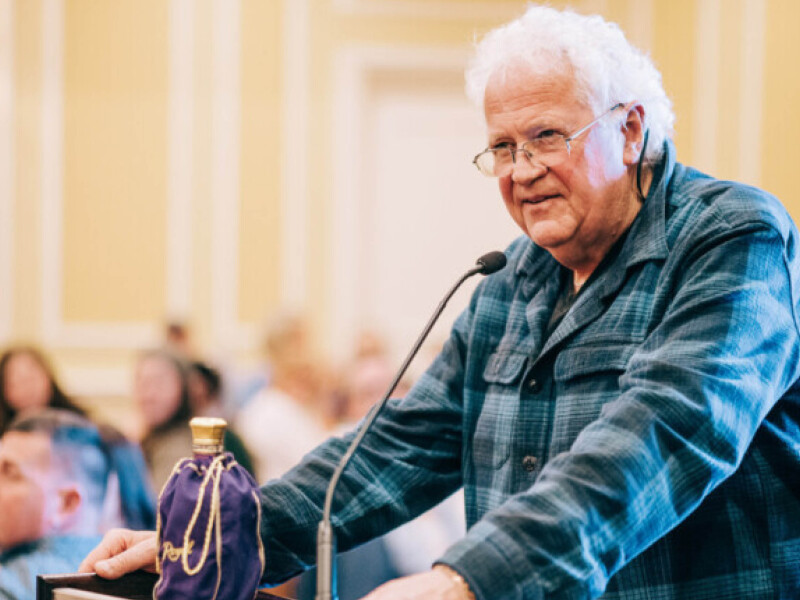
Standing before a packed room at the Maine Fishermen’s Forum, Brian Robbins didn’t frame his decades-long career in fisheries journalism as something he built alone.
He kept coming back to one simple line.
“I got lucky…I was just lucky,” Robbins said.
The moment came Saturday night at the dinner sponsored by National Fisherman as Robbins accepted the Maine Fishermen’s Forum Distinguished Service Award, recognizing his decades of work with Commercial Fisheries News (CFN), the Stonington, Maine-based publication that printed its final issue in Dec. 2025 after a 53-year run.
For many in the room, CFN wasn’t just a newspaper – it was sewn into the fabric of the communities that make up Maine’s working waterfront.
As Jerry Fraser wrote in National Fisherman following the paper’s closure, CFN was “at its heart a community newspaper,” one that stretched from Maine through the Mid-Atlantic, connecting fishermen, markets, policy, and culture in a way few publications ever have.
Robbins lived that role from the inside out.
“I didn’t come ashore to become a journalist,” he told the crowd, recalling his early days hauling gear and working on the water. What followed, he made clear, was never a solo effort.
He pointed to mentors like Robin Alden, Susan Jones, and Rick Martin- figures who helped shape both the publication and his path within it. "Rick, CFN's general manager when I came ashore, took over as publisher when Robin left in the 90s. She was a dear, dear friend as well as a mentor to me," Robbins said. He spoke about the behind-the-scenes crew who kept the paper running, from the office to production, crediting them with making the work possible.
“You trusted me with your stories… nobody ever questioned, you all just trusted me,” Robbins said.
That trust, more than anything else, built CFN’s place in the industry. Fraser noted that while the digital age brought an explosion of information- from management updates to political news– CFN stayed grounded in what fishermen actually wanted: stories about how others were making a living on the water.
Robbins echoed that connection in his own way, recalling the risks fishermen took to just get him the perfect shot for a story. “I trusted you, too,” he said, mentioning that though lobster boats may have been coming at him head-on, he knew the captain would turn away at the last minute just in time for him to snap a photo.
“And just like in the movies, in the end, I got the girl,” Robbins said at the end of the speech, pointing to his wife, Felicity. "I love you, Tigger." A reflection on a career that mirrored the industry it covered: hard-earned, community-driven, and never taken for granted.
With CFN now closed, its absence leaves a noticeable gap along Maine’s waterfront. But as the room at the Forum made clear, the stories – and the people behind them – aren’t going anywhere.
And if you ask Robbins how it all came together, he won’t talk about legacy or impact. He’ll just tell you he got lucky.