

A Florida Atlantic University (FAU) researcher is developing a new tool that could help commercial fishermen reduce shark bycatch, an issue that has long challenged longline fisheries.
Through FAU’s Innovation Pilot Award Program, established in 2024 to help move early-stage research toward real-world application, Stephen Kajiura, a professor of biological sciences, received a $15,000 award to advance a patent-pending shark deterrent device designed for use on longline gear.
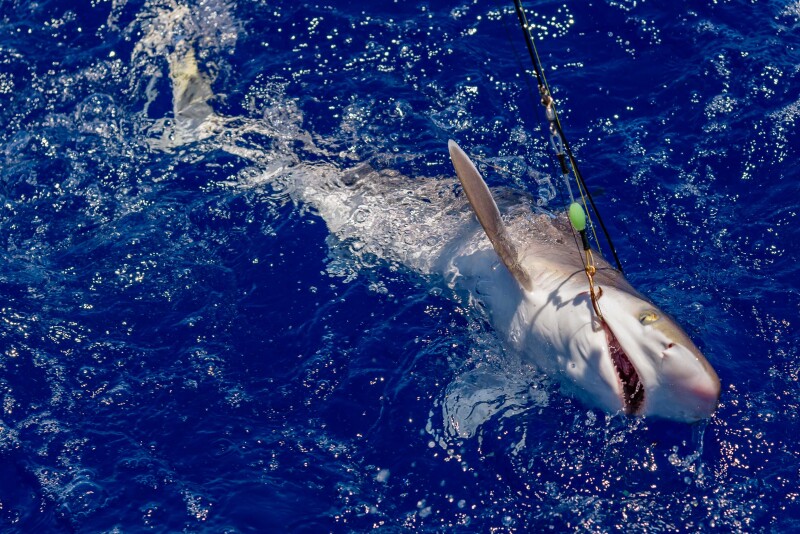
Shark bycatch remains a persistent problem in commercial fisheries targeting species like tuna and swordfish. Sharks caught unintentionally are often discarded dead, contributing to population declines and disrupting marine ecosystems. For fishermen, interactions with sharks also mean damaged gear, lost bait, and reduced catch value.
Kajiura’s device attaches directly to a fishing hook; it uses zinc and graphite to generate a small electric field in seawater that targets sharks’ electro-sensory system, effectively repelling them from baited hooks. Early field testing has shown the device can reduce shark catch rates by up to 69 percent while leaving target species unaffected.
“The beauty of this innovation is in its simplicity and selectivity,” said Dana Vouglitois of FAU’s Office of Technology Development. “By understanding sharks’ unique electrosensory capabilities, Dr. Kajiura and his team have created a solution that is practical for commercial use.”
Unlike some existing deterrents, the device is designed to be low-cost and easy to integrate into current fishing operations. Researchers are continuing to refine the design through ongoing field trials with commercial fishermen, focusing on durability and usability in active fisheries.
Kajiura emphasized the importance of industry collaboration as the project moves forward.
“We’re excited to continue testing the device with commercial fishermen, gather their feedback, and refine the design,” he said. “This funding brings us closer to commercial production, protecting sharks while supporting sustainable fisheries worldwide.”