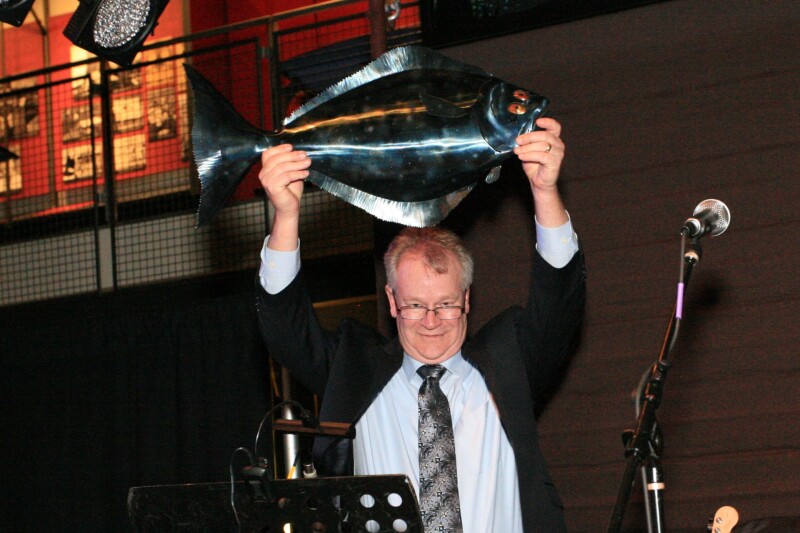
Like many a teenager back in the late 1960s, Bob Alverson jumped at the chance to earn money for college by landing a job in the commercial fisheries industry in Alaska.
Alverson, who grew up in the Seattle area, spent a summer washing pots and pans and feeding over 100 fishermen at Columbia Ward Fisheries at Peterson Point, on the north side of the Egegik River in western Alaska.
"It was a hard job, but I enjoyed the people," said Alverson, who was at work at 5 a.m. every day, working alongside the baker and the cook.
The second summer at that cannery, a 22-mile-long fishing net from a Japanese fishing vessel washed up on the side of the Egegik River. Columbia Ward fishermen were furious about the foreign vessel harvesting the red salmon.
Alverson said he was also "fit to be tied, because we got paid a portion of the pack of what was canned. We were incensed that they were taking the fish."
When he had graduated from the University of Washington in 1972 with a bachelor's degree in economics, the job market in the Seattle area was tight. He took a job with the insurance firm Trans America Corp., but within two years joined Fishing Vessel Owners of America, working for Harold Lokken, then executive director of FVOA. Those were exciting times, with Lokken working on legislation for the Magnuson-Stevens Fishery Conservation and Management Act, which extended U.S. fisheries jurisdiction out to the 200-mile limit. Alverson also traveled to Washington, D.C., to work with Senators Warren Magnuson and Ted Stevens on the legislation.
When Lokken retired in 1976, Alverson took over the post, which he still holds today. FVOA, a trade association of longline vessel operators, was formed in 1914 to promote safety at sea, ensure competitive pricing, and to promote habitat-friendly gear with minimum bycatch. Much of that has been accomplished to date, and Alberson said it has been rewarding to see how individual fishing quota (IFQ) programs and other management efforts have made the industry safer for fishing families.
FVOA was also at the forefront of a 16-year battle to establish IFQ halibut and sablefish fisheries for the Bering Sea and Gulf of Alaska.
"The industry is forgetting where we came from," he said. "In 1974-75 we still had 700 foreign vessels registered to fish off the coast and 500 participating. When we got the Magnuson Act, we had to invest and catch the fish and force them out. We had to convince the SSC (the Scientific and Statistical Committee of the North Pacific Fishery Management Council) to move these people out.
"In 1984 we petitioned the council, with Chuck Bundrant and all the older companies, that we didn't want the Japanese to have an allocation in the Gulf of Alaska, for the Gulf quota of black cod. The Japanese agreed to stay out of the fishery until Oct. 15. On Oct. 7, the Commerce Department announced that we had made the quota and there was none for the Japanese," Alverson said. It was the same issue with the cod fishery, a two-year fight on the council. "We finally got rid of the allocation of cod fish to the Japanese in 1988-89," he said.
The most challenging issue these days is recruiting a new generation of men and women into jobs in commercial fisheries, he said.
"I was hired when mostly first and second generation (families) were engaged," he said. Alverson's father, Dr. Dayton L. Alverson, was honored as a Highliner in 1977.
"After those first and second generations immigrants, they don't know all the rules," he said. Many fishing clubs like those of Norwegian and other Scandinavian descent that attracted young people to the industry no longer exist. Nowadays, most such commercial fishing organizations, like the North Pacific Fisheries Association, are organized around gear types, species, or geographic regions representing diverse members rather than specific ethnic groups.
"We are struggling to keep an association together as one generation. There is opportunity for people coming out of high school to be welders and electricians who deal with more than the fishing industry," he said.
After the Covid-19 pandemic, many experienced fishermen retired and left the industry. "Right now, hook and line pot fisheries in Alaska are having a hard time finding crew," he said. "It's not like in 1974 when I came in," he said. "Every boat now, they all walk on with a laptop."
A full share in payment for the catch may run from $100,000 to $135,000. "It's hard work, but there is still some money to be made as a crewman," Alverson said. "A lot of these younger guys want more time off. They don't finish out the season. If they are good on a boat, they are usually good at shoreside construction. Right now, with a downturn in construction in the Washington area, the fishing industry is picking up more people," he said.
Another issue is substance abuse. "When I got hired, it was alcohol," Alverson said. "Now most of the boats are cigarette-free, but they have to worry about drugs. Most shore-based and almost all the catcher processors require drug tests."
In his capacity as executive director of FVOA, Alverson, meanwhile, is showing no signs of slowing efforts to improve the industry and fisheries environment. He currently serves on the groundfish advisory panel for the Pacific Fishery Management Council, representing hook and line and pot operations in Washington, Oregon, and California. He has also served on the NPFMC and International Pacific Halibut Commission.
The FVOA served as an outspoken leader in the contentious halibut and crab bycatch reduction measures of the 1980s and 1990s, also known as the bycatch wars, through reintroduction of no-trawl zones and numerical bycatch limits for domestic bottom trawl fisheries in the Southeastern Bering Sea and the Gulf of Alaska around Kodiak Island. FVOA was again a leader in renewed trawl bycatch negotiations at the NPFMC in 2015 and 2020.
"One area we have not done enough in is habitat protection," he said. "Bottom trawling should be restricted during spawning periods. Hard on bottom trawling has changed the ecosystem and made it weaker."
Alverson is also proud of the work that FVOA has done in support of the development of the domestic at-sea observer program for commercial fisheries under the jurisdiction of both the NPFMC and PFMC, the first of which began at the NPFMC in 1991. FVOA has also supported the avoidance of marine mammal interactions with longline vessels and gear and insurance programs to benefit vessel owners and their gear.
With no plans to retire in the near future, Alverson still has plenty of advice to share with younger generations, including caution in hiring crew for finfish fisheries at mid-summer. "If someone out there is still looking for crew in July, there is a reason those still available have not been hired yet," he said.