

Catherine Scobby started work as the port administrator for Port Orford in February 2024, but in less than a year, she’s seen the biggest change in the port in over 30 years.
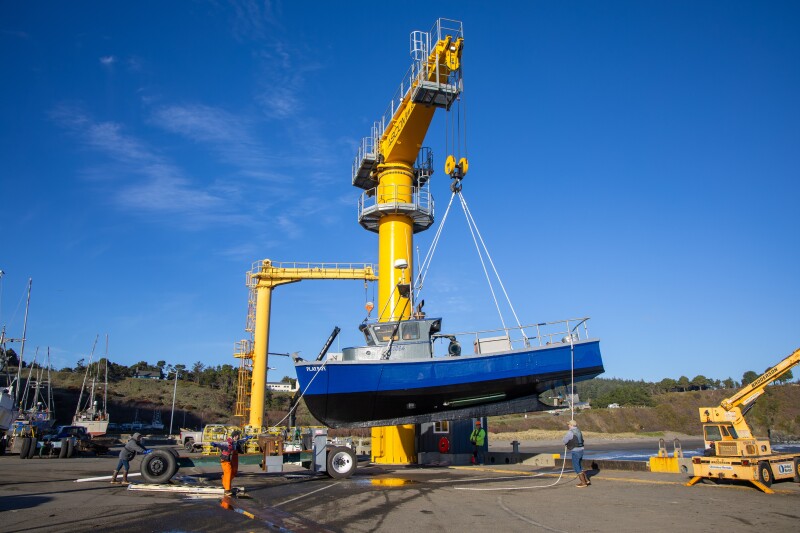
After 8 years of planning, Port Orford replaced the antique cranes used to lift boats safely onto a dock that reaches out into the open ocean with a pair of new 50-ton Ascom cranes. “We just commissioned them on November 30,” says Scobby. “Just in time for the opening of crab season on December 16.”
According to Scobby, the cranes have been working non-stop as fishermen set anywhere from 300 to 500 crab pots each. “We’ve been going around the clock the past few days,” she says. “There’s some weather coming, so we might get a break tonight.”
As Scobby understands it, the older 25-ton crane and the 15-ton cranes were antiques installed decades ago. “The were World War II era cranes,” she says. “They took them off of a naval vessel and they were on land when the port bought them around 1990 or 91. The maintenance on them was getting to be too much and we have two boats that are almost at the maximum capacity of the 25-ton crane.”
A $1.6 million grant from Connect Oregon, a $694,000 low-interest loan, and money from harbor fees all helped finance the $2.3 million project. “It was very impressive to watch,” says Scobby. “They drilled down to bedrock, and every cement truck on the south coast of Oregon was lined up ready to pour.”
Bergeron Construction, a marine construction company from Astoria did the installation, with engineering from PBS Engineering and Environmental, an Apex company.
With the new 50-ton cranes installed and commissioned, Port Orford hopes to see more fishing and aquaculture activity. “We’re hoping to attract more bigger boats,” says Scobby. “And we’re installing a seawater flow-through system to enable fishermen to access the live market for blackcod, rockfish, and lingcod.”
Scobby notes that although the port is very small, boats fishing from Port Orford get more fishing days than any other Oregon port. “We are the only port without a bar to cross, so our boats can get out when others can’t. And our fishing grounds are very rich. They just did the meat test for the Dungeness crabs, and ours were the best on the coast.” Scobby also points out that Port Orford is the only named port on the National Oceanic and Atmospheric Administration’s Fisheries Seafood Strategy intended to meet President Trump’s 2020 Executive Order Promoting American Seafood Competitiveness and Economic Growth.
Boats fishing from the dolly dock use the cranes on a first-come, first-served basis and must be equipped with structural pick-up points. “The boats supply their own ropes and lifting points,” says Scobby. “Captains or someone on the boat has to complete a course, and vessels are inspected. When things are running smoothl,y it takes about 5 minutes to lift a boat into or out of the water.”