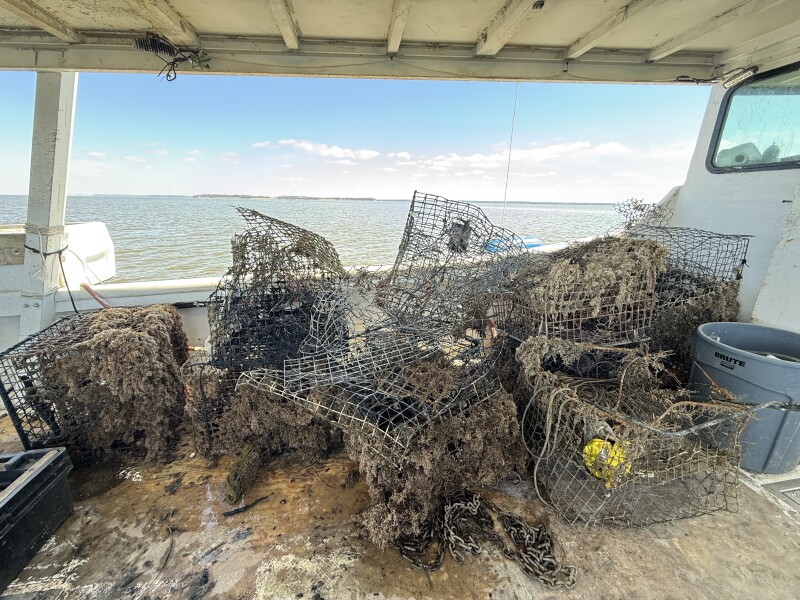
Twenty vessels and 40 watermen are combing Baltimore County waters this month as part of a coordinated ghost gear removal effort in the upper Chesapeake Bay, targeting lost and derelict blue crab traps that continue to fish long after they've been abandoned.
The project is a partnership between Tradepoint Atlantic, Terminal Investment Limited (TiL), and the Oyster Recovery Partnership (ORP), a nonprofit with more than two decades of experience working alongside the seafood industry on sustainable fisheries management. Field operations, staged out of Holly Neck Marina and McCluskey's Marina, are focused near Hart-Miller Island and the mouth of the Patapsco River off North Point State Park, and are set to run through the end of March.
Recovered material will be sorted for disposal and recycling, with Baltimore Recycling Center and Sims Metal handling the back end of the operation.
The effort is connected to the proposed Sparrows Point Container Terminal Project — a 330-acre redevelopment of the former Sparrows Point steel mill site on the Patapsco — and represents what Tradepoint Atlantic describes as a commitment to environmental stewardship alongside ongoing industrial redevelopment at the site.
"By removing derelict fishing gear from our waters, Tradepoint is working to strengthen environmental stewardship while creating jobs for our local watermen and supporting our local economies," said Pete Haid, senior vice president of Environmental at Tradepoint Atlantic.
For the watermen involved, the work addresses a problem that's long been part of life on the Bay. Lost crab pots don't just disappear — they keep fishing, trapping and killing crabs, baitfish, and other marine life in what the industry calls the "ghost fishing" effect. They foul active gear, create navigation hazards, and degrade the bottom habitat that crabs and other species depend on.
Ward Slacum, executive director of the ORP, framed the problem plainly: "Crab pots can be lost for a variety of reasons, but when they are, they continue to impact the Bay and the fishery. This project is about working together, partnering with Tradepoint Atlantic and collaborating with local watermen, to remove derelict traps and other debris, reduce unintended catch, protect habitat, and improve the productivity of local fishing grounds, all while supporting a healthier, more sustainable fishery for everyone who depends on it."
Robert T. Brown, president of the Maryland Watermen's Association, welcomed the initiative — particularly the economic boost it provides at a difficult time for the industry. "Lost crab pots are something we all deal with, and it's good to see this kind of partnership to clean them up," Brown said. "This work helps the Bay and puts watermen to work at a tough time for the seafood business. We appreciate Tradepoint Atlantic and ORP stepping up to keep our fisheries strong."
ORP has been running derelict gear removal programs in collaboration with Chesapeake watermen for over two decades, helping to locate, pull, and recycle lost traps from Bay waterways. The organization's broader mission centers on restoring native oyster populations and improving water quality throughout the estuary.