

There is an old saying from the Great Depression: “Use it up, wear it out. Make do or do without.”
For Steve Rupinski, owner of Skipjack Marine in Cream Ridge, N.J., it’s all about getting everything he can out of Yamaha engines.
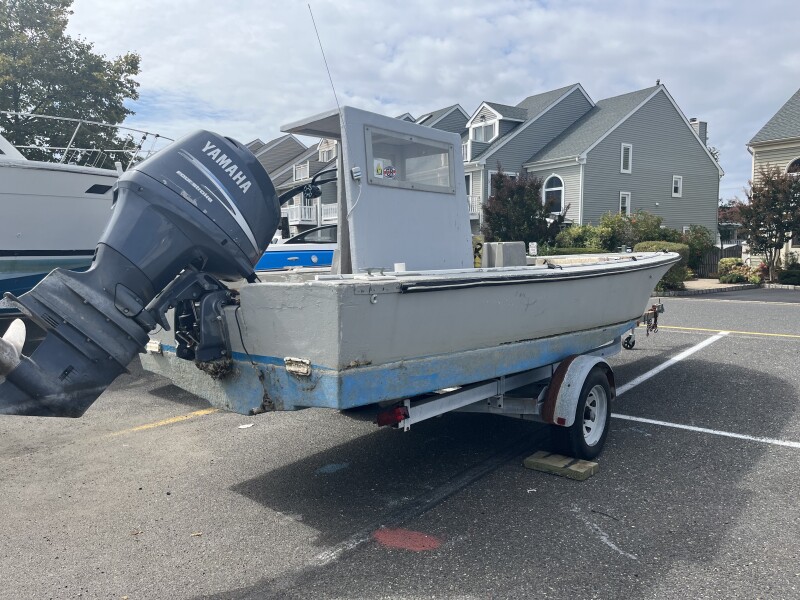
“I sell all used engines,” Rupinski said. “My customers are mostly baymen — the clammers up in Sandy Hook, the crabbers here in South Jersey, Delaware, and Maryland. A lot of them have old boats — Privateers, and T-Crafts from the 80s. They don’t want to put a new $20,000 engine on a $4,000 boat, so they buy from me.”
Rupinski has word out at marinas from Long Island to Virginia, and when a boat owner hits a point where the cost of repair is prohibitive, dealers tell them to give Rupinski a call. “With the price of labor at $200 an hour at a lot of shops, and the price of parts what it is because of the tariffs, a lot of times a new engine looks better than repairing the old one, and if they call me, they can still get something for their old one. So, it’s not a total loss.”
Rupinski tries to work close to home, but has gone as far as North Carolina and Maine to get engines. “I just got back from the east end of Long Island. It’s only 160 miles. I left at 5 a.m., and it still took me four hours. A guy out there had three Yamaha 150s on a ChrisCraft. He blew one of them and decided to repower the whole boat, so I went out there and picked them up. Two out of three are still good.”
Yamaha 150s and 300s are Rupinski’s stock and trade. “I tell people, they’re like the Toyota of outboards — reliable, long-lasting, and easy to work on, he said. “With a 10 millimeter and a 12 millimeter wrench, you can pretty much take apart the whole engine.”
Rupinski noted, too, that the Yamahas he sees can last 20 years or more. “I got one in here the other day that has 5,800 hours on it. They usually go 4,000 to 5,000 hours; clammers can get as many as 6,000 hours if they take care of it, but that’s getting to be a tired motor. Most commercial guys around here replace their motor every 10 years or so.”
If an engine still has any life in it, Rupinski sells it to a contact he has in South America. “They buy them and keep them running somehow,” he said. “They use them to power ferries on the rivers down there.”
When an engine is too far gone in some ways, but with good parts, Rupinski sometimes keeps it around. “If somebody sinks their motor and needs a new wiring harness, why not take one off another engine that’s not running? The harness is still good, and they don’t have to pay $1,500 or have to wait for it to come from Japan or someplace. They can get right back to work.”
After going through the engines and testing them, Rupinski resells for $4,000 to $8,000, giving fishermen — many of them part-timers — a low-cost option for power.
Taking care of the region’s small-scale commercial fishermen is a priority for Rupinski. “I always keep a block of time open in the week in case a fisherman comes in with a problem,” he said. “Especially when they’re working. Because they need to get back on the water as fast as they can.”