



When fishermen gather around a galley table or a bar table after a long trip offshore, the stories flow as quickly as the drinks go down. But for most of the working waterfront, those conversations vanish as soon as the fishermen leave the table- carried only in the memories of the people who lived them. For Mark Caylor, creator and the host of the Galley Stories podcast, the fear of losing those voices became a calling.
For Caylor, this passion project didn’t begin in a wheelhouse or a bait shed. It began at a family Christmas in Texas.
Caylor grew up far from saltwater, “a boy from Nebraska who went commercial fishing in 1992,” as he put it. He was visiting family in Texas when a simple kitchen table conversation altered what Caylor would spend his months working from home doing. His younger brother, a retired Army combat medic, was talking with their grandfather, a veteran who served in Vietnam, about the darker parts of their service. Caylor had never heard either of them speak that way before.
Their grandfather was a quiet man from a quiet generation, said something that stopped Caylor cold in his tracks.
“He said, ‘yeah, you know, when I was shot down in Vietnam,’” Caylor shared. “Which, by the way, I didn’t know he was a pilot. And he shared that he was a prisoner of war for two years, also didn’t know that about him.”
The conversation unfolded into a painful story of survival. After being shot down, captured, and brought into a prison camp, his grandfather saw how sick and weakened the other prisoners were, and another prisoner and he decided they were going to get out as soon as possible. The other guys told him, ‘If you do that, they’re going to kill everybody else.’”
His grandfather escaped with a fellow British prisoner. As they were getting away, they heard a lot of gunfire, Caylor said. They were thinking everybody was killed, and the two men spent weeks in the jungle before they were rescued.
Caylor shared that he listened, just stunned, to what his grandfather had to say. “I was sitting there thinking, ‘I’ve never heard this in my entire life, and my grandfather was 90 years old.’”
The realization that vital stories can disappear as the older generation passes followed him home to Ballard, Washington, kickstarting his journey with Galley Stories.
A table of fishermen
Every Friday at 3 p.m., Caylor sat at a regular table inside the bar Market Arms with a bunch of old Norwegian fishermen, swapping tales the way fishermen always have. The stories were incredible but also fleeting.
“I took what I felt when I was with my family in Texas and thought, ‘Who is ever going to hear this?’” Caylor shared.
That question quickly became a mission for him. He asked a friend if he’d be willing to sit for a test interview, and he quickly jumped on board. “He was like, ‘Hell yeah, just get me a Manhattan.’” It took several episodes before the first test ever aired, but there, Galley Stories was born.
For Caylor, the concept was simple- everybody around you has a story and you don’t know it. You’re never going to find out unless you ask them.
Six months at sea, six months home
Today, Caylor splits his year: six months in Alaska, and six months in Camano Island, Washington. He primarily works with the crab fleet, and his schedule allows him to dedicate half the year to running the podcast. His partner of 15 years, Stephanie, helps take care of the technical side. “She hooks up our internet… punches in the passwords on my phone and shit. I am really, really bad at all that.”
He laughed about not being a big tech guy, which is ironic given that Galley Stories has become one of the most recognized podcasts in the commercial fishing community. However, he insists that the magic behind it has nothing to do with the microphone or technology.
Every episode in person
Caylor has tried to record nearly every conversation face-to-face and often aboard his own boat or in the wheelhouse of his guests. “I’ve done a couple by phone or video chat, but you lose everything. If I’m sitting there, I can see their facial expressions… see when they’re getting emotional… and with empathy, push them to tell more,” he shared.
Some of the early episodes were recorded aboard his past houseboat in Ballard. “I’m talking like the first 16 or 17 were recorded on my boat.” When he interviewed Sig Hansen, they recorded inside the Northwestern, a vessel well known for its appearance on TV. “If you listen to his, you’ll learn more about Sig in those two episodes than you can in 25 years of Deadliest Catch,” Caylor said.
He's recorded fishermen in Gloucester and Boston, Massachusetts, up through the Maine coast. “It’s important for me to do it in person, and though the travel expenses fall on me, I wouldn’t trade learning something new through each fisherman,” he said.
Across coasts, ages, and fisheries, the pattern is all the same- the walls drop when fishermen step aboard a vessel to chat with Caylor, surrounded by the smells, sounds, and scars of their work at sea.
The stories he’ll never forget
Caylor hesitated when asked which episode had meant the most to him, not because he couldn’t choose, but because he didn’t want to diminish the value of any of the others.
“I’ve never recorded and posted a story that I didn’t learn something from,” he said. “Everyone brings something to the table.”
But he still shared two that live vividly in his memory:
Episode 4- Tor Tollessen- You Can’t Get Seasick on a Mountain. A native Norwegian fisherman who still has the accent to show for it. “He has an amazing story to share with really critical events that happened that actually drove him away from the water.” Caylor shared.
Episode 112 & 113- Captain Tim Vincent- “My Greatest Catch”. The other is Tim Vincent, who sat for two episodes, the second of which recounted the harrowing rescue that became one of his most distinct fishing memories. “He brought a written version of his story to share with me. He said he wrote it down 25 years ago, and he doesn’t look at it often. He read it quickly before he shared so he could share the way it actually happened with listeners,” Caylor shared.
“I watched him for 20 minutes, silently reading his notes. Then Vincent lifted his head and delivered the story as if it were an audiobook. He described the fear, urgency, and the emotional weight of trying to save three men while backing a 170-foot boat against the rocks.”
Vincent gets what he called “Elvis legs,” in which he gets so worked up remembering the events of the rescue he told Caylor. If anyone ever wants to understand the soul of the podcast, Caylor encourages them to listen to that second episode with Vincent, “To really get an idea of what I do and why I do it, listen to Tim Vincent.”
Saving the voices of families
For Caylor, preserving the stories isn’t just the point of the podcast. It’s personal, urgent, and often emotional. “I’ve recorded four people who have passed away,” he shared. “And all four of those families have contacted me afterwards, thanking me for recording them… allowing them to hear their voice again.”
The weight of that has never been lost on him.
“You can never get more encouragement than that,” he said. “A thank you for saving this story, because no one would have heard it.” Bringing him right back to the conversation with his brother and grandfather- a story he wishes he had captured at the time.
The next chapter of Galley Stories at the Expo
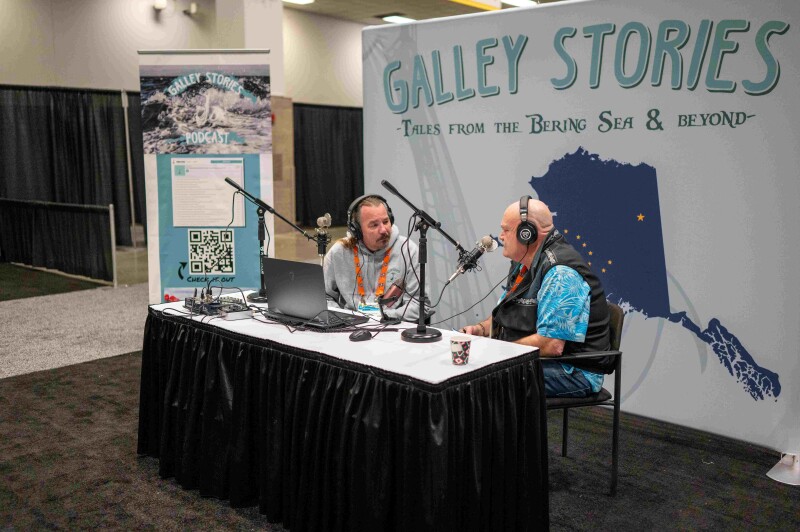
This year’s Pacific Marine Expo brings another chance to capture voices from across the fleet. Caylor recorded on-site at the Expo this past year, collecting stories in person from his booth on the show floor, and looks forward to doing the same over the next few days at Lumen Field in Seattle.
During the expo, he plans to interview Mark Ludwig, also known as “Birddog,” on Friday and Keith Singleton on Saturday. Last year, visitors to his booth lined up eager to sit and tell their stories. “I think I did five recordings at the booth,” he shared. “A lot of people walk up and are like, ‘Oh, I’ll tell you a story.’ You gotta feel it out and see if the conversation comes naturally.”
Some want to boast, and others want to share something real. “You can tell right away if someone’s got a good story to share,” Caylor said.
A small community with a big reach
Caylor is continually struck by the closeness of the fishing community. “Look how small our worlds are,” he said. “You and I both know the same person, and we’re maybe 4,000 miles apart?”
The industry is tiny, but its reach is global, and the stories feed nations. And Caylor will continue to help preserve them.
A passion project with no price tag
Despite its impact within the community, Galley Stories isn’t monetized. “Everywhere I go for this podcast and the interviews I have done come out of my own pocket,” Caylor said. He pays for travel and recording, and his generous sponsors, Xtratuf and Vallation Outerwear, help cover travel expenses for the Pacific Marine Expo. National Fisherman and the Expo have provided his booth for the past few years, for which he is eternally grateful. “It’s still 100 percent a passion project for me,” he shared.
Caylor believes deeply in what he’s doing, not just for today’s fleet, but for generations who will one day be their voices with years of stories to tell. Through Galley Stories, hundreds of families will never have to wonder what their loved ones hoped to share. Their voices- their humor, their pain, their pride, and their grit- will live on. When Caylor was asked how the community can support the podcast, he said the easiest way is to check out the Galley Stories gear shop he built. Every hat or shirt sold helps keep the conversations on the road and in the wheelhouses where they belong.
“Everybody has a great story,” Caylor said. “You just have to be willing to sit down and listen.”
.png.small.400x400.png)

