



In the wake of the devastating Ilwaco Landing fire in January 2024, something lasting took shape along the Columbia River—not just a response, but a movement.
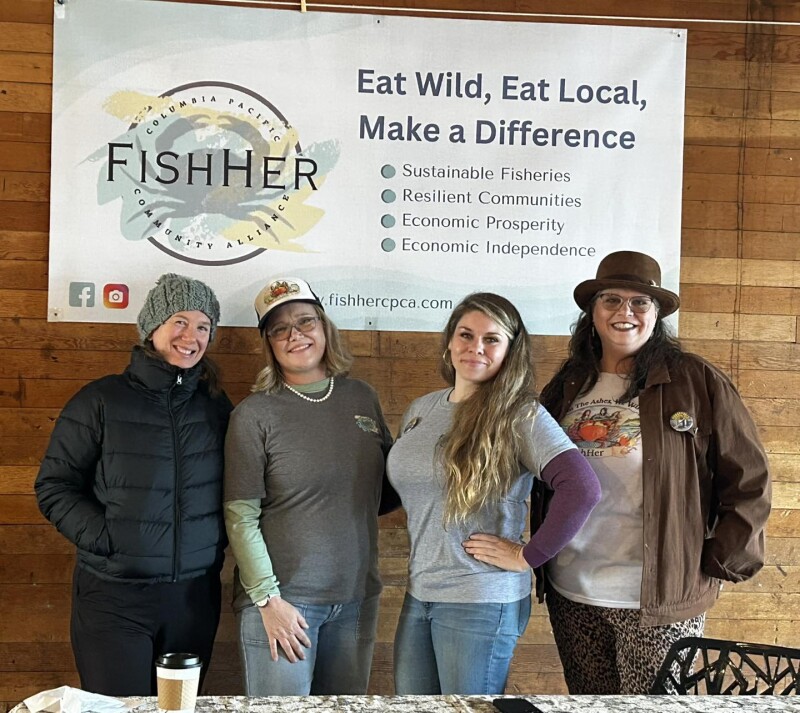
Fishermen’s families, especially the women who kept things moving behind the scenes, built something new. What started as a scramble to feed crews, organize volunteers, and get crabbers back on the water has grown into the FishHer Columbia Pacific Community Alliance (FishHer CPCA), a grassroots effort now reaching far beyond its origin.
“I realized we don’t have a group for the Columbia River region,” Amy Sharp said, following the fire. “As a result of the fire, we are creating a nonprofit organization of us women on the river to promote our industry, be there for the community, and respond to future emergencies.”
More than a year later, that mission hasn’t slowed; it’s expanded. Today, FishHer CPCA is involved in safety innovation, workforce training, international collaboration, and strengthening the cultural backbone of commercial fishing communities.
Turning tragedy into action
One of the organization’s most immediate focuses has been safety at sea, particularly around man-overboard incidents– a leading cause of fatalities in commercial fishing. On behalf of FishHer, Sharp has been working with the Coastal Trollers Association’s president, Geoff Lebon, on Project Joel,” Sharp said.
Project Joel, named for West Coast fisherman Joel Kawahara, aims to give fishermen a fighting chance in the critical first minute after going overboard. The loss of Joel from a man-overboard accident broke the hearts of the West Coast trollers from Alaska to California and beyond, and the initiative named after him aims to help facilitate self-rescue.
With support from the Pacific Northwest Agricultural Safety and Health Center (PNASH), FishHer and its partners have begun outfitting test vessels. “We received an initial start-up grant from PNASH to purchase safety equipment to outfit 15 test boats to see if the OLAS (overboard location alert system) engine cut-off system will work for the commercial fleet,” Sharp explained.
The system automatically shuts down a vessel if a crew member falls overboard, preventing a boat from continuing to steam on, or run away—one of the biggest barriers to self-rescue in small-crew operations. The broader outfitting effort also includes emergency ladders and wearable flotation.
“We are seeking grant funds to get vessels outfitted with the OLAS engine cut-off system, emergency ladders, and PFDs,” Sharp said.
The work is still in its early stages, but momentum is building quickly.
Bridging coasts and industries
What began as a West Coast initiative is already expanding into a national conversation guided in part by Sharp’s interactions with FISH Platform, or the Fishing Industry Safety & Health Platform. The global initiative is dedicated to standardizing maritime data exchange and improving safety standards–
“While at FISH Platform, I learned that REDDE Marine Safety out of Maine had put an ACR OLAS system on their test vessel,” Sharp said. “So I reached out to them to see if we could help empower them in their project, and vice versa.”
Sharp said that connection has opened the door to cross-country collaboration.
“The intent is now for us to collaborate to help streamline this process of testing, fundraising, distribution, and fleet installation for both the West and East Coast. So no one is re-creating the wheel.”
It’s the kind of practical, fisherman-first thinking that defined the Ilwaco response, only now applied at scale.
Investing in the next generation
FishHer’s work isn’t just about current crews, it’s also about who comes next. “We were able to get a grant to host a Coast Guard drill conductor course in Cathlamet, Washington, for the youth of that community,” Sharp said.
The training is designed for young people who head north to Alaska each summer to fish– giving them hands-on safety experience before they ever step aboard. It is open to students and community members.
“Students may be eligible for PPE or safety gear support,” she added, noting the program is still being finalized.
It’s a direct investment in a future fleet, one better prepared for the realities of the job.
Building a stronger network
FishHer is also helping knit together a broader network of fishing community organizations up and down the coast. “In January, the first HELM Summit was held,” Sharp said. Board members from WEFish, FishHer: CPCA, Newport Fishermen’s Wives, Charleston Fishing Families, and Central Coast Women for Fisheries, and Oregon Sea Grant all came together for a weekend of collaboration.
The summit focused on everything from shared projects to crisis response.
“We had a grief counselor provide training to help us show up in our communities during tragedies,” Sharp said. “We all discussed our major projects so those efforts can extend further seamlessly.”
The group plans to reconvene this fall in Seattle, continuing to strengthen ties across regions and fisheries.
Looking ahead
Even as FishHer builds locally, its leaders are looking globally for ideas to bring back to their home coast. “We will be traveling to Iceland on behalf of FishHer to represent the harvesters in our region,” Sharp said.
The trip, organized with support from Oregon State University, will focus on one of the most talked-about models in modern fisheries: full fish utilization. “The delegation will form a work group after the trip to bring positive innovation to our region,” she said, pointing to Iceland’s near 100 percent fish utilization as a key area of interest.
Back home, the organization hasn’t lost sight of its roots. In March, FishHer hosted its second Commercial Fishermen’s Appreciation Lunch, “a huge success,” Sharp said.
It’s a simple idea—feed the fleet, bring people together, but one that echoes the very first response to the Ilwaco fire, when volunteers rallied to make sure no one went hungry while rebuilding gear and getting back to work.
That spirit drives everything FishHer does.
“I am just a woman who has had the honor to be in an incredible industry filled with incredible men and women,” Sharp said. “Much love from the West Coast.”
.jpg.small.400x400.jpg)
