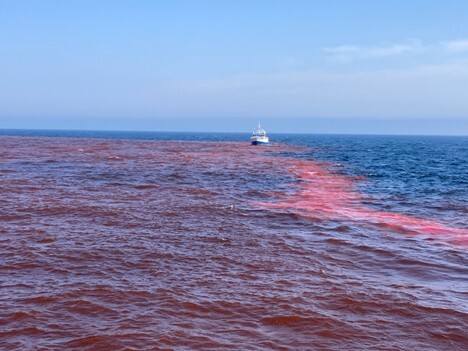
In an August 2025 field trial, researchers dispersed 16,200 gallons of sodium hydroxide tagged with a rhodamine tracer dye (visible in the red water color) to raise the alkalinity of a patch of seawater in the Gulf of Maine and calculate carbon uptake. Ph
Key Takeaways
With the launch of a set of guidance memoslast week, the fishing industry established its leadership in a set of novel ocean-based climate interventions that could someday become one of the largest human activities in the ocean: marine carbon dioxide removal (mCDR).
mCDR techniques are currently experimental; their effectiveness and environmental safety are yet to be firmly established. But against a backdrop of rising global temperatures and backpedaling on international climate commitments, these potential climate solutions are attracting increased attention. In just the last year, several field trials to test these methods at sea have been completed or planned.
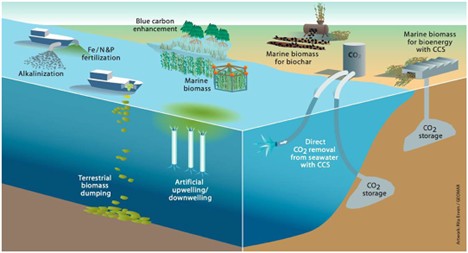
mCDR is a suite of proposed techniques that would leverage the ocean’s naturally occurring biotic and abiotic carbon pumps to remove more heat-trapping carbon dioxide from the atmosphere. Courtesy of Wikipedia
The new guidance memos position the fishing industry at the center of mCDR planning from the very start, hoping to establish the industry’s standing as a must-consult constituency and showing that fishermen have indispensable knowledge for making sure this new field advances responsibly.
“As mCDR research moves from the laboratory into the ocean, it is essential that coastal communities—including fishermen and their representatives—be included in the planning process,” said Fiona Hogan of the Responsible Offshore Development Alliance, which led the project. “Too often, stakeholders are not admitted early enough into offshore development processes to have meaningful influence over how projects are structured.”
Based on ideas put forth during a set of virtual roundtables by commercial fishermen and fishing industry association staff across Alaska, the West Coast, and the Northeast, the memos outline critical first steps for involving the fishing community in mCDR technology development, project governance and permitting, and collaboratively designed research. Acknowledging the potential for serious missteps that could harm ocean ecosystems and their dependent communities, the memos offer a hopeful-but-fragile path forward for “fishery sensitive” approaches to mCDR. Key to making this vision possible will be a firm commitment by mCDR funders, project leaders, and relevant policy makers to include fishing industry expertise and priorities from the earliest stages. "Fishermen have unique knowledge about the functioning of complex ocean ecosystems gained through decades or generations on the water,” said Darcy Dugan from the Alaska Ocean Acidification Network, one of three coastal and ocean acidification networks that participated in the memos’ creation. “Bringing fishermen into mCDR research and planning efforts creates real opportunities to be partners in co-designing this new ocean-based climate solution alongside scientists and engineers.”
Current status of mCDR
mCDR is not a single technology. Instead, it is a suite of several proposed techniques that share one objective: to remove and store additional carbon dioxide from the atmosphere in the ocean by deliberately enhancing natural oceanic processes, such as photosynthesis or the abiotic carbon cycle.
Biotic mCDR methods would draw down carbon dioxide from the atmosphere into the sea by propagating seaweeds, sinking vegetation to the ocean’s depths, or triggering phytoplankton blooms. For instance, a project led by the mCDR start-up company Carboniferous, Inc. is currently seeking a permit from the Environmental Protection Agency (EPA) to sink twenty packages of sugarcane waste product to the floor of the anoxic Orca Basin in the Gulf of America, where scientists will derive clues about carbon sequestration potential by measuring how fast the material breaks down.
Meanwhile in the North Pacific, the Exploring Ocean Iron Solutions (ExOIS) consortium is making plans to fertilize a patch of the Gulf of Alaska in international waters with iron particles, aiming to trigger a phytoplankton bloom. While this kind of experiment has been done at least thirteen times before in various parts of the globe, none of those earlier experiments measured carbon capture resulting from the blooms. The proposed work aims to fill that gap.
In contrast, abiotic mCDR methods would enable the uptake of additional carbon dioxide by stripping carbon dioxide from seawater or by converting dissolved carbon dioxide into stable, naturally occurring molecules in water through the application of electrochemical processes or the addition of alkaline substances that raise ocean pH.
This latter approach—called ocean alkalinity enhancement—was the method tested by the Woods Hole Oceanographic Institution’s LOCNESS (Locking Ocean Carbon in the Northeast Shelf and Slope) field trial in August 2025, which dispersed 16,200 gallons of alkaline sodium hydroxide into the Gulf of Maine. Early results from that experiment published last month signaled no measurable impacts to sea life and successful production of conditions allowing the surface ocean to take up carbon from the atmosphere.
Alongside these prominent field trials, early discussion around mCDR policy instruments is beginning to take place. In February, coastal senators and representatives introduced a bipartisan bill titled Removing and Sequestering Carbon Unleashed in the Environment and Oceans Act (ReSCUE Oceans Act), which aims to establish the United States as a leader in mCDR research and responsible testing. Meanwhile, a draft version of a legislatively commissioned report in Massachusetts envisions the state as a hub for mCDR research and development, and other coastal states are considering their own mCDR ambitions.
The prevailing financial model supporting the growth of mCDR is likely to be the carbon market, in which polluting companies can offset their emissions by paying mCDR companies to remove carbon dioxide from the atmosphere on their behalf. Although the technology behind mCDR is still quite new—and many scientists would say unproven—carbon offset protocols have recently been developed to facilitate these sales, and almost a million tons of mCDR-based offsets have already been transacted on the carbon market.
What’s most noteworthy about all of this is how fast it has happened. In the space of about four years, mCDR has gone from a fringe idea to major area of research and investment, underscoring the need for the fishing industry to develop its standing in this field as soon as possible.
Voices from the fleet
Fishermen and fisheries representatives who helped inform the new guidance memos praised the work.
"It's so important for members of the fishing community to get ahead of things like mCDR that may be coming at us," said Melanie Brown, who fishes in Bristol Bay, Alaska. "Thanks to projects like this one, we are getting ready and informed in advance of specific projects being proposed in our waters."
"It's going to be critical for the fishing industry to provide input on things like mCDR research priorities, siting and timing of mCDR projects, and any potential mitigation measures that might be needed down the road," said Shaye Rooney of the Commercial Fisheries Center of Rhode Island. "There are a lot of unknowns and questions to be considered and addressed before any projects should be able to move forward. It's valuable that a guide to best practices has been developed through an industry-led initiative like this."
"Fishermen have been working on the water and working with nature for hundreds of years, and we have a lot of stake in the game," said Antonio Arena, who fishes in Bristol Bay, Alaska. "I hope to be fishing for the next 25 or 30 years, which means that when I get to the end of my career, I'm going to be facing the repercussions of either climate change or the failure of a climate solution. I'm personally very invested in seeing something like mCDR work, but it has to be done the right way."
Have you listened to this article via the audio player?
If so, send us your feedback around what we can do to improve this feature or further develop it. If not, check it out and let us know what you think via email or on social media.
Sarah Schumann fishes commercially in Rhode Island and Alaska and coordinates the Fishery Friendly Climate Action Campaign, which is partnering with the Responsible Offshore Development Alliance to support thought leadership by commercial fishermen in advancing “fishery sensitive” approaches to the science and governance of ocean-based carbon dioxide removal. Sarah can be reached at [email protected].




.png.author-image.300x300.png)