




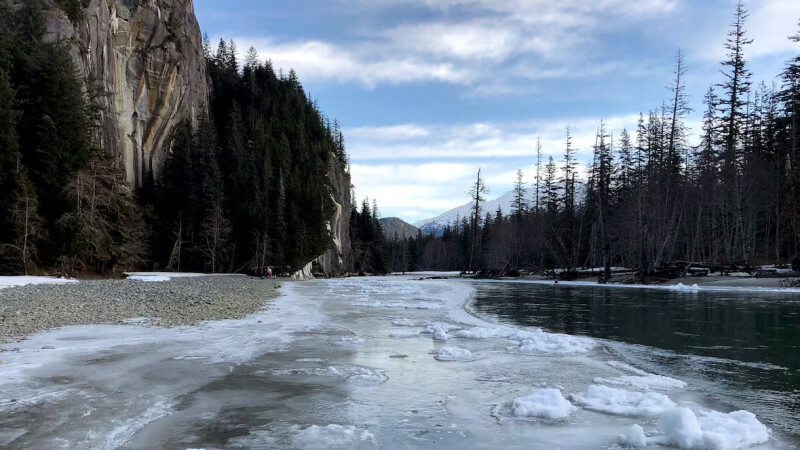
Reports of mine tailings dams leaching toxicants into salmon-rich transboundary waterways flowing into Southeast Alaska are raising concerns of fishermen, tribes, First Nations, and communities on both sides of the Alaska-British Columbia border.
According to Salmon Beyond Borders and the Alaska Longline Fishermen's Association (ALFA) the administration of Alaska Gov. Mike Dunleavy has put the risk of transboundary mining contamination of shared rivers at greater risk a decade after the Alaska and government of British Columbia signed a Memorandum of Understanding about Canadian mining on these transboundary rivers flowing into Alaska.
"For eight years the Dunleavy administration has allowed ongoing and new pollution from B.C. transboundary mines to go unaddressed and for B.C. to skirt accountability for commitments outlined in state-provincial agreements," said Breanna Walker, director of Salmon Beyond Borders, in a statement issued on Nov. 25.
"Alaska's fisheries are increasingly at risk from British Columbia's transboundary mines," said Linda Behnken, executive director of ALFA. "We rely on both state and federal governments to negotiate meaningful protection for Alaska waterways and fisheries. In the absence of meaningful action our fish, fisheries and fishing communities are vulnerable."
State of Alaska officials say they are in fact very engaged with British Columbia through the Transboundary Bilateral Working Group. Sam Dapcevich, special assistant to the DEC commissioner, said in an email on Nov. 26 that "Alaska also continues to advocate for cleanup of the Tulsequah Chief mine. DEC is fully engaged and working with our B.C. counterparts on activity awareness and status of projects," he said.
Alaska Commissioner of Fish and Game Doug Vincent-Lang said that the partnership between Alaska and British Columbia has led to significant program toward safeguarding these waterways and fisheries from impacts of Canadian mining practices. "All future mines are now properly bonded to ensure cleanup in the event of an incident, and restoration plans are in place for legacy sites like the Tulsequah Chief mine," Vincent-Lang said. The commissioner also said that transboundary waters entering Alaska are meeting the state's water quality standards and fish sampled to date show no signs of contamination. "Overall, the agreement is delivering results, and we are seeing meaningful progress," he said.
The Tulsequah Chief gold, copper, lead, zinc and silver mine, which was shut down in 1957, meanwhile, it continues to pollute the waterways in northwestern British Columbia.
Dunleavy aide Jeff Turner points to the government of British Columbia website, last updated on May 21. The website states that a robust permitting process and reclamation requirements are in place to make sure that mining projects near the B.C. and Alaska border are planned, operated, and closed safely. The 11 mines include Brucejack, Eskay Creek, Galore Creek, Golden Bear, Kitsault, KSM, New Polaris, Premier, Red Chris, Red Mountain Underground Gol,d and the Tulsequah Chief.
Teck Resources, the original developer of the Tulsequah Chief Mine, is voluntarily leading and funding site investigation and closure planning with the Taku River Tlingit First Nation (TRTFN) and the B.C. government, as the most recent owner, Chieftain Metals, went bankrupt. A final plan for implementing site reclamation is still a work in progress.
On March 17 of this year, the SkeenaWild Conservation Trust, a nonprofit entity in northwestern British Columbia, whose mission is to conserve wild salmon and steelhead populations in the Skeena Watershed, issued a report on the Red Chris mine, an open-pit copper-gold-silver mine at the headwaters of the Iskut and Stikine rivers, which began operating in 2015. In 2023, owners of that mine began pursuing expansion of their operations. In February of this year, in response to U.S. tariff threats, the provincial government included the Red Chris expansion project on its list of projects to fast-track.
Expansion of the Red Chris mine will shift the mine's focus from copper to gold, the SkeenaWild report said.
"Mine operators are considering additional future expansions that would further destroy aquatic habitat and raise the consequences of a tailings dam failure." The report was also critical of what it termed "shortcomings in provincial regulatory requirements and oversight, resulting in inadequate monitoring, predictions and planning, failure to minimize the scope and scale of the project, disregard of independent expert advice, and delays in thoroughly assessing and managing mine environmental effects."
The report concluded that a major tailings dam failure at Red Chris would destroy or deteriorate critical fish or wildlife habitat and could result in loss of human life.
On June 18, Salmon Beyond Borders urged action from state and federal officials due to increased political tension between the U.S. and Canada that prompted the B.C. government to announce plans to fast-track potentially dozens of proposed gold mines and exploration projects in the transboundary Taku, Stikine, Unuk and Salmon river basins, which flow from northwest B.C. into Southeast Alaska.
Salmon Beyond Borders' Breanna Walker at that time urged a push back against B.C.'s plans to industrialize the transboundary region, on threat of "undocumented extinction in this salmon stronghold."
A CBC (Canadian Broadcasting Corporation) report in January of 2025 cited a report from the Pacific Salmon Foundation noting that the transboundary region is rich in mineral resources and that there is a high likelihood that mining development will increase substantially in the years to come, particularly as glaciers recede and new habitats become accessible to mining exploration. The Pacific Salmon Foundation said several things need to happen, including filling existing data gaps with information on salmon biodiversity, more research on habitats and their quality, and making data readily accessible and easy to comprehend. "Examples of all these include attaching radio tags to salmon to understand their long voyages and patterns in between, as well as developing more comprehensive mining threat assessments, which evaluate the risks such as tailings dam failures," the report said.
Alaska officials meanwhile are standing by their contention that their collaboration with the B.C. government is making meaningful progress to safeguard salmon habitat in Southeast Alaska.
.png.small.400x400.png)
