

California fishery managers are tightening restrictions on the commercial Dungeness crab fleet as whale entanglement risk rises along the coast, while also expanding the use of alternative gear.
California Department of Fish and Wildlife (CDFW) director Meghan Hertel announced new actions under the state’s Risk Assessment Mitigation Program (RAMP), targeting Fishing Zone 1 through 3, spanning from the California/ Oregon border south to Pigeon Point.
Under the latest determination, Fishing Zone 3– from the Sonoma/ Mendocino County line to Pigeon Point– will close to traditional trap gear at 6 p.m. on April 30. At that point, “the commercial take and possession of Dungeness crab from those waters is prohibited with traditional trap gear.”
CDFW is also opening the door for fishermen to continue working in the area using pop-up gear. Beginning 7 a.m. on May 7, vessels in Zone 3 will be authorized to deploy the ropeless systems, which keep lines and buoys stowed on the seafloor until retrieval.
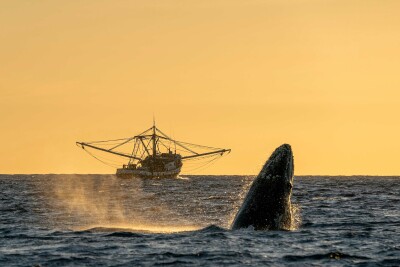
The shift comes as humpback whales return to forage off California, a seasonal migration that has increasingly overlapped with the crab fishery. CDFW noted they “anticipate an increase in whale abundance in the upcoming weeks. Individuals should remain vigilant and be prepared to remove gear quickly, to minimize entanglement risk in these Fishing Zones.”
Further north, Fishing Zones 1 and 2 remain open, but with tighter control. Existing trap reductions will stay in place, and a 30-fathom depth restriction will take effect at 6 p.m. on April 30.
CDFW also expanded allowances for retrieving lost or abandoned gear — a growing priority in reducing entanglement risk. In Zone 3, unlimited retrieval of derelict traps will be allowed beginning May 7, with additional flexibility for vessels using authorized alternative gear later in the month. All marine life encountered during retrieval must be released immediately, and vessels participating in gear recovery are required to report activity to the agency.
The move builds on earlier actions this spring, including the authorization of pop-up gear in Fishing Zones 4 and 5, which began April 3. CDFW shared that the next risk assessment is expected in early May.