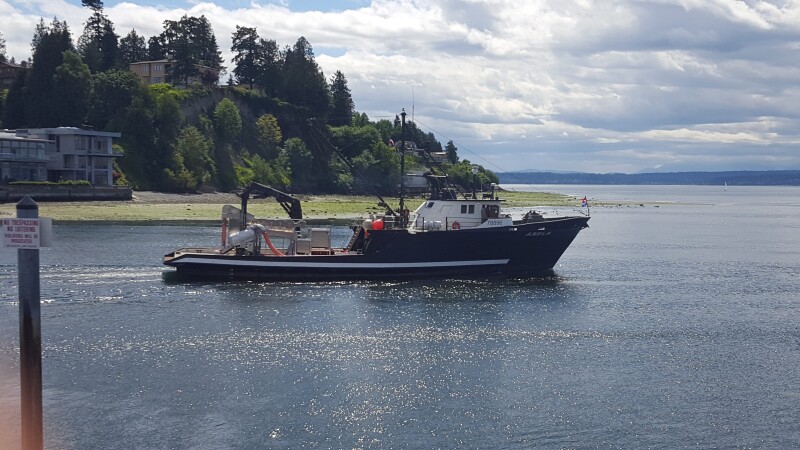
Over the course of 55 years, the uniquely designed Anela has transitioned from a tuna boat to a hotel, and eventually to a salmon tender.
When the Alaska salmon tender Anela first left Martinolich Shipyard in Tacoma, Wash., the vessel’s unique design caught the eye of Kris Mullan, who, as a kid, watched the unusual boat being launched in 1971. Decades later, the Seattle fisherman is now the vessel’s owner.
“It was the first sampan built in the U.S.A,” says Mullan, who purchased the vessel in 2017. “Anela means ‘angel’ in Japanese, and the design was a collaboration between the Japanese owner of the Angel Fish Company in Hawaii and Martinolich. A sampan has a wide flare, especially at the bow, and it’s wider on deck than at the waterline.”
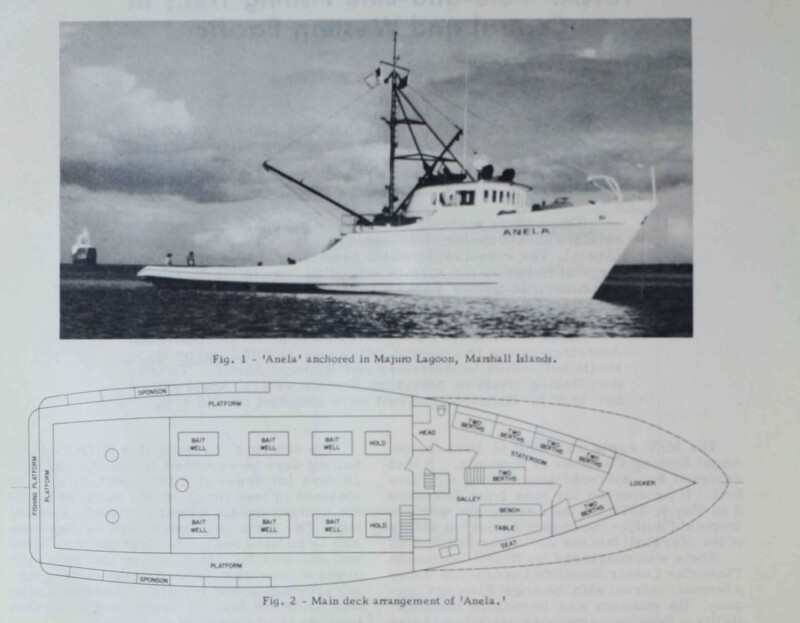
At the former Martinolich yard, Anela came down the ways at 102 feet overall, with a 24.5-foot beam at the waterline – 26.5 at the rail – and a draft of 12 feet when fully loaded. The vessel was initially rigged as a tuna bait boat on which four or five fishermen with poles lined each side of the deck, baiting tuna close to the boat, and slinging them in on barbless hooks.
“The usual bait boats had racks that they rolled out onto the sides,” says Mullan. “But the Anela had troughs along the sides that the guys stood down in, and they tossed the tuna into what they call the arena in the center of the deck to bleed out. They fished like that from when the boat was delivered in 1972 into the ‘80s.”
Mullan is steeped in the boat’s history and adds that the National Oceanographic and Atmospheric Administration (NOAA) chartered the boat not long after it was launched. “NOAA took it to the Marshall Islands to experiment with bait fishing for skipjack tuna. There’s a report on it. It led to the start of a fishery down there.”
The early version of the boat had 12 berths on the main deck, 10 in one stateroom and two in another. “Somebody bought it and turned it into a live-aboard hotel,” says Mullan. “When I bought it in 2017, it was sinking at the dock in Kake, Alaska.”
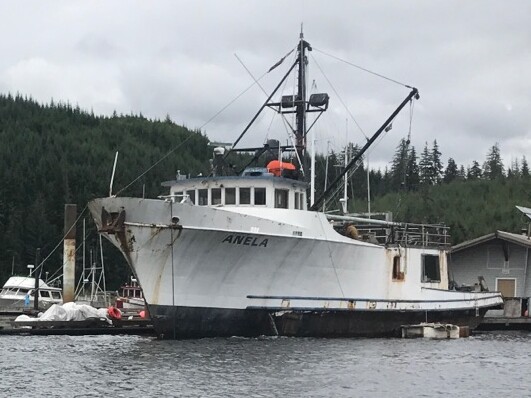
Mullan hired a captain to get the boat to Seattle, but the journey turned into a series of catastrophes narrowly averted. “Five hours after leaving Kake, the main engine spun a main bearing, the boat drifted all night in Frederick Sound until I found a tug to go retrieve it. I found temporary moorage in Petersburg, Alaska, and continued to get the boat seaworthy to head to Seattle. I flew up every three weeks to help with progress, but it wasn't happening.” Mullan hired a tug to get the boat and had it towed to Stabbert Maritime in Seattle, where most of the initial conversion to a salmon tender took place.
“When I bought the boat, I thought I could get it all done for around $400,000. Now I have a million into it and am always doing something.”
Currently, the Anela is docked at Pacific Fishermen Shipyard (PacFish) in Seattle, where she is undergoing a few improvements. “We’re putting new steel in the floor of the head,” says Mullan. “And redoing the galley.”
It’s the first time that the Anela has been to PacFish, one of the oldest yards in Seattle. With boats having been built and repaired on the site since 1871, PacFish – established in 1946 – has history. For many years, Doug Dixon ran the yard, highlighting its history. Dixon kept a room in the shop as a museum dedicated to Frederick Douglass, the 19th-century former slave and abolitionist who was also a master ship caulker.
Dixon noted that Jacques Cousteau’s research vessel, Calypso, was built on the site as a minesweeper and later converted by Cousteau. He also kept a piece of the sternpost of the Wawona in the yard. The Wawona was the largest three-masted schooner built in the U.S.; launched in 1897, it was taken apart in Seattle in 2009.
PacFish has a skilled team now led by Chris Johnson. The yard can handle just about any job, and although its most recent restoration was the steamship Virginia V., the yard was founded by and remains committed to commercial fishermen.
“We repowered her in 2019,” says Mullan. “She had an 850-horsepower 398 Cat with a lot of hours on it. I found the same engine being used as a generator in Florida with only 150 hours. I bought it and stripped the original for everything I needed to marinize the new one, and then put it in.” Mullan had to cut a hole in the side of the Anela to get the old engine out and the new one in.
The drivetrain includes a Twin Disc 7251 with 4.5:1 reduction, 7.5-inch diameter shaft, and 50-inch wheel. “I don’t know the pitch off the top of my head, but it’s a fast boat, that’s the sampan design. It has what you call an axe bow, very sharp, the hull speed is 14 knots. But we run 10 knots, and we’re only turning 700 to 900 RPMs.”
Mullan also put in a pair of Cummins 6BT 5.9-D 100kW gensets. “They’re the old bulletproof mechanical engines, and either of them can run everything,” says Mullen. “Including the RSW.”
The Anela’s RSW (refrigerated sea water) system consists of two Carrier compressors: a 30-ton and a 50-ton, and a 50-ton IMF chiller. “I know how important the chiller is, and IMF is one of the best,” says Mullan.
On deck, Mullan bought a North American 8-ton crane from a king crab boat that was getting a new one. “I put his old one on the boat. It’s got a 2,200-pound capacity at 42 feet, so I can reach anywhere around the boat, and off the stern by 15 feet; it’s great for offloading on either side.”
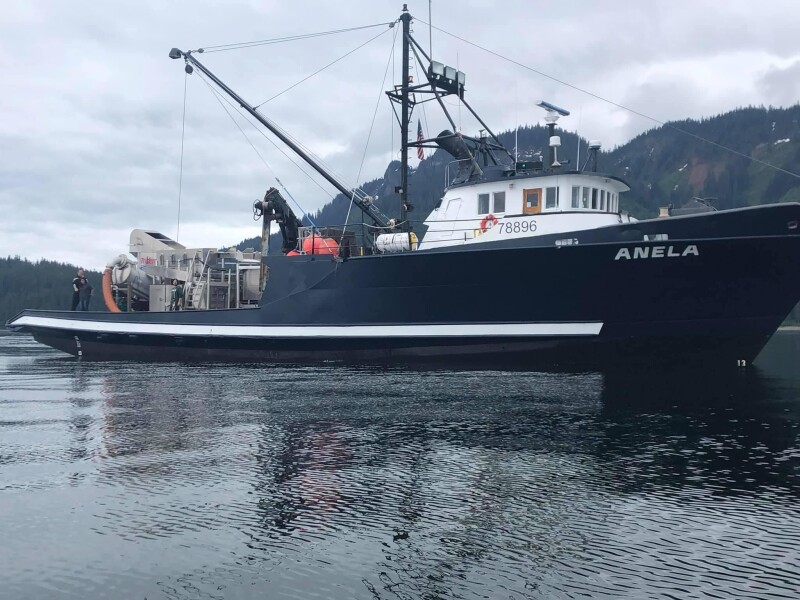
For moving fish, Mullan went for volume and speed. “I’ve got a big Transvac fish pump on there that pumps about 70,000 pounds every 30 minutes,” he says. “Everybody likes that. Also, we give out ice cream to the boat crews when we’re pumping, they like that too.” With all the new equipment on deck, Mullan had a new stability test done in 2019.
As a tender, the Anela carries a very basic electronics package. “It has a big 100-mile Koden radar that came with it,” says Mullan. “I wasn’t familiar with Koden, but I like it. That’s tied in with the plotter and sounder.”
The boat still has space for ten crew, although for tending, they only carry three or four. “I’m going to redo the staterooms,” says Mullan. “Because the guy who has been running the boat for me, Carson Lang, wants to start taking his family.”
Mullan expects the Anela to get out of PacFish and up to Alaska for the coming season – a boat with a lot of history, leaving a yard with a lot of history. It’s the first time Mullan used PacFish, but they may have been made for each other.
Owner: Angel Marine
Year built: 1972
Hull material: Steel
Tonnage:150 tons
Length: 102’ overall
Beam: 24.5’ at the water. with deck flare – 26.5’ overall (deck extension)
Draft: 12’ (fully loaded, fuel, water and product)
Propulsion: D398 Caterpillar 850 HP (fresh engine, 150 total block hours), Twin Disc 7251 with 4.5:1 reduction, 7.5-inch diameter shaft, 50-inch wheel.
Gensets: 2 Cummins 6BT 5.9-D 100 KW gensets
Deck: North American 8-ton crane, 2,000-pound capacity at 42’ reach
Pump: Transvac 70-ton/hour
Births:10 people in 3 staterooms (captain’s stateroom, a 3-person stateroom, and a 6-person stateroom)
Fuel:12,000 gallons in 5 tanks
Potable water: 3,000 gallons
Hold capacity: 220,000 lbs. in 4 holds
Speed: 10 kts cruise (16 gph), 13.8 kts max speed
RSW: New IMS 50-ton Titanium chiller for two Carrier compressors, a 30-ton and a 50-ton
Electronics: Koden radar, unspecified plotter, sounder, radar, AP 70 Autopilot
.