

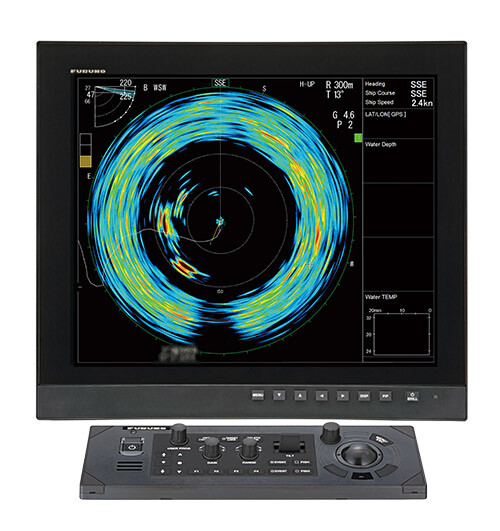
Furuno’s newest Omni Sonar is moving into the commercial fisheries market and taking it by storm.
Furuno has been making Omni Sonar since 2014, starting with the CSH 8L, followed by the CSH 8L Mark II. The Mark II is a full-circle scanning sonar that can detect fish schools, individual fish, and changing underwater conditions. Operating at 85 kHz, the older Furuno Omni monitors fish distribution and seabed conditions 360 degrees around the vessel.
“We sold a thousand of those,” says Matt Wood at Furuno. “There was a sport fisherman who bought one and started winning tournaments all over. Fishermen can be kind of cagey, but when people asked him how he was doing it, he told them.”
In 2024, Furuno introduced the CSH10, a new version of the original machine. “It’s still an 85kHz midrange sonar,” says Wood. “But it has more features and settings that allow you to dial in what you want, the type of water you’re in, type of boat, and more. You can go as deep as you want with customization, or if you want to set it and forget it, we can preset it for your region and fishery.”
The original Furuno Omni came out of the gate as a high-end recreational fishing unit, and the CSH10 was introduced at the Fort Lauderdale Boat Show in October of 2024. Wood believes the unit can also find a place on commercial fishing vessels.
“We tested it on the Pacific Ram, an 80-foot trawler, and got great feedback,” he says. “Its effective angle is 20 degrees to 80 degrees, and it can detect fish down to 900 meters (490 fathoms). We think it can make a great primary sonar on smaller to midsize vessels like the Pacific Ram, and up to 150 feet or so, and an effective secondary or backup sonar for the 250 and 300-foot factory trawlers.”
Among other things, Wood notes that the CSH10 is good for analyzing “carpet sign.”
“Carpet sign is when the fish spread out during the day and get close to bottom,” he says. “The CSH10 can show you the structure of the fish aggregations. It’s kind of a greenlight redlight thing. Are there enough cherries in there to make it worth the risk of setting, especially around those spires off northern California?”
To make it easier for CSH8L users to upgrade, the CSH10 has the same footprint and transducer tube size as the original. “It is installed in an 8-inch sonar tube and tubes are available as an option,” says Wood.
The new unit also has the potential to be integrated into AI systems that expand its capabilities. “We’ll be able to tie it to our TZTXL MFD (Navnet TZtouchXL multifunction display),” says Wood. “Then it can help generate intuitive routing, based on bottom type and ocean conditions to help users get on fish, and it can overlay on the plotter so you can correlate where there’s fish with other features.”
Wood notes that the price is around $95,000. “With tariffs, it’s a $100,000 unit that we can’t keep on the shelf. We’ve delivered over 100 since the October show, and we’re backordered for hundreds more. The user feedback is all great.”