
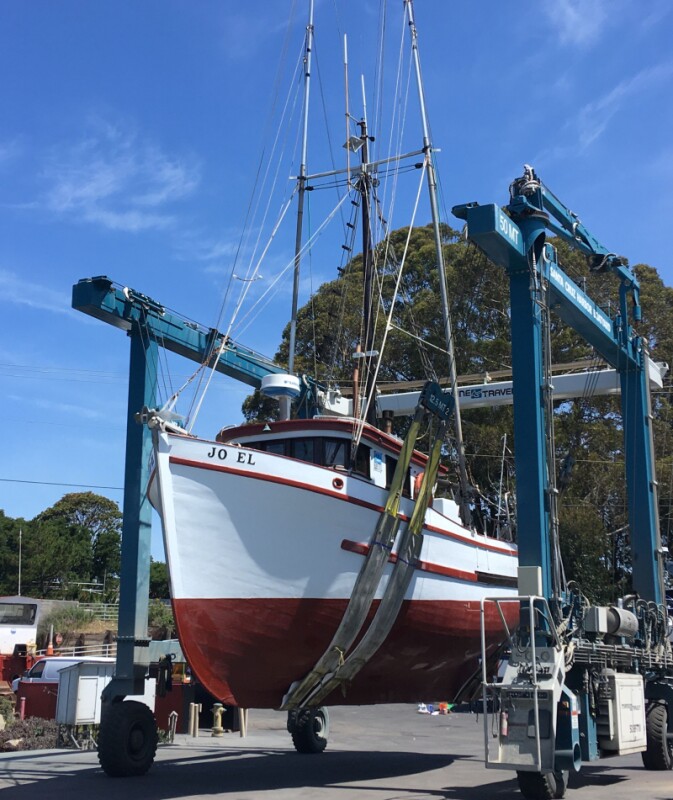
Owner/Operator Brett Montague keeps things simple on the 58-year-old albacore troller, Jo El, with a focus on quality, not quantity.
When Brett Montague bought the 40-foot albacore/salmon troller, Jo El, in 2018, the previous owner had had it for 38 years. “Before that, it went through three owners in rapid succession,” says Montague. “So we don’t know much about who built it. All we know is that it was home built in Sunnyside, Washington. I have heard that there was another like it built there, but I can’t say for sure.”
Montague operates out of Newport, Oregon, and what he does know is that the boat is built primarily of Douglas fir. “The planking is all one and a half-inch Doug fir,” he says. “The frames, too, I think. There’s so much paint on them, I can’t tell. The bulwarks are all Alaska yellow cedar.” He adds that while the vessel is 58 years old, it’s solid. “I haven’t had to do anything to it. I just do what Chris, the previous owner, did: haul it out once a year, paint the bottom, change the zincs, and check the propeller. We drop the keel cooler and clean behind it, and paint. I do any corking that needs to be done, and sealing the seams.”
For power, Montague has an old 125-hp John Deere 4045. “I think he put it in in 2003,” he says. “It’s got over 42,000 hours on it, but it’s going strong. I change the oil and filters every 250 hours.” The little 4-cylinder engine turns Twin Disc gear at 2.92:1 with a 1.5-inch stainless steel shaft and a four-blade, 30x17, bronze prop a Twin Disc gear at 2.92:1.
“It’s silly how efficient it is,” says Montague. “The last owner set it up as a freezer troller, with a homemade, hydraulic-driven, 5-ton blast freezer. I run that and the salmon gurdies off the front of the engine. With the freezer running going full throttle half the day, I average 1.7 gallons an hour.”
While hydraulics drive the freezer and gurdies, there is no power steering on the Jo El. “It’s got old-fashioned chain steering,” says Montague. “I thought about changing it, but it works. The couple of times I’ve had problems, I’ve been able to fix them easily.” Nor does Montague speak of a hauler on the stern for albacore. “We hand haul every fish,” he says. “At the rate that we can freeze fish, it makes sense to hand haul,” he says. “And I enjoy it. I’m still young enough.”
At age 42, Montague has decided that the Jo El is a good fit for the way he wants to fish, with a focus on quality, not quantity. “I thought about going bigger, but this is all I need. I could fish single-handed, but I always take another guy. I have two bunks forward, and there’s a lot of space in the wheelhouse. I have a full-sized diesel stove, a table big enough for two.”
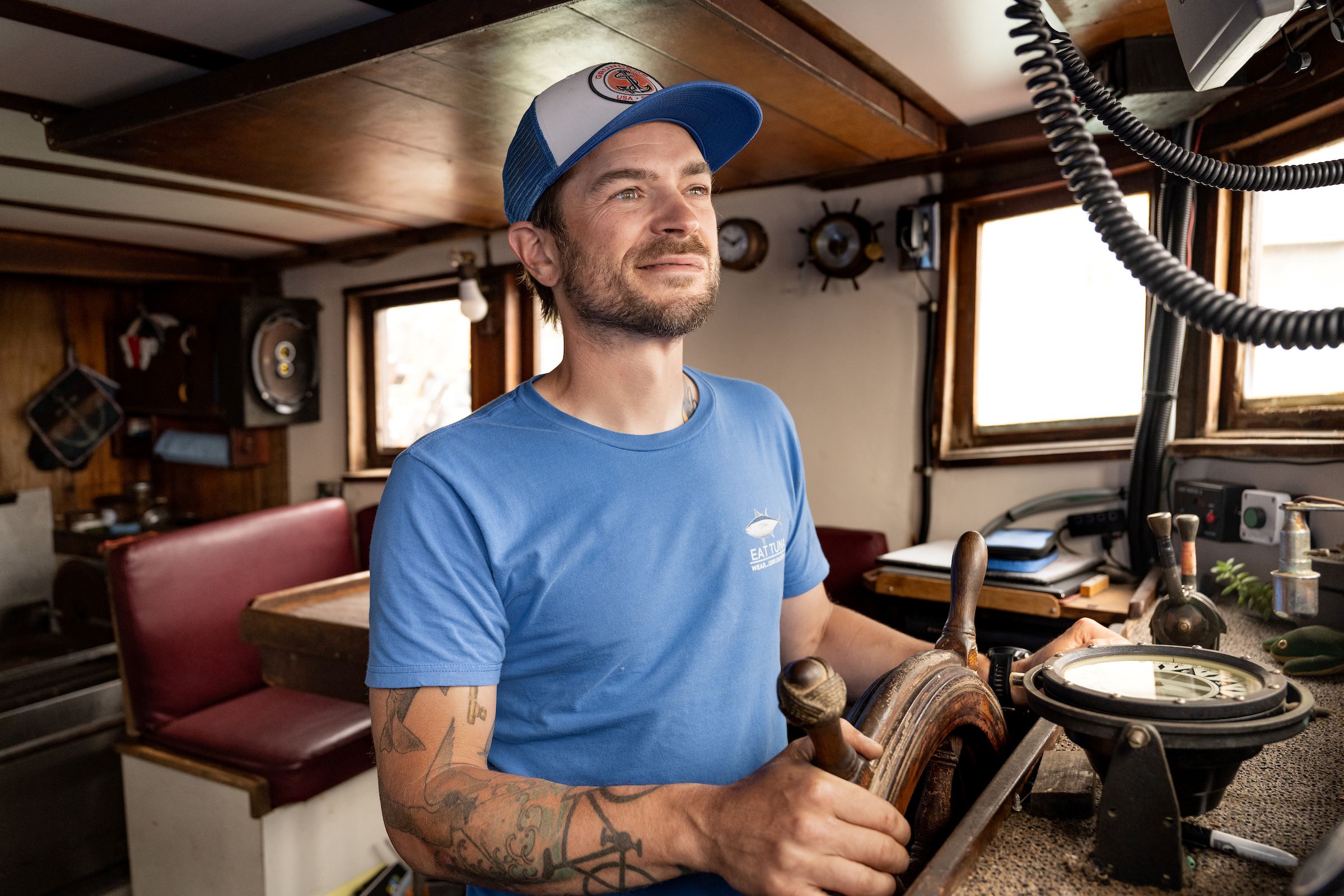
Montague keeps his electronics package simple too. “I have a Furuno 24-mile radar, a Garmin sounder, and I run Coastal Explorer charts on my laptop. I also have a 12-volt ComNav autopilot that works fine, and a Global Star satellite phone to call home and check in. Everyone has Starlink, but I’m not going to get it.”
On deck, Montague has a basic troller set up. He drops down the long trolling poles on port and starboard, and either runs eleven lines when fishing for albacore—four on each pole and three random—or he runs six lines when trolling for salmon—three on each pole—all handled from the gaffing pit.
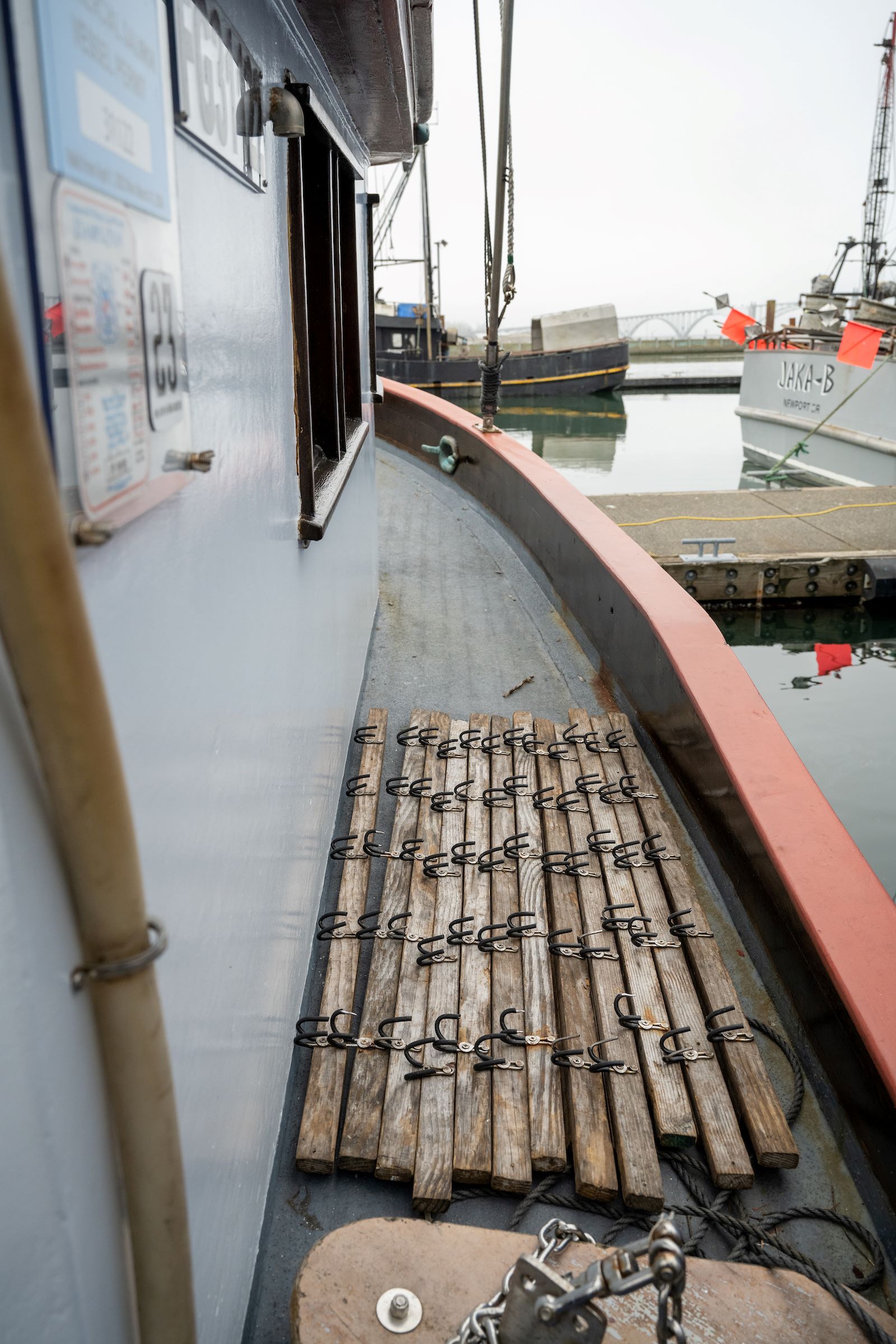
With his freezer, Montague has lots of options. He can freeze about 120 tuna a day, and with a fuel capacity of 600 gallons, as well as four 55-gallon barrels of diesel lashed to the port and starboard rails, he can stay out for as long as 12 days, or until he fills his hold. “I can put 6 tons aboard,” says Montague. “We bring them aboard, spike them, cut them, and put them in a chiller tank to bleed out.” Montague and his crewman then hook the fish onto wooden rails and hang them in the blast freezer, at -30 degrees. “It takes eight to ten hours for an albacore to freeze. Once I get my rails full, I quit for the day. People think I’m crazy.”
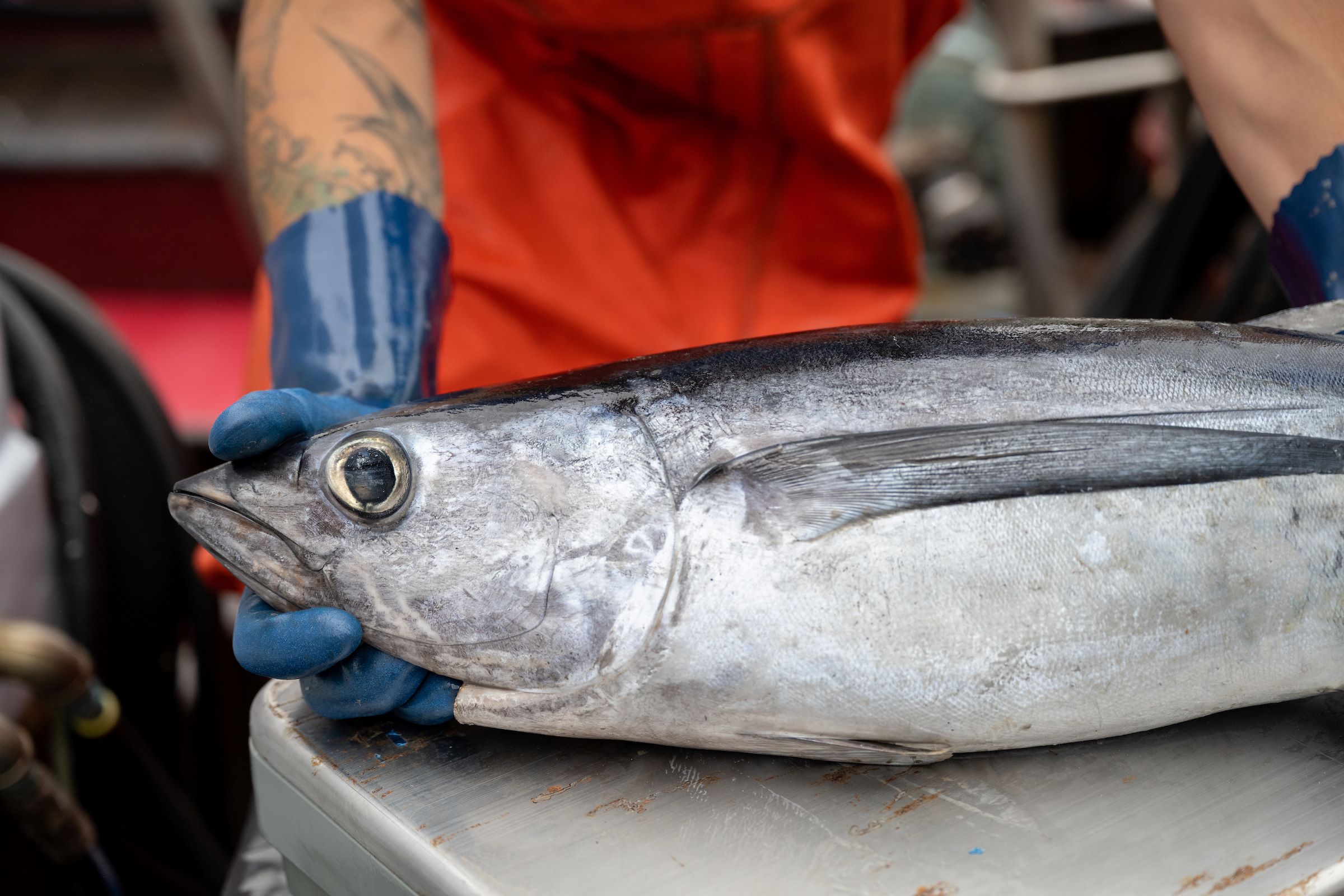
As noted above, quality is Montague’s mission, and he is equally careful with the salmon he catches. “I bang them when they’re still in the water, bring them aboard, cut them, pressure bleed them, and put them in a chill tank to continue bleeding out, though there’s not much after the pressure bleeding.” Montague then either hangs the salmon in the freezer or lands it fresh, depending on where he is fishing and how long he’s been out. “I have a ship and shore tank, and I can chill the water down to 32 degrees and keep the fresh salmon in that.”
Between the bleeding tank, the extra fuel barrels, and the evaporator for the freezer, the work deck of the Jo El appears a little crowded. “A lot of guys put the evaporator down in the hold, but having it on deck leaves more room for fish,” says Montague.
To make his low-volume, high-quality business model work, Montague sells much of his catch to Local Ocean Seafood in Newport and markets the rest himself. “I have always wanted to get quality fish to people,” he says. “I tried buying and selling before I bought the Jo El,” he says. “But that fizzled out. Then, when I got the boat, my wife started a food cart business selling only what we caught. But the demand was there, and we started Safe Harbor Seafoods.” He notes that with the albacore season over, he and his wife will be spending the next few months canning and smoking.
Montague also plans to expand his fishing operation to bring more species to market. “We just got our VMS in the mail, so now we can target species like black cod, ling cod, and rock fish. Now, if I get any of those as bycatch when I’m salmon trolling, I can keep them. And I plan to rig up for fishing vertical longlines in the winter. You get 25 hooks on a line, a weight on the bottom, and a buoy at the top, and you can catch those open access species.”
A fortunate combination of decades of care and maintenance of a wooden boat, an owner with a vision, and a growing market has kept the Jo El afloat, both physically and economically, but there is still a lot of work to be done, Montague points out. “It’s all about educating consumers,” he says. “Ever since that movie Seaspiracy came out, a lot of people think all fishing is done with big nets. I tell them, No. All my fish are caught on hooks with almost no bycatch.”
With years ahead of him and the Jo El ready for another 58 years on the water, Montague is well-positioned to continue his mission of bringing the highest quality seafood to the people of Oregon and beyond.
Name of Boat: Jo El
Home Port: Newport, Oregon
Owner: Brett Montague, dba BNS Fisheries
Builder: Home Built, Sunnyside, Washington
Hull Material: Wood
Year built: 1967
Fishery: Albacore, Salmon, Rockfish, Ling Cod, Black Cod
Length: 40 feet
Beam: 12 feet
Draft: 6 feet
Engine: 150-hp, John Deere 4045
Power Train: Twin Disc @2.92:1; 1.5 inch stainless shaft; 30x17, four-blade bronze propeller
Hydraulics: powered off the front end of the JD 4045
Fuel Capacity: 600 gallons
Top Speed: 6.5 knots
Cruise: 5.5 knots
Hold capacity: 6 tons
Blast freezer: 5-ton home-built blast freezer.
Crew accommodations: Galley bench and settee, diesel stove, fo’c’sle with 3 bunks.
Electronics: Furuno radar, Garmin Sounder, NavCom autopilot, Global Star sat phone
Deck Gear: Port and starboard 3-spool salmon gurdies, and a Warren Junes albacore hauler to be installed for hauling vertical longlines.