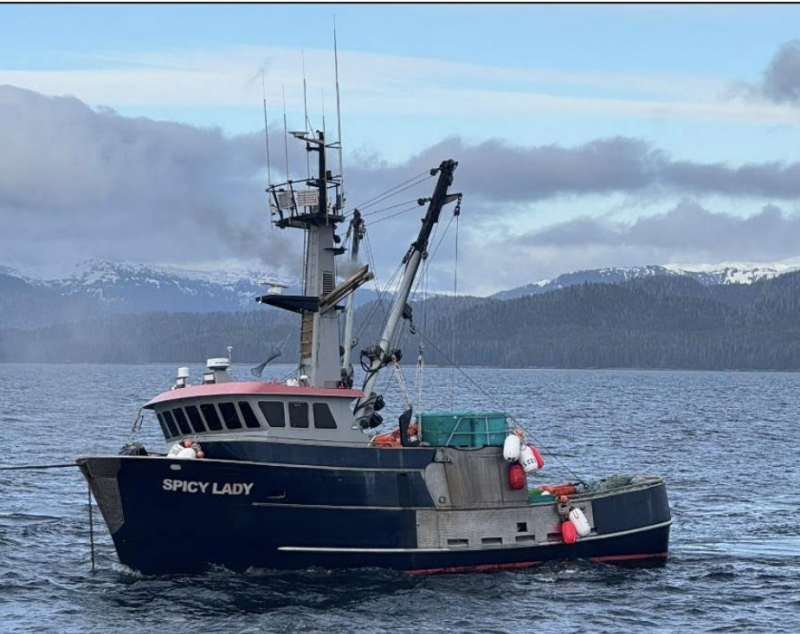
A fire that started in a berthing area forced the crew of an Alaska fishing vessel to abandon ship and left the vessel a total constructive loss of $1.6 million, according to a National Transportation Safety Board report.
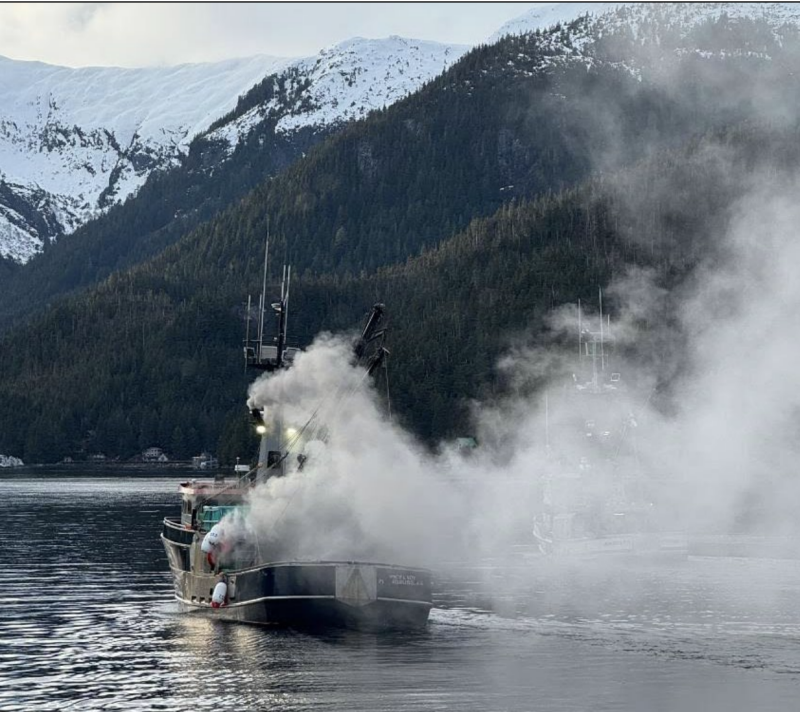
The commercial fishing vessel Spicy Lady was fishing in Chatham Strait March 6, 2025 about 1 mile west of Point Gardner, Alaska, when the vessel caught fire. The five crewmembers on board were unable to extinguish the fire and abandoned the vessel onto a nearby Good Samaritan vessel, with one the vessel’s deck boss sustaining minor injuries.
The crew on the aft working deck were preparing to haul in a crab pot when they noticed smoke coming from the main cabin. The deck boss and another crewmember entered the main cabin to investigate and saw a fire in a crew berthing area located near the bow of the vessel.
A mattress was on fire in the portside middle bunk; the deck boss tried to remove it but was unsuccessful, sustaining burns to his hands. The crew tried to fight the fire using handheld fire extinguishers and hoses from the vessel’s washdown pump but were forced to evacuate the main cabin due to increasing smoke and limited visibility.
One deckhand noted that the fire grew “exponentially” when the main cabin door was opened. After evacuating the cabin, the crew closed all doors, windows, and vents to the main cabin, and retrieved the life raft on the aft working deck. The crew were unable to shut down the main engine and generator due to the fire. While on the aft working deck, the captain used a cell phone to call the nearby fishing vessel Angelette for assistance and then notified the Coast Guard.
At 2 p.m., the Spicy Lady crew boarded the Angelette, and the Angelette crew began a tow of the Spicy Lady, escorted by another nearby fishing vessel, Westerly, toward Warm Springs Bay near Baranof Island.
At 2:32 p.m. the captain of the Spicy Lady notified the Wrangell Volunteer Fire Department of the fire. The Wrangell firefighters dispatched a crew flown in 100 miles by floatplane to extinguish the fire using water and foam, the NTSB report notes.
After the fire was extinguished, the crew ventilated the cabin and shut down the main engine and generator, and the Spicy Lady was towed to a dock in Warm Springs Bay after being met by the Coast Guard fast response cutter Douglas Denman. The deck boss, who had attempted to remove the burning mattress from the bunk, sustained burns to his hands and was transported to a medical center in Wrangell for treatment.
He told firefighters that when he entered the forward berthing area to investigate the source of the smoke, he observed a burning “plastic tote” on the mattress in the portside middle bunk, which contained an “unknown amount” of lithium-ion batteries.
The Spicy Lady captain told investigators the batteries were associated with “a personal item being charged in that port bunk.” The captain noted that another two or three lithium-ion batteries used for handheld power tools were stored in the starboard-side bottom bunk, but he stated that these batteries were not being charged at the time of the fire. The captain also noted that after the fire, numerous circuit breakers were tripped on the vessel’s power distribution panel.
The Wrangell Volunteer Fire Department determined that the fire originated in a portside bunk in the forward berthing area, but the exact source of the fire was not determined in their report. In the weeks following the fire, a damage survey of the Spicy Lady was completed on behalf of the vessel’s insurer. The survey report found that the forward berthing area was “completely destroyed by direct fire, high heat, and heavy soot and smoke.”
According to the survey report, the forward berthing area had two alternating current (AC) power outlets (one port and one starboard), one AC light switch mounted on the port side, and a 12-volt direct current (DC) reading light in each bunk. The surveyor found that the AC wire for the portside power outlet and light switch was bare and showed signs of corrosion and electrical arcing. The survey report showed the portside outlet had a power strip plugged into it.
Other areas of the main cabin, including the galley, crew dining area, and captain’s cabin, sustained substantial smoke and heat damage. In the wheelhouse, numerous electronics, windows, and furnishings were damaged and required replacement. The engine room sustained lesser damage but was “impacted heavily by heavy oil, seawater, smoke and soot residuals.”
“The survey determined that the vessel was a constructive total loss valued at $1.6 million. A causal investigation was not completed as part of the damage survey, and as such, the exact source of the fire was not determined,” the NTSB investigators concluded.