

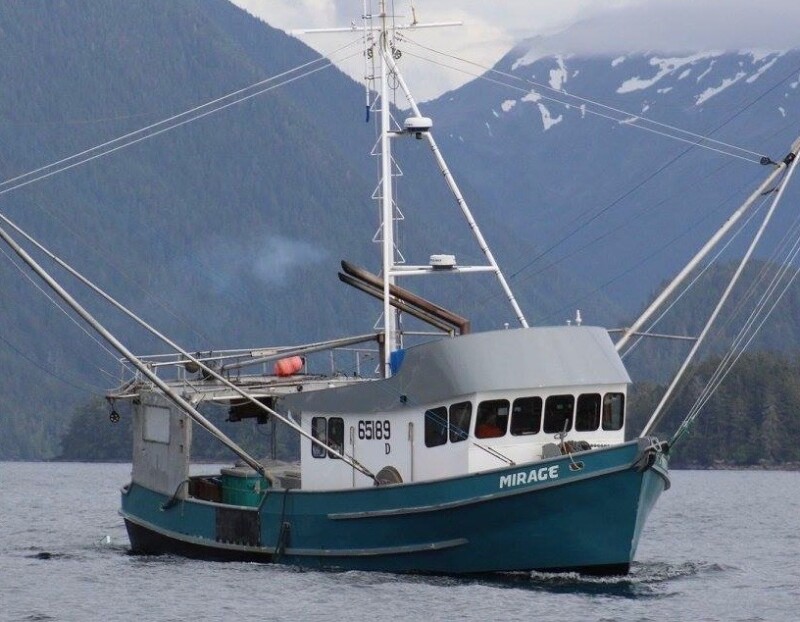
Veteran harvester Jeff Turner is fishing halibut and black cod in Southeast Alaska this summer aboard his 50-foot longliner and troller Mirage, equipped with a new hybrid diesel-electric propulsion system.
After a short break from harvesting from Sitka up to Yakutat, Turner will head to the central and western Gulf of Alaska to fish black cod. His vessel is already using less fuel, emitting less exhaust and noise, and burning less oil — all of it good for his budget and the environment, said Linda Behnken, president of the Alaska Longline Fishermen's Association.
Behnken, herself a veteran longliner, has led ALFA's efforts over the past eight years to bring diesel-electric propulsion systems to longliners in Southeast Alaska for the financial and environmental benefits they offer.
"Jeff figures he is saving 20% on fuel from last season which is significant given the increased cost of fuel this year," Behnken said.
"Mirage had some initial issues with the new system, but all were eventually tracked down and for the past month of longlining from Southeast to Yakutat the systems have worked well. It's not cost effective yet, but we are looking to standardize parts and lower instillation costs."
The cost of the diesel-electric hybrid system on the Mirage was $150,000.
The cost of upgrading a second vessel, Energizer, with the hybrid diesel-electric propulsion system will be covered by grants and owner funds.
Energizer will have electric propulsion with a 27-kw diesel generator to recharge batteries if needed. For normal operation, this gillnetter will be fully electric, Behnken said.
So far no other fishing vessels in Alaska are using these propulsion systems, but there is significant interest, and one Bristol Bay boat owner — not identified by name — has plans to install a hybrid system on his drift gillnetter. ALFA is eager to support more hybrid installations to decarbonize working waterfronts and lower operating costs, Behnken said.
Basic diesel-electric ship propulsion is nothing new. The system uses diesel engines to generate electricity, which then powers electric motors to turn the propellers. The Russian river tanker Vandal, built in 1903, was the world's first diesel-electric vessel, designed to navigate shallow waters where direct mechanical transmissions were impractical.
ALFA has been working with Chandler Kemp, an assistant professor of sustainable energy and energy efficiency consultant affiliated with the University of Alaska Fairbanks and Stanford University, and has developed blueprints for converting commercial fishing boats to hybrid diesel-electric systems and eventually to hydrogen fuel cell or fully electric systems.
In 2023, ALFA noted in its annual report that the association had wrapped up an Energy Transitions Initiative Partnership Project (ETIPP) with the National Renewable Energy Lab and applied to the Department of Energy (DOE) for funds to convert two fishing boats to hybrid diesel-electric and one mariculture boat to full electric.
The DOE awarded ALFA the funding, and the ALFA BETA (Boat Energy Transition Accelerator) at last had the resources to act on ETIPP recommendations.
ALFA secured a $700,000 DOE award to drive the transition forward for the commercial fishing fleet, and in 2024, a $514,000 appropriation from Sen. Lisa Murkowski, R-Alaska, to help decarbonize the seafood industry.
The ETIPP program, managed by the National Laboratory of the Rockies, pairs coastal, remote, and island communities with national lab experts and regional organizations. Selected communities may receive up to $50,000 in direct funding and up to 24 months of in-kind technical assistance to build energy resilience. The program connects these communities with national energy experts who provide technical analysis, modeling, and decision support to identify energy reliability and affordability solutions best suited to each community's needs.
In addition to ALFA, ETIPP's cohort in Alaska includes the city of Adak, the Bristol Bay region, the Chilkat Indian Village in Klukwan, the communities of Kotlik and Kotzebue, the tribal government of Mary's Igloo, Newtok, Scammon Bay, and the Southeast Conference of Alaska.
In Bristol Bay, famous for the world's largest run of wild sockeye salmon, ETIPP technical assistance is focused on helping the region evaluate microgrid options that integrate local energy generation into existing power infrastructure to reduce the region's reliance on expensive diesel imports and improve the reliability and security of its energy system, DOE officials said.