


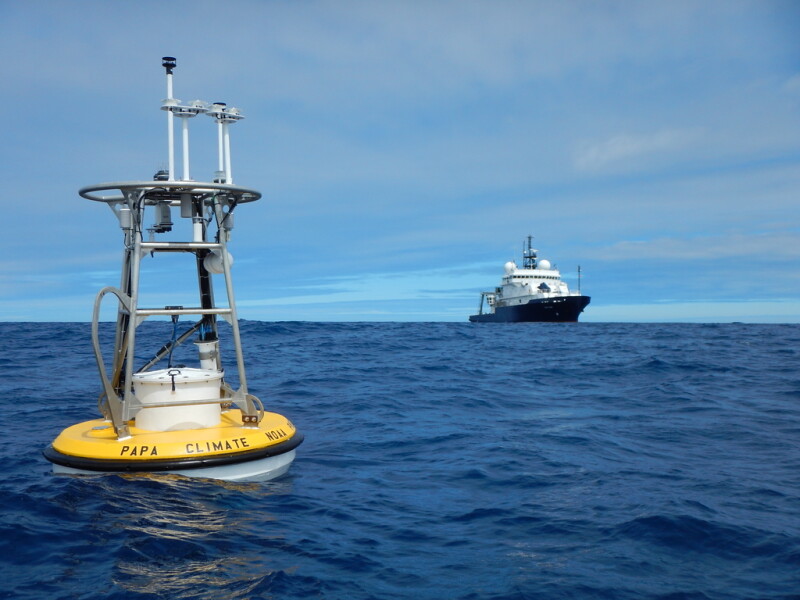
The Alaska Marine Community Coalition is raising concerns over plans to dismantle much of the federal Ocean Observatories Initiative (OOI), arguing that the loss of long-term ocean monitoring could reduce critical information used to understand changing conditions in Alaska's fisheries.
In a recent statement, the coalition said the National Science Foundation plans to remove in-water equipment from four of the five OOI sites over the next 15 months, including Ocean Station Papa in the Gulf of Alaska, located roughly 620 miles offshore. The network has collected continuous oceanographic data since 2016, while Station Papa itself has served as one of the North Pacific's longest-running ocean monitoring locations.
The coalition said the station provides information on deep-water temperatures, ocean chemistry, currents and biological conditions that help scientists track changes affecting species including salmon, halibut, crab and pollock.
"Ocean Station Papa is just one of those key sites that has consistent data spanning many decades," University of Alaska Fairbanks oceanographer Seth Danielson said in the coalition's release, noting that data from the site was instrumental in research surrounding the 2014-2016 marine heat wave known as "the Blob."
The release also points to concerns over ocean acidification and changing climate conditions, arguing that continuous monitoring is important for fisheries management and ecosystem forecasting. Russ Hopcroft, chair of the oceanography department at the University of Alaska Fairbanks, called Station Papa "one of the important sentinel sensors" for monitoring developing ocean conditions.
According to the coalition, previously collected OOI data will remain publicly available until Sept. 30, 2028, when the program's data center is also expected to shut down. The group argues that interrupting decades-long data records could create additional uncertainty for fisheries managers and coastal communities that rely on long-term ocean observations to track environmental change.
The Alaska Marine Community Coalition encouraged Alaskans to contact the state's congressional delegation to express support for maintaining long-term ocean monitoring infrastructure.