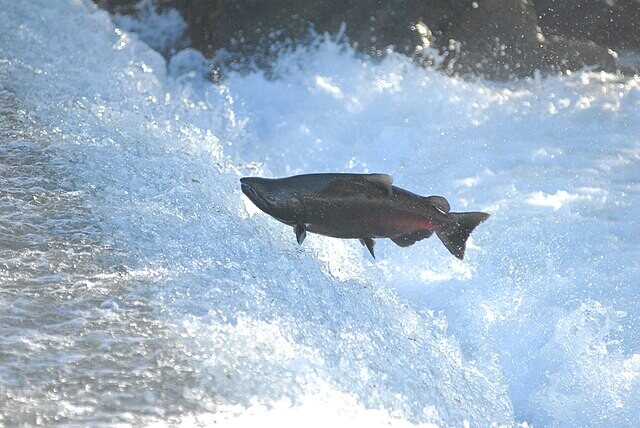
In early September 2025, for the first time in over 80 years, members of the Syilx Okanagan, Secwépemc, and Ktunaxa Nations saw salmon returning to the upper reaches of the Columbia River in British Columbia. While only two sockeye salmon that had been released as fry in the upper Columbia River in 2023 returned to Canada as adults, it marked the first step in what the tribes hope will be the restoration of viable salmon to their ancestral spawning grounds.
The Bringing the Salmon Home initiative launched in partnership with the governments of British Columbia and Canada is part of an international effort to bring fish back to over a 1000 miles of their former spawning grounds above the Chief Joseph and Grand Coulee dams.
On the U.S. side, the Upper Columbia United Tribes (UCUT) and the Northwest Power and Conservation Council finalized a plan, “Fish Passage and Reintroduction into the U.S. and Canadian Upper Columbia Basin,” aimed at long-term restoration of Chinook and Sockeye runs above the dams.
The first phase of the plan investigated whether the habitat and food resources above the dams were sufficient for returning salmon. The investigation, completed in 2019, found the Upper Columbia could support the production of 76,000 adult Sockeye salmon and 44,000 adult summer/fall Chinook.
The second phase, Phase 2 of the Implementation Plan (P2IP), relies on trapping and transporting returning adults and also introducing hatchery fish to the Columbia. The bulk of the $200 million budget for P2IP will go towards getting fish past the dams.
According to the UCUT, the organization and its member tribes secured over $15 million for full implementation of the decades-long plan. Funding sources include the U.S. Congress, U.S. Bureau of Reclamation, NOAA’s Pacific Coastal Salmon Recovery Fund, the taxpayers of Washington State (through the state budget), the departments of the State of Washington, and others.
According to the UCUT literature, the long-term goals are to establish access to sources of non-ESA Chinook and Sockeye donor stocks and develop interim hatchery facilities to produce fish for feasibility studies. Gather data on key metrics specific to fish behavior and survival in the blocked area. Develop and test upstream and downstream interim fish passage facilities while maintaining current operations at blocked area hydropower facilities. Provide the data necessary for full-scale reintroduction and permanent fish passage. “As the program grows, we expect the number of adults and juveniles to increase into the thousands of adult salmon and hundreds of thousands of juvenile salmon,” says the UCUT
The project gained support from the Biden Administration and benefited from an agreement that the administration made with the Lower Columbia Tribes in 2023. But in June 2025, President Trump revoked the 2023 Biden memorandum, “Restoring Healthy and Abundant Salmon, Steelhead, and Other Native Fish Populations in the Columbia River Basin”.
While the Columbia saw increased returns in 2025, Yakama Nation Tribal Council Chair Gerald Lewis said in a statement. “This termination will severely disrupt vital fisheries restoration efforts.”