

Blue Ocean Gear, a California-based company, has developed intelligent, connected fishing buoys that allow users to track the exact location and movement of their fishing gear.
Lost fishing gear represents a major financial and environmental problem. According to the ESG Sustainability Directory, "lost fishing gear represents a direct economic loss to fishers" and "'ghost fishing' reduces commercially valuable fish stocks, leading to lower catches and reduced revenue for the entire industry." A 2020 World Wildlife Fund publication named lost fishing gear, or "ghost gear," the "most harmful form of plastic debris to marine wildlife."
NOAA's Small Business Innovation Research (SBIR) program, funds small business research and development within NOAA's mission areas with the goal of developing innovative and commercially viable products and services, has supported multiple phases of Blue Ocean Gear's Smart Buoy development since 2020.
Initial funding focused on locating ropeless fishing gear to avoid whale entanglements. In 2022, NOAA awarded the company a Phase I grant of $149,478 to develop a more ruggedized design with increased depth and impact performance and the addition of ocean condition sensors for use in Alaskan waters. A 2023 Phase II award of $648,918 supported further development to enable data measurements using Smart Buoy technology on fishing gear in Alaska and the Gulf of Mexico.
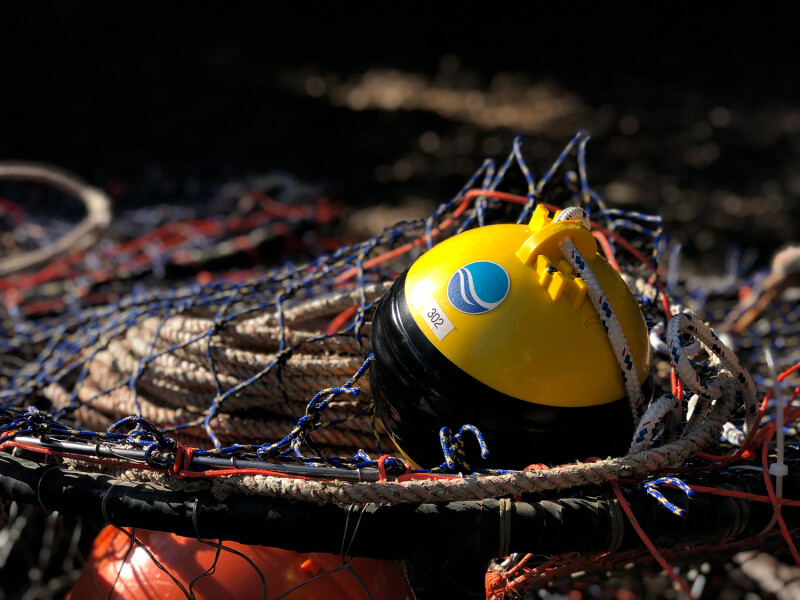
The buoys collect data that can help prevent lost gear and allow fishermen to review information from previous seasons to identify and avoid areas likely to have conflict with other vessels or challenging currents or ocean conditions.
The buoy is equipped with an automatic sensor that activates when it meets the water. Its PlotterLink transceiver allows it to connect to plotters, phones, and PCs without additional onboard internet. The battery lasts up to six months between charges, depending on use.
The buoy collects latitude and longitude coordinates, distance traveled, velocity, ambient water temperature, and acceleration. This allows Blue Ocean Gear to assemble a repository of ocean water temperature and current data, which is also of interest to industries like ocean-based wind energy and shipping. Third parties cannot see an individual's data without permission, except when used on an anonymized, aggregated basis.
Captains have reported time and cost savings from using the buoys. One quoted on the Blue Ocean Gear website said, "On a big day, Smart Buoys save me 5 hours." Another said, "Knowing exactly when and where my buoy resurfaces saves me $5,000 per trip." One fisherman told Blue Ocean Gear, "Last trip, I was in an incredible fog, but was able to harvest my gear like it was a sunny day."
"The NOAA SBIR program supported Blue Ocean Gear's efforts to successfully bring our technology from the design and test phase into production and commercialization," said Kortney Opshaug, CEO of Blue Ocean Gear. "As a small business, the opportunity to connect and work with different branches of NOAA was immensely valuable in providing feedback that led to a more versatile design as a direct result. Our SBIR projects not only led to an extended contract with NOAA, but also contributed to forming an ongoing partnership that has helped us continuously innovate and improve as an organization as we scale."