

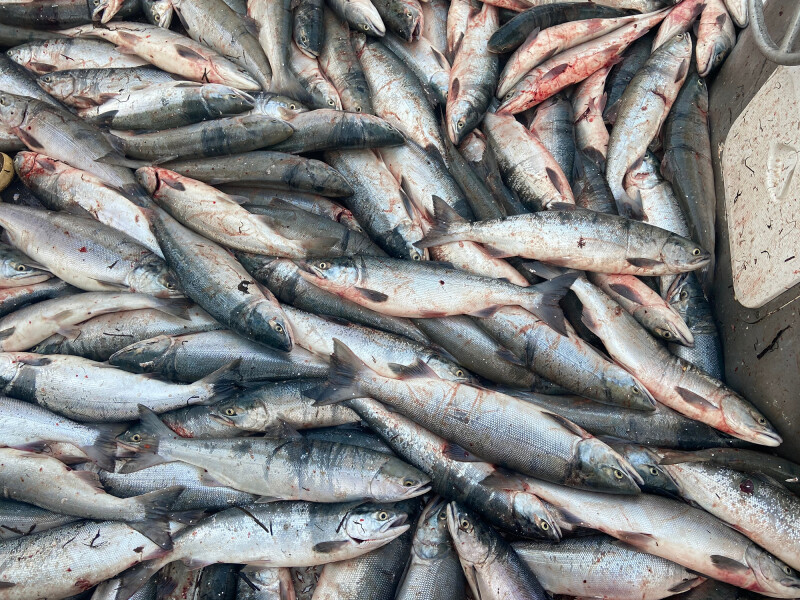
Aficionados of wild Alaska salmon are stocking up at retail shops on sockeye fillets from the Copper River to Bristol Bay and beyond as the commercial salmon season goes into full swing, paying from $15.99 a pound to $56.95 a pound for the succulent fish and starting to fill their freezers.
The harvest of Prince William Sound sockeyes was down 73% from the Alaska Department of Fish and Game forecast, while the Bristol Bay sockeye salmon fishery was up 59% from last year to date.
Retail prices for those Copper River reds continued to hold even as the first flow of freshly harvested sockeyes arrived in markets from Cook Inlet, the Alaska Peninsula, Kodiak, and elsewhere in Prince William Sound.
Fishmongers at 10th & M Seafoods, a specialty seafood shop in Anchorage, said shoppers were buying up to 10–15 pounds of wild sockeye fillets from Bristol Bay for $13.95 a pound.
Costco warehouses in Anchorage still had an ample supply of Copper River sockeye fillets for $15.95, just a buck down from the $16.95 a pound price at Costco when the season opened in late May.
At the famed Pike Place Fish Market in Seattle, whole four-pound Copper River reds were $124.99 apiece, Copper River red fillets were $39.99 a pound, whole Copper River kings were $639.99, and Copper River king fillets were $99.99 a pound.
Cordova, Alaska, processor Drifters Fish was offering five pounds of Copper River sockeye fillets for $190, and the Anchorage online retailer FishEx wasn't budging on its offer of premium portions of Copper River red fillets at $56.95 a pound.
Salmon dinner prices at upscale Anchorage restaurants, where that item is often a first choice for visitors to the state, were ranging from $27.60 to $41 a plate, with the demand showing no sign of ebbing.
By July 9 ADF&G's in-season preliminary statewide wild salmon harvest blue sheet showed an overall harvest of 40.7 million fish, including 31.7 million sockeyes, 4.6 million humpies, 4.2 million chums, 24,000 cohos, and 71,000 Chinook salmon.
Fisheries economist Sam Friedman, who compiles in-season weekly statewide commercial salmon reports at McKinley Research Group on behalf of the Alaska Seafood Marketing Institute, noted that Alaska's 2025 salmon harvest continues to outpace 2024, driven by the Bristol Bay sockeye harvest, which was up 59% from a year ago to date. Harvests of other salmon species were down so far in 2025, but may rise, as pink salmon and coho salmon runs are still in their early stages, Friedman said.
In total, at the time of his weekly report on July 8, just under 40 million salmon, 14% of the pre-season forecast, had been harvested, most of them from Bristol Bay fisheries, where processors were initially paying harvesters $1 a pound, plus another 30 cents for chilling. In average years, the Bristol Bay sockeye harvest has peaked by this week, Friedman noted.
Outside Bristol Bay, sockeye harvests were down in all other regions except Cook Inlet, where nearly 300,000 red salmon had already been delivered to processors.