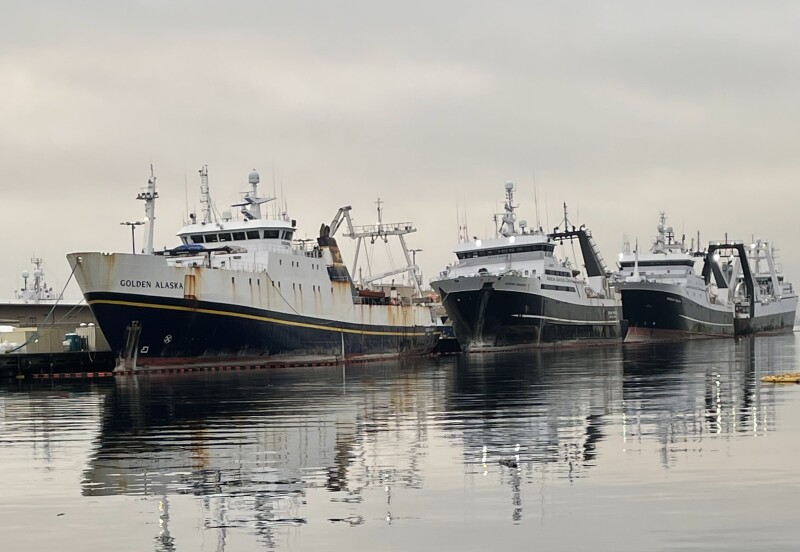
In the United States, commercial fishing vessels over 65 feet in length are required to have an automatic identification system (AIS) installed and operational. AIS is generally transmitted over a VHF signal and provides nearby vessels with a vessel’s name, size, and course and speed.
While AIS transmits over VHF, satellites also pick up these signals, and companies like Spire Global and ORBCOMM provide data to government agencies such as the U.S. Coast Guard and NOAA, as well as environmental organizations and other entities. But U.S. fishing vessels operating in the Bering Sea have created a noticeable hot spot where vessels go dark. The big trawlers are known for turning off their AIS, primarily as a way to protect their favored fishing grounds, and they can do so legally as long as they log and report it. Even if a U.S. vessel temporarily turns off AIS, its VMS, which reports directly to the Federal Government via Woods Hole, remains mandatory. If that signal is interrupted, the vessel must cease operations and proceed to port.
NOAA and the U.S. Coast Guard use AIS for a twofold mission: safety and regulatory enforcement. Although dark vessels may avoid detection temporarily, other detection methods combined with artificial intelligence are allowing various entities to complete the picture of who is fishing where. Outside U.S. waters, numerous governments and environmental organizations, supported by technology companies, are using AIS and other data to identify and disrupt IUU fishing.
While the U.S. Bering Sea fleet often operates in the dark, legally, to avoid competition. Many fleets around the world do so to mask IUU fishing. Russia, for example, is subsidizing the modernization of its Bering Sea and Barents Sea fishing fleets and reallocating quota to companies that build high-tech fish-hungry boats. In early January, the Ukrainian website, Militarnyi, recognized as a reliable source, published an article on illegal Russian fishing, including instances in the Bering Sea. The story notes that in May 2025, the European Union (EU) sanctioned two of Russia’s large fishing companies, Norebo JSC and Murman Seafood, to discourage illicit fish smuggling operations. And in June of 2026, Alaska’s Senator Dan Sullivan introduced legislation to protect Alaska’s fishermen in the Bering Sea.
“There was a senior Russian official who publicly declared, ‘We know we’re at war with American fishermen,’” said Sen. Sullivan. “What more should we be doing with regard to the unfair competition with Chinese and Russian fleets?” he asked. “We've talked about their IUU practices, their slave labor practices. What are the other things we can be doing, and how has the ban on Russian seafood into the U.S. market helped your industry and other fishermen throughout the country?”
Several organizations and companies like Windward.AI—which fuses AIS data, remote sensing signals, proprietary AI models, and Generative AI—are providing information to law enforcement charged with protecting fisheries resources. While AIS poses a problem for US fishermen who want to keep their hot spots secret, the technology can increasingly be used to protect them against bigger threats.